

Hexagons can become flowers, cubes, stars, mosaics, sunbursts, and woven illusions from the same six-sided shape. The documented history of hexagon patchwork reaches back to 18th-century England. Researchers have identified a hexagon template from 1770, and the Illinois State Museum records printed instructions for paper piecing in 1835, making this a technique with more than 250 years of history (Illinois State Museum history of hexagon quilts).
This guide compares eight quilting hexagon patterns by visual effect, construction demands, difficulty, fabric and precut fit, and finishing needs. You'll also find a short What You'll Need sidebar, descriptive image prompts and brand-aware captions, practical guidance for 108-inch backings and batting, and links to relevant resources from The Fabric Company. Use the list to choose a project that fits your sewing style, not just a pattern that looks attractive in a photograph.
1. Grandmother's Flower Garden
Grandmother's Flower Garden turns small hexagons into recognizable blooms. A center hexagon anchors a ring of six petals, and repeated flowers can create rows, scattered motifs, or a large medallion. The structure is familiar, but your fabric choices determine whether the quilt feels vintage, graphic, soft, or boldly contemporary.
A traditional arrangement might place a bright center inside contrasting petals, then surround each flower with a quiet background. For a modern version, try Riley Blake Designs florals with solid centers and a restrained background. Fat Quarters and Layer Cakes offer a broad color range, while Jelly Rolls can supply coordinated strips if you're cutting your own templates.
Design decision: Choose the flower arrangement first, then select fabrics. A busy print in every position can hide the flower shape, while value contrast between the center, petals, and background makes the motif easier to read.
English paper piecing works especially well when you want portable handwork. The method stabilizes each fabric piece around a paper template, helping maintain sharp corners and consistent shapes. The English paper piecing fabric guide is a useful companion before you begin.
Use a 60-degree rotary cutter and specialty hexagon ruler for faster cutting from yardage. A coordinating 108-inch backing can reduce piecing on a large quilt, while batting controls the finished loft and drape. If you're shopping in person, Our Springfield, Tennessee showroom is a practical place to compare cotton prints, backing widths, and batting options together.
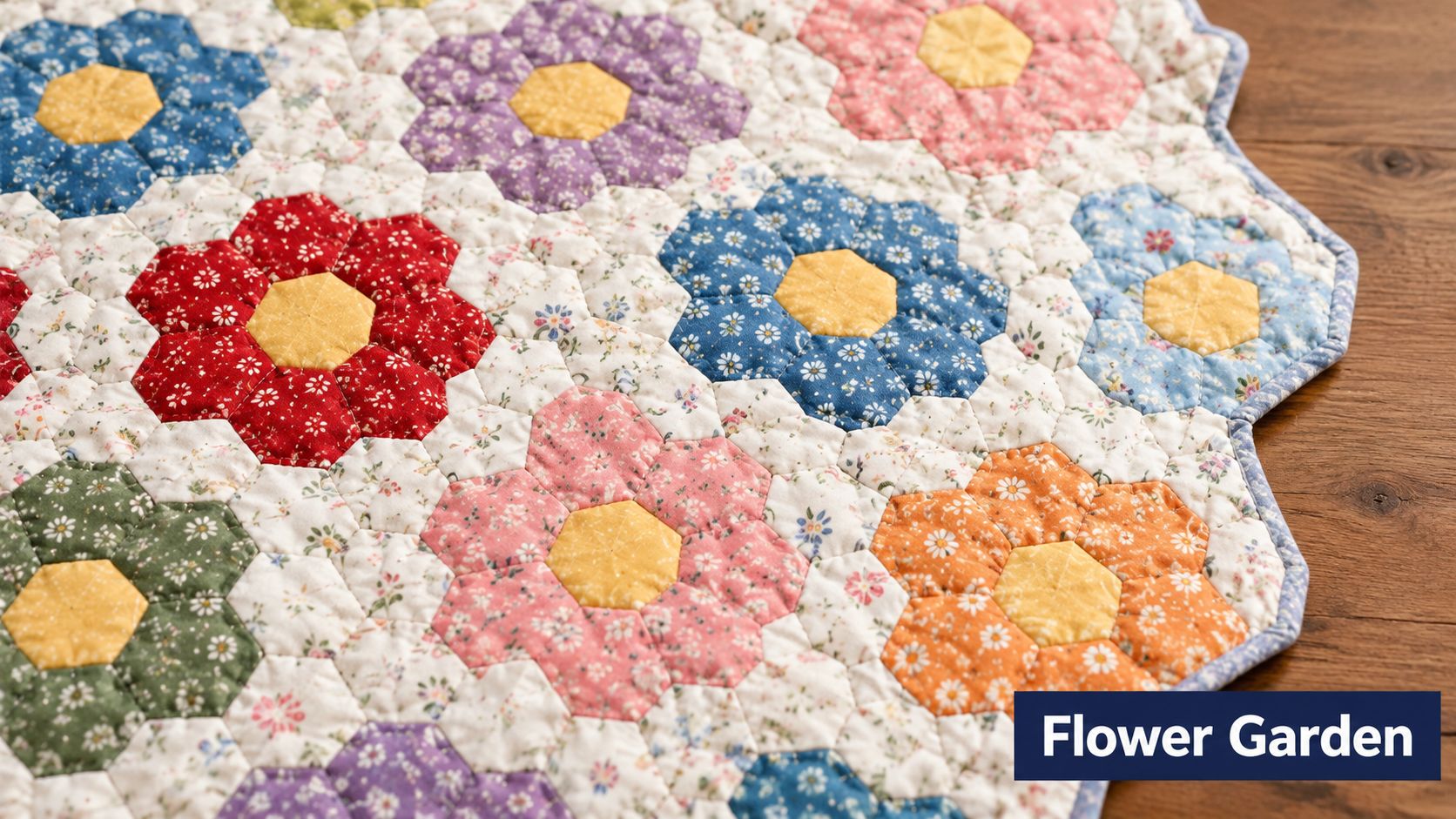
Caption: A flower layout lets Riley Blake Designs prints, solid cottons, and carefully chosen value contrasts share the focus.
2. Tumbling Blocks
Tumbling Blocks creates the illusion of three-dimensional cubes, but the effect depends on value, not complicated embellishment. Each cube uses light, medium, and dark pieces from a related color family. When the units meet correctly, the eye reads angled faces and shifting depth.
This pattern rewards planning more than improvisation. A group of blue fabrics may look coordinated on a cutting table but flatten into one tone once arranged. Photograph your fabrics in black and white, or use a value finder, before cutting. Layer Cakes can be sorted into light, medium, and dark piles, although the fabric size must still suit your chosen template.
Build the illusion before sewing
Arrange several cube units on a design wall. Look for accidental light pieces touching one another in places where you want a dark face. Small changes can make the blocks appear to rotate, stack, or disappear.
Chain-piecing helps keep the process orderly. Sew one side of each cube, then rotate the units and add the next side. Pressing seams open can reduce bulk where several points meet, though the best pressing direction depends on your fabric thickness and preferred finishing method.
A foundation method may appeal if you want extra support while managing angled joins. The foundation paper piecing supplies guide can help you compare the tools used for accurate geometric construction.
Caption: Cloud9 prints can work in a value study when the light, medium, and dark faces remain clearly separated.
Finish a cube quilt with a backing that echoes the dominant color family without competing with the illusion. A 108-inch coordinating backing gives the quilt a clean reverse side, while the batting's loft affects whether the surface reads flat and graphic or softly dimensional.
3. Honeycomb English Paper Piecing
Honeycomb is the most direct use of the hexagon shape. The units join edge to edge in a regular field, so the finished quilt resembles a beehive or tiled mosaic. There's no need to create a flower, star, or cube. The visual character comes from the fabric order, color movement, and consistency of the joins.
This makes Honeycomb a strong choice for portable hand sewing. In English paper piecing, each fabric hexagon receives a 1/4-inch extension on every side of its paper template. You turn the seam allowance over the paper, baste it in place, and join neighboring pieces with a whipstitch. The paper supports bias-prone edges and helps preserve sharp corners (Illinois State Museum EPP technique).
Paper templates are useful only when their size and seam treatment stay consistent. Confirm the finished paper-to-paper dimension before cutting a large quantity of fabric.
Sort your stash by color before you sew. You might create a controlled ombré, a monochromatic field, or a deliberately mixed arrangement using Fat Quarters and Charm Packs. For a small project, try a table runner or cushion cover. For a larger quilt, keep completed rosettes or sections pressed before joining them.
The English paper piecing hexagon resource can support your planning, especially if you're deciding between pre-cut papers and templates you prepare yourself.
Caption: A Honeycomb layout keeps the geometry quiet, allowing fabric from Robert Kaufman, Riley Blake Designs, or your own stash to carry the design.
Choose a neutral or tone-on-tone 108-inch quilt backing to frame the surface. Binding, prairie points, or appliqué can give the edge a more finished character, but a simple binding often suits the clean geometry best.
4. Kaleidoscope Hexagons
Kaleidoscope Hexagons build drama from smaller units arranged into larger radial blocks. Triangles and hexagons meet around a center, creating a mandala-like burst. When several blocks are placed together, the seams can form secondary patterns that move across the quilt.
This is a pattern for quilters who enjoy precision and visual payoff. Start with one block rather than cutting the entire project. A test block reveals whether the center is strong enough, whether the print scale is too large, and whether your seams lie flat at the intersections.
Choose coordinated precuts carefully
A Jelly Roll may provide a controlled strip-based palette, while a Layer Cake can offer broader print variety. Neither precut guarantees a successful kaleidoscope. You still need a clear value relationship between the center, surrounding units, and background.
Arrange the pieces on a design wall before sewing. Chain-piece matching units in batches, label sections, and press seams open when several layers collect at one point. A design software preview can help, but it shouldn't replace a physical test. Screen scaling can change the apparent dimensions of a template, and the number of pieces may change if a pattern is resized.
For a tool that supports angled layouts, see the Creative Grids 45 Degree Kaleidoscope Dresden Plate. It can be a useful reference when you're comparing radial construction ideas.
Caption: A coordinated palette from Robert Kaufman or Cloud9 can make the radial seams easier to read.
Use quality batting with enough stability to support the piecing without hiding the design. A 108-inch coordinating backing keeps the reverse side simple, and free-motion quilting can trace the radial movement once the quilt top is squared.
A visual demonstration can also help you judge block rotation and seam direction.
5. Hexagon Star
Hexagon Star creates six-pointed stars through color blocking and repeated rings. The center can be a single focal hexagon, while matching surrounding pieces establish the star points. More rings add scale and complexity, but even a simple arrangement can produce a clear, recognizable motif.
The design sits between the direct simplicity of Honeycomb and the precision-heavy character of Kaleidoscope. That makes it a useful project for a quilter who wants a strong image without managing a highly fragmented radial block.
Use a design wall before stitching. Move the center fabrics, outer points, and background pieces until the stars have enough separation. A focal print can work in the center, but tone-on-tone or solid fabrics often make the outer points easier to see.
Let value control the star
Color creates mood, but value creates structure. A red star against a deep red background may look elegant in person yet lose its shape from across the room. Photograph your layout in grayscale to check whether the points remain visible.
Layer Cakes can supply coordinated prints and solids for a scrappy arrangement. Fat Quarters work well when you want more control over individual stars. Robert Kaufman reproduction-style prints can support a traditional appearance, while Cloud9 florals can shift the same structure toward a modern look.
Pressing toward the outer points may reduce bulk around the center. Use a quarter-inch foot and fine thread if you're machine piecing. If you prefer hand sewing, EPP gives you more control over each edge and makes the project easier to carry.
The star quilt pattern guide offers another way to think about star layouts before selecting fabrics.
Complete the design with quilting that follows the points. A quiet 108-inch backing in a related color lets the front remain the focus, and batting with moderate loft can emphasize the star relief without making the intersections bulky.
6. Hexagon Mosaic Scrappy Mixed Media
Hexagon Mosaic is a strong option for a stash that refuses to stay organized. Instead of assigning every fabric a fixed position, you combine prints, solids, remnants, and embellishments until the surface develops its own rhythm. The result can feel like tile work, a memory quilt, or a textile collage.
The pattern is forgiving, but it still benefits from a few boundaries. Use the same template size throughout a section, separate pieces by size, and remove fabrics that are too stretchy, badly frayed, or weak from wear. Recycled clothing can be meaningful, but mixed fibers behave differently from stable quilting cotton and may need reinforcement.
Make scrap work genuinely low-waste
Scrap-friendly doesn't automatically mean low-waste. Paper templates, extra seams, unusable offcuts, and the handling time for very small remnants all matter. Before cutting, ask whether a scrap is large enough to cover the template with a consistent seam allowance. If not, save it for appliqué, binding accents, or a different project.
A useful sorting system includes:
- Separate by size: Keep hexagons and fabric pieces in labeled bags so small remnants don't disappear into the general Stash.
- Group by stability: Store quilting cotton separately from stretchy garments, flannel, and loosely woven textiles.
- Reserve the selvage: Selvage can become a label, trim, or future strip-piecing material rather than immediate waste.
- Mix purchased and saved fabric: Charm Packs can establish a foundation, while remnants add personal character.
English paper piecing suits this pattern because hand stitching can accommodate a changing fabric mix. Press seams in different directions when necessary, but watch for bulky intersections. A bold solid 108-inch backing can give the busy front a visual resting place.
For a practical material plan, compare how many usable pieces your chosen format produces before buying more fabric. The circular quilting discussion in this recent review of quilting and textile reuse reinforces why transparent accounting matters when sustainability is part of your project goal.
7. Sunburst Hexagon
Sunburst Hexagon uses expanding rings to suggest light moving outward from a center. The pattern depends on a planned gradation. Darker fabrics may sit near the middle, with medium and lighter values expanding toward the edge, or you can reverse the direction for a different effect.
Unlike a random mosaic, Sunburst rewards a complete color plan before cutting. Lay out every ring and photograph it in color and black and white. A fabric that looks like a gentle transition under one light may create an abrupt jump under another.
Build one sample first
Make one block before committing to a large quilt. The sample lets you judge whether the center feels bright enough, whether the ring order is easy to follow, and whether the seams create too much bulk. An ombré Layer Cake can simplify color coordination, while yardage gives you greater control over repeat and scale.
Robert Kaufman ombré collections can support a continuous color movement, but prints still need enough value separation to preserve the rays. If every fabric has the same visual weight, the sunburst may become a general patchwork field.
Digital design tools can help you preview color placement, but use them as planning aids rather than guarantees. Screen color varies, and scaling a pattern can alter finished dimensions, seam geometry, and piece counts.
Press toward the outer rings when that reduces thickness at the center. Choose neutral batting if you want the color to remain crisp, then use radiating quilting lines to reinforce the movement. A neutral 108-inch backing will showcase the front without adding another competing color story.
8. Interlocking Hexagon Diamonds
Interlocking Hexagon Diamonds use directional color blocking and neutral space to create a woven appearance. Colored units suggest overlapping diamonds, while white or quiet hexagons separate the shapes and give the eye a place to read the pattern. The finished quilt can look dimensional even though the surface is built from flat pieces.
This design is less forgiving than a random mosaic because contrast carries the illusion. Black, white, and grayscale fabrics can make the structure clear, while a low-contrast collection may cause the diamonds to blend together. A bold palette from Cloud9 or Robert Kaufman can work well when the values remain distinct.
Start with a digital layout or hand-drawn map. Mark every color family and label the neutral spaces before cutting. If you're working with Layer Cakes, confirm that the cut pieces will fit your selected template and reserve enough fabric for the background. The neutral area often requires more yardage than expected because it appears throughout the quilt.
Practical rule: If the diamonds disappear in a black-and-white photograph, increase the value separation before sewing more units.
Cut and sort all pieces into labeled bags. Consistent pressing toward the darker fabric helps maintain the visual hierarchy and can keep the surface flatter. Fine needles and quality thread make the points easier to control, especially when several seams meet.
For the reverse side, choose a solid or subtle tone-on-tone 108-inch backing. Batting with a controlled loft will support the quilt without overpowering the woven illusion. This is a strong choice for an experienced maker who wants the piecing, rather than novelty fabric, to carry the finished project.
8 Hexagon Quilt Pattern Comparison
| Pattern | Implementation Complexity (🔄) | Resource Requirements (⚡) | Expected Outcomes (📊⭐) | Ideal Use Cases (💡) | Key Advantages (⭐) |
|---|---|---|---|---|---|
| Grandmother's Flower Garden | Moderate, precise hex cutting and seam matching; hand or machine piecing | Moderate, many hexagons, hexagon ruler, rotary cutter, precuts (Fat Quarters/Layer Cakes), batting/backing | High visual impact with floral, 3D flower effect; forgiving of minor errors; 40–80 hrs | Scrap-busting, stash builders, traditional or modern quilts, portable handwork | Striking floral motif, versatile fabrics, forgiving pattern |
| Tumbling Blocks (Isometric Cubes) | High, exact value placement and seam accuracy to preserve 3D illusion | High, coordinated light/med/dark values, precise templates, design tools, quality cutters | Spectacular 3D optical movement and depth when executed well; 50–100 hrs | Value studies, show quilts, color-theory practice, feature collections | Powerful optical depth; showcases value gradation |
| Honeycomb (English Paper Piecing) | Low technical complexity but time-intensive for hand EPP; simple edge-to-edge assembly | Low, pre-cut hex packs, EPP supplies, thread; very portable | Uniform, tightly packed mosaic; versatile sizing; highly forgiving; 30–150 hrs | Hand-sewers, portable projects, charity/guild work, scrap use | Meditative portable handwork; excellent scrap-busting; forgiving |
| Kaleidoscope Hexagons | High, many small pieced units, precise radial symmetry and seams | High, Layer Cakes/Jelly Rolls helpful, specialty rulers, design wall, quality tools | Sophisticated mandala-like blocks with strong secondary patterns; 60–120 hrs | Feature-fabric blocks, modular quilts, show or art quilts | Dramatic radial designs; modular construction; highlights novelty prints |
| Hexagon Star (Six-Pointed Star) | Moderate to high, seam accuracy needed for crisp points and alignment | Moderate, coordinated Fat Quarters/Layer Cakes, templates, rotary cutter | Clear star focal points, scalable layouts; moderate complexity; 40–90 hrs | Intermediate quilters, focal-print showcase, modular or medallion quilts | Recognizable star motif; flexible sizing; good focal emphasis |
| Hexagon Mosaic (Scrappy Mixed Media) | Low, no planned color placement but many pieces to assemble | Low, uses stash scraps, Charm Packs optional, EPP supplies or machine tools | Busy, unique, highly forgiving quilts; strong scrap-reduction results; 30–120 hrs | Stash reduction, guild/charity projects, beginners avoiding strict planning | Stress-free color choices; sustainable scrap use; unique outcomes |
| Sunburst Hexagon (Radial Color Gradation) | High, precise color/value sequencing and seam accuracy for radial effect | High, ombre/gradient collections, templates, design tools, accurate cutting | Dramatic radial gradation with strong focal impact; gallery-worthy; 50–110 hrs | Ombre/gradient showcases, color-theory explorations, art quilts | Striking sunburst focal point; excellent for value progression |
| Interlocking Hexagon Diamonds | Very high, extensive planning, precise placement to form diamond illusion | Very high, significant yardage for negative space, design software, precision rulers | Sophisticated woven/diamond illusion with gallery-level impact; 80–150+ hrs | Advanced quilters, exhibition pieces, modern geometric designs | High "wow" factor; refined modern aesthetic and strong secondary patterns |
Turn a Hexagon Idea Into a Finished Quilt
The best pattern depends on the kind of work you want to do. Choose Honeycomb or Mosaic for portable scrap projects and flexible fabric decisions. Choose Grandmother's Flower Garden or Hexagon Star when you want a recognizable motif that can look traditional or modern. Choose Tumbling Blocks or Sunburst for a focused value study. Choose Kaleidoscope or Interlocking Diamonds when you're ready for more demanding geometric planning.
Construction method matters just as much as appearance. English paper piecing is portable and stabilizes bias-prone edges, making it useful for hand sewing, small pieces, and complex rosettes. Machine piecing can move faster, but Y-seams, angled joins, and precise pressing require careful testing. Foundation-based methods can support accuracy, although digital scaling may change the finished geometry if you don't verify the template.
Fabric format should match the design. Fat Quarters offer variety and control. Layer Cakes can simplify coordinated value studies. Jelly Rolls and 2.5-inch strips suit strip-based cutting and controlled palettes. Charm Packs and pre-cut hexagons reduce preparation, while Stash and Remnants let you build a personal mosaic.
What You'll Need
- Precuts: Browse The Fabric Company's Precuts collection for Fat Quarters, Jelly Rolls, Charm Packs, and Layer Cakes that fit your chosen color plan.
- Fabric: Look for stable quilting cotton by the yard, tone-on-tone prints, solids, and carefully sorted Remnants.
- Batting: Compare batting packages and rolls for the loft, Scrim, drape, and needle-punched cotton structure you want. Hobbs is one relevant brand to consider.
- Backing: Plan for a 108-inch quilt backing when the quilt size and layout make a wide backing practical.
- Tools: Keep paper templates, a rotary cutter, a specialty ruler, fine needles, premium thread, clips, and a design wall nearby.
- Equipment: If machine piecing suits your project, The Fabric Company carries sewing equipment from brands such as PFAFF and SINGER.
Test one unit or one full block before cutting the entire quilt. Check the paper-to-paper measurement, seam allowance, value contrast, and fabric stability. Put the test on a design wall and view it from a distance. A pattern that looks balanced close up may lose its structure across a larger surface.
Plan the finish before the quilt top is complete. Decide whether you want dense or open quilting, a low or higher batting loft, a simple binding, or an edge treatment such as prairie points or appliqué. Reserve fabric for binding, and confirm whether a 108-inch backing will cover the finished top with the margin your longarm or domestic quilting setup requires.
Key takeaways
- Start with structure: Flowers, cubes, stars, and diamonds each depend on a different arrangement of value and negative space.
- Match method to maker: EPP suits portable handwork, while machine and foundation methods can support other speed and accuracy needs.
- Check value early: A grayscale photograph can reveal whether a motif will remain visible.
- Account for materials: Scrap use is most useful when you track template size, seam allowances, paper, leftovers, and fabric stability.
- Finish deliberately: Batting loft, quilting density, binding, and backing width all shape the final result.
For visual planning, use a real-project image with descriptive alt text such as “close-up of a Riley Blake Designs floral hexagon quilt with crisp hand-stitched joins.” A caption can identify the fabric or equipment naturally, for example, “Notice how the Cloud9 tone-on-tone print separates the star points.” If you photograph a sewing setup, describe the actual tool and brand, such as “PFAFF sewing machine beside labeled hexagon units,” rather than using a vague caption.
Our Springfield, Tennessee showroom is another place to compare fabrics, batting, notions, and backing options before committing to a large project. The Fabric Company also offers online shopping for makers who are planning from home, including precuts, quilting cottons, batting, 108-inch backings, and sewing supplies.
Shop our latest Hexagon Quilting Fabrics collection here.
Join The Weekly Thread for more tips and 10% off your first order.
The Fabric Company offers quilting fabrics, precuts, batting, 108-inch backings, notions, and sewing equipment for hexagon projects from planning through finishing. Visit The Fabric Company to compare options online or plan a visit to Our Springfield, Tennessee showroom.