

You're standing in front of the batting wall with a baby quilt pattern in one hand and a show-quilt plan in the other. The rolls are labeled cotton, polyester, wool, bamboo, silk, and 80/20, but the label doesn't always tell you how the finished quilt will drape, shrink, or behave under your needle. This guide makes the types of quilt batting easier to compare, so you can choose between a crinkly heirloom finish, a flatter modern look, or a stable utility quilt.
The Quilt Batting Wall Made Simple
A quilter choosing batting is really making three decisions. The first is fiber. Cotton, polyester, wool, bamboo, and silk each bring a different hand, weight, breathability, and aging pattern to the quilt. The second is loft, which controls whether the finished piece lies close to the surface or puffs up around the quilting. The third is construction, meaning how the fibers are held together before they go into the quilt sandwich.
A customer making a baby quilt may want a light, washable fill with a dependable final size. Someone making a family heirloom may prefer cotton because the first wash creates a traditional crinkle. A longarm quilter may care most about whether the batting stays stable when quilting lines are spaced widely. Those are different jobs, so there isn't one universal “best” batting.
A useful starting point: Choose fiber for the feel and aging you want, loft for the shape and warmth, and construction for the way you plan to quilt.
The change from household fill to engineered batting explains why today's wall has so many choices. Historically, quilt-makers used whatever fiber was available for the middle layer, mainly to add warmth economically. Modern batting may be needle-punched or bonded, with construction designed to control fiber movement, loft retention, washing, and stitch spacing. This is part of the broader history of building a practical quilting stash, where makers choose materials for predictable performance rather than availability alone.
For a quick orientation:
- Crinkly heirloom drape: Low-loft cotton, planned shrinkage, and quilting close enough to keep the fiber web secure.
- Flat modern look: Low-loft cotton or a stable blend, with careful control of quilting density and finished dimensions.
- Stable utility quilt: Polyester or a cotton-poly blend, especially when repeated washing and consistent sizing matter.
- Puffy show texture: Wool or higher-loft polyester, paired with a quilting design that supports the loft.
The next question is what's holding those fibers together. That construction detail can matter just as much as the fiber printed on the package.
How Batting Is Built and Why It Matters
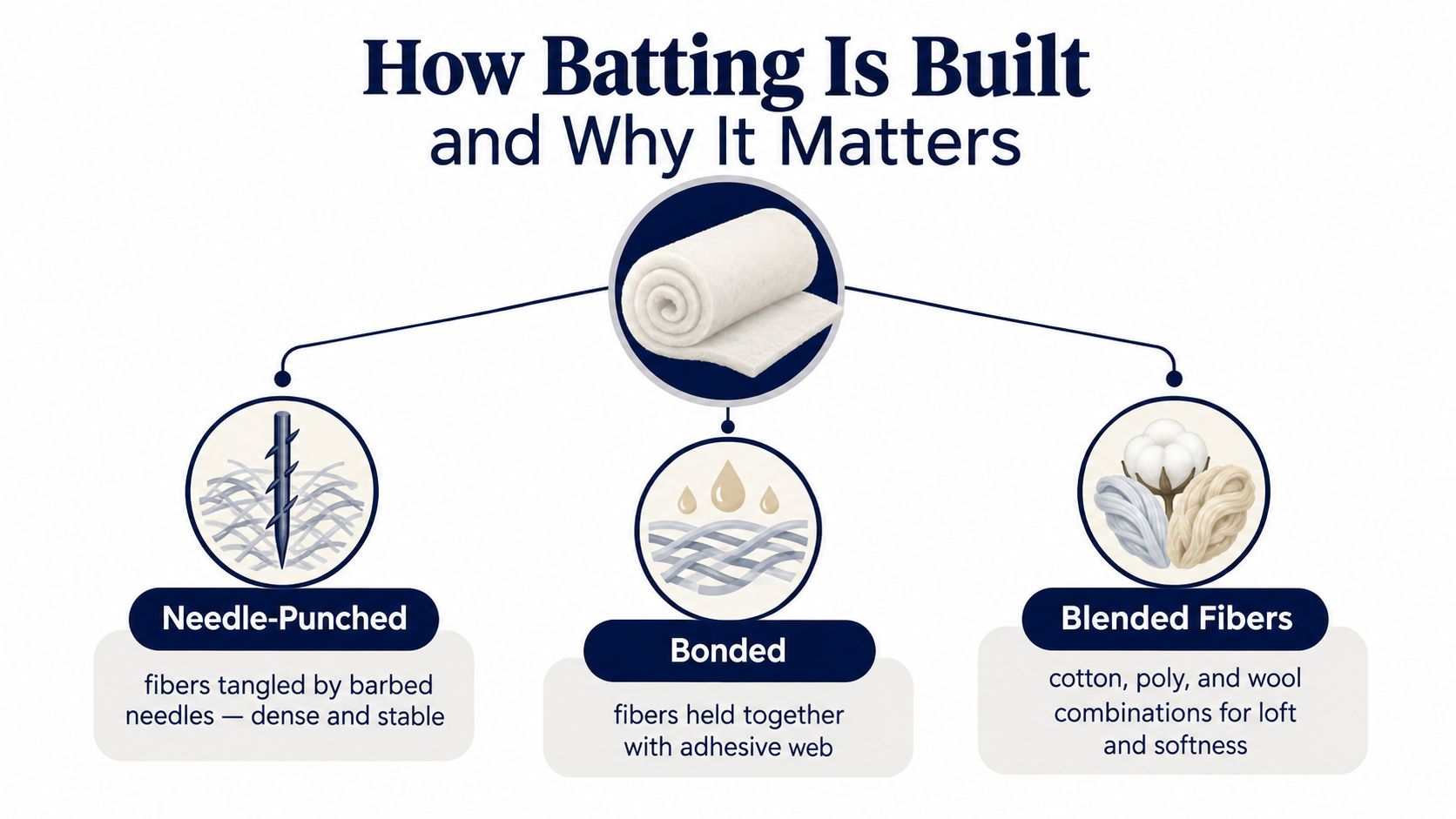
Batting may look like a soft sheet, but manufacturers build it in specific ways. Needle-punched batting is made by pushing loose fibers through a thin base cloth called scrim with millions of barbed needles. The needles tangle the fibers, creating a more integrated web that resists shifting.
Bonded batting holds fibers together with thermal processes or resin. It can feel soft and consistent, but the bonding method affects how the fill responds to washing and repeated handling. A label may also describe a thermal-bonded construction, where heat helps secure the fibers without relying on the same mechanical tangling used in needle-punching.
Why scrim changes the choice
Scrim is a thin polypropylene stabilizer needle-punched into the batting during manufacturing. It acts like reinforcement inside the fiber web. That added structure helps reduce fiber migration, bearding, piling, stretching, and bunching. It also allows some battings to tolerate wider quilting intervals.
A commonly specified 80/20 cotton-poly batting with scrim allows quilting lines up to 8 to 10 inches apart, according to Pellon's Nature's Touch Natural Blend Batting specifications. That doesn't mean every scrimmed batting has the same limit. Always follow the package instructions, because fiber, loft, and construction work together.
Without enough stabilization, loose fibers can move under the needle or work their way through the quilt top. That fuzzy migration is called bearding. Scrim can reduce that risk, but it may also create a slightly firmer hand than a soft, lofty batting.
What to read on the label
Before buying, check:
- Fiber content: This tells you whether you're choosing cotton, polyester, wool, a blend, or a specialty fiber.
- Loft: The measurement indicates how thick the batting is before quilting.
- Maximum quilting distance: This is the manufacturer's guidance for how far apart stitches may be placed.
- Shrinkage: Cotton and cotton blends can change size after washing, while polyester is marketed as low-shrink or no-shrink.
- Fusibility: Fusible batting has adhesive that can help hold small quilt layers together before stitching.
These specifications connect directly to your project. Fiber controls hand and aging. Loft controls puffiness and warmth. Construction controls stability under the needle. For a broader overview of how to choose quilt batting, compare the package details rather than relying on the fiber name alone.
Comparing the Main Batting Materials
Standing at the batting wall, start with the finished quilt you want to hold. A crinkly heirloom, a flat modern quilt, and a production-stable utility quilt each call for a different fiber, loft, and quilting plan. Cotton usually creates the traditional low-loft drape and wash-time crinkle. Polyester keeps sizing more consistent and handles easily. Blends balance those traits, while wool, bamboo, and silk serve more specific needs for warmth, breathability, or softness.
| Material | Hand and Drape | Typical Loft | Shrinkage | Best For | Key Tradeoff |
|---|---|---|---|---|---|
| Cotton | Soft, breathable, heavier drape | About 1/16 inch | About 3%–5% | Heirlooms, hand quilting, traditional quilts | Shrinks and can require closer quilting |
| Polyester | Light, smooth, often loftier | About 1/4 inch | 0%–2% | Utility quilts, baby quilts, stable sizing | Can feel less natural and may beard |
| Cotton-poly blend | Balanced hand with added stability | Varies by product | About 1%–3% for cotton-poly blends | Everyday quilts and machine quilting | Doesn't give the full cotton crinkle |
| Wool | Warm, springy, lofty | About 3/8 inch | 0%–3% | Warm quilts and textured quilting | Needs careful care and costs more |
| Bamboo blend | Soft, breathable, smooth | About 1/16 inch | About 2%–3% | Light quilts and a silky hand | Specialty availability and higher cost |
| Silk | Very smooth and light | Varies by product | Check the label | Premium, delicate quilts | Expensive and less forgiving |
Cotton for a lived-in finish
Cotton batting suits a quilt meant to soften, settle, and develop character. It is heavier than polyester and generally low loft, so the finished piece drapes over a bed instead of standing away from it. Washing creates the puckered surface many quilters want in an heirloom.
The tradeoff is dimensional change. Cotton batting typically shrinks about 3% to 5% after washing, as described by Batty Lady's batting information. Allow for that change when cutting, and choose quilting distances that the product label permits. Cotton works especially well for hand-quilted pieces, family quilts, and traditional projects where aged appearance matters more than exact post-wash measurements. For needle glide and stitch definition, see this guide to the best batting for hand quilting.
Polyester for predictable utility
Polyester batting is light, commonly inexpensive, and easy to quilt. It is marketed as low-shrink or no-shrink, helping a finished quilt retain its dimensions through laundering. That predictability fits baby quilts, charity quilts, and practical batches made for repeated use.
The hand feels different from cotton. Polyester can seem smoother or less natural, and some versions may flatten or let fibers show through the quilt top. Choose a well-stabilized product and follow its quilting-distance guidance. For a flat, modern result, select a lower-loft polyester and quilt closely enough to keep the layers settled. A loftier version gives more surface definition when the design calls for it.
Cotton-poly blends for balance
An 80/20 cotton-poly blend combines cotton's familiar hand with polyester's added stability. It suits a quilter who wants softness and some crinkle without accepting as much first-wash change as pure cotton. Scrimmed blends can also support machine quilting when the label permits wider spacing.
Cotton's natural grip can feel more cooperative during hand quilting. A blend often gives domestic-machine and longarm quilters a practical middle ground, especially for everyday quilts. Check the individual label because fiber content, loft, scrim, and maximum quilting distance vary by product.
Wool, bamboo, and silk
Wool is springy and warm without cotton's weight. Its higher loft creates stronger stitch definition and a fuller quilt, making it a good match for textured work and cold-weather quilts. It also needs careful care, and its higher cost may matter for large projects.
Bamboo blends usually offer a smooth, breathable hand similar to low-loft cotton. Silk feels especially refined and light, but it is expensive and less forgiving during quilting and care. These options suit makers choosing a particular finish rather than a general-purpose batting.
For a separate blanket project, personalized blanket material options explains how fleece, sherpa, and woven materials differ from quilt batting.
Choose cotton for crinkle and heirloom drape, polyester for stable utility quilts, or an 80/20 blend for an adaptable everyday quilt. Use closer quilting for a controlled, durable surface, and reserve wider spacing for products whose labels allow it. Wool, bamboo, and silk make sense when warmth, breathability, or a luxurious hand leads the decision.
Understanding Loft for Every Quilt Style
Loft is the thickness of batting, and it changes more than the quilt's height. It affects warmth, stitch definition, drape, handling, and how much room the fibers need between quilting lines.
Natural cotton is listed at about 1/16 inch loft, polyester at about 1/4 inch, bamboo blend at about 1/16 inch, and wool at about 3/8 inch in the Museum of Fine Arts Boston batting reference. Those figures show why two quilts with the same patchwork can look completely different after quilting.
| Loft Level | Thickness | Best Quilt Style | Stitch Spacing |
|---|---|---|---|
| Low | About 1/16 inch to 1/8 inch or less | Modern quilts, wall hangings, miniatures, garments | Closer spacing, based on the label |
| Mid | About 1/4 inch | Bed quilts, charity quilts, general machine quilting | Moderate spacing, based on construction |
| High | About 3/8 inch and above | Textured show quilts, tied quilts, trapunto-style work | Wider spacing only when the label allows it |
Low loft
Low-loft batting gives a flatter, cleaner profile. It works well for minimalist quilts, wall hangings, mini quilts, and quilted garments where bulky seams would distract from the design. Cotton and bamboo blends commonly fit this visual direction.
Low loft doesn't mean you can ignore stitch spacing. A thin, loose batting may still shift or beard if quilting lines are placed too far apart. Dense quilting helps secure the layers, but the manufacturer's maximum interval remains the final guide.
Mid loft
Mid loft is the everyday workhorse. It adds warmth and enough thickness to show quilting without making the quilt difficult to fold or feed through a domestic machine. Cotton-poly blends often suit this role because they balance hand, structure, and manageable bulk.
A mid-loft quilt can become a bed quilt, charity quilt, gift quilt, or longarm project. Choose the fiber based on the finished hand you want, then confirm whether scrim and construction support your stitch plan.
High loft
High loft creates a puffy, dimensional surface. Wool's springiness can make quilting patterns stand out, while higher-loft polyester can support tied quilts or dramatic texture. The larger the loft, the more carefully you need to handle the sandwich during basting and quilting.
High loft isn't automatically warmer in every use. It changes the quilt's shape and feel, but warmth also depends on fiber, density, and the finished construction. Use it when visible dimension is part of the design, not just because a thicker roll looks appealing on the shelf.
Picking Batting for Domestic and Longarm Machines
Your machine changes the practical batting decision. A domestic machine has limited throat space, so a thin or moderate loft usually rolls more easily under the arm. A walking foot can help feed the layers evenly, while free-motion quilting benefits from batting that doesn't drag or shed heavily into the bobbin area.
For domestic work, start with a low-loft cotton, a stable cotton-poly blend, or another batting whose label supports your stitch design. Fusible batting can simplify small projects because the adhesive helps hold the layers before stitching. It's still important to test a sample, especially when using dense quilting or decorative thread.
A longarm frame gives you more room, but speed exposes weak construction quickly. A scrimmed batting can hold the fiber web in place during rolling and quilting. One specified scrim-supported 80/20 batting allows lines up to 8 to 10 inches apart, so it may suit an open longarm design when that spacing matches the product instructions.
Domestic versus longarm needs
| Machine Type | Recommended Fiber | Scrim Needed? | Sizing |
|---|---|---|---|
| Domestic | Low-loft cotton or cotton-poly blend | Helpful for stability, not universal | Precuts or manageable cuts |
| Longarm | Stable cotton-poly blend or wool | Often useful for wider spacing and frame handling | Wide cuts, rolls, or 108-inch options |
Polyester can stretch on frame rails, so secure the leaders and watch for distortion as you advance the quilt. Cotton can surprise you after the first wash if you planned the top to finish at an exact size. The batting isn't the only factor, but it can change the finished dimensions enough to affect borders, binding, and backing alignment.
Studios also need to think beyond one quilt. Rolls or bolts reduce repeated cutting, while smaller cuts make sense when storage is limited or projects vary widely. Keep the material dry, protect it from dust, and record the fiber and loft on the outside of an opened package. Bulk batting guidance for professional longarmers is useful when comparing larger-format purchasing decisions.
Matching Batting to Stash Builders, Charity Makers, and Longarmers
A stash builder needs batting that can wait patiently for the right top. A charity maker needs dependable care and a reasonable cost. A longarmer needs a consistent sheet that behaves the same way from one edge of the frame to the other. The same batting can work for more than one audience, but the priority changes.
Stash builders
For a growing stash, a mid-loft 80/20 cotton-poly blend is a practical anchor. It fits many bed quilts, handles ordinary washing, and offers a middle-ground finish that won't force every future project into a strongly crinkled or strongly puffy style.
Keep a mix of crib, twin, and 108-inch cuts if your storage allows it. A wide cut is especially useful when you're working with large quilt tops or planning a project around a 108-inch quilt backing. Store partial pieces with their fiber content and loft marked clearly, because batting scraps can look surprisingly similar.
Stash takeaway: Choose a versatile blend first, then add specialty cotton or wool when a specific project calls for its hand.
Charity makers
Charity quilts often need simple care and reliable construction. Polyester can be a sensible option when low shrinkage and predictable dimensions matter, especially for quilts that may face frequent laundering. White and natural colors each have a place, depending on the quilt top and whether you want the batting to remain visually neutral beneath pale fabrics.
A stable cotton-poly blend can also work when the finished quilt needs a softer, more natural hand. The key is to match the quilting distance to the label rather than assuming every inexpensive batting behaves the same way.
Charity takeaway: Prioritize washable, stable batting that suits the recipient's likely care routine.
Longarmers
Longarmers should focus on consistent caliper, roll behavior, and stitch spacing. Wool can provide spring and visible quilting definition. A stable cotton-poly blend can offer a flatter, more controlled hand for everyday production. Scrim matters when the quilting plan uses wider lines or the quilt will be advanced repeatedly on the frame.
Buy wide rolls when your workflow supports them, but request a swatch before committing to a large order. The same listed fiber content can feel different at different lofts and with different bonding methods.
Longarmer takeaway: Pay attention to construction and frame behavior, not just the material name.
The simplest decision rule is this: pick fiber by hand, loft by project, and width by machine. That rule keeps the batting choice connected to the result instead of turning the shopping trip into a contest between labels.
Sizing, Care, and Smart Buying Tips
Batting sizes are often sold for common quilt dimensions, but the quilt top, batting, and backing still need room for basting and quilting. Common reference sizes include crib at 45 by 60 inches, twin at 72 by 90 inches, queen at 90 by 108 inches, and king at 120 by 120 inches, as shown in this quilting batting sizes guide.
A 108-inch-wide batting roll or 108-inch backing can eliminate a center seam on many queen-size projects. That's a major convenience for longarmers and anyone who wants a clean, uninterrupted back. Twin XL and oversized quilts need their own measurement check, so measure the finished top before cutting rather than relying only on the bed label.
Washing and drying
Prewashing depends on the finish you want and the manufacturer's instructions. With cotton batting, skipping the prewash allows the first wash to create more of the traditional crinkle. If exact sizing matters, plan for the stated shrinkage or choose a low-shrink option instead.
For routine care, use cool water and mild detergent when the label permits it. Dry on low heat, and avoid high heat that can damage polyester fibers or felt wool. Manufacturers also advise avoiding agitation while cotton or cotton-blend batting is wet and drying it flat, which helps preserve the fiber web and stitch definition. See Pellon's batting resources for product-specific care guidance.
A practical buying checklist
- Confirm the fiber: Read the content label instead of choosing by color or brand alone.
- Check the loft: Decide whether you want flat drape, moderate warmth, or visible puff.
- Match stitch spacing: Use the manufacturer's maximum quilting interval.
- Measure the quilt: Allow enough material for your top, quilting, and handling.
- Consider the format: Choose precuts for occasional work and rolls or bolts for repeated projects.
- Request a swatch: Test hand, needle feel, and color before a bulk order.
- Store it flat: Keep batting in a dry closet away from sunlight and heavy creasing.
Our Springfield, Tennessee showroom can be a useful place to compare batting, quilt backings, precuts, and other project supplies in person. You can also review the selection online, including batting packages and rolls, 108-inch backings, 2.5-inch strips, Charm Packs, Layer Cakes, and Fat Quarters. Look for product details from brands such as Hobbs, Robert Kaufman, Cloud9, and Riley Blake Designs, and check whether a PFAFF machine or another sewing machine fits your quilting setup.
The Fabric Company offers batting in packages and rolls, plus 108-inch quilt backings and precuts for makers planning anything from a small wall hanging to a full-size bed quilt. Visit The Fabric Company online or stop by Our Springfield, Tennessee showroom to compare project supplies, then shop the latest batting collection and join The Weekly Thread for more tips and 10% off your first order.