

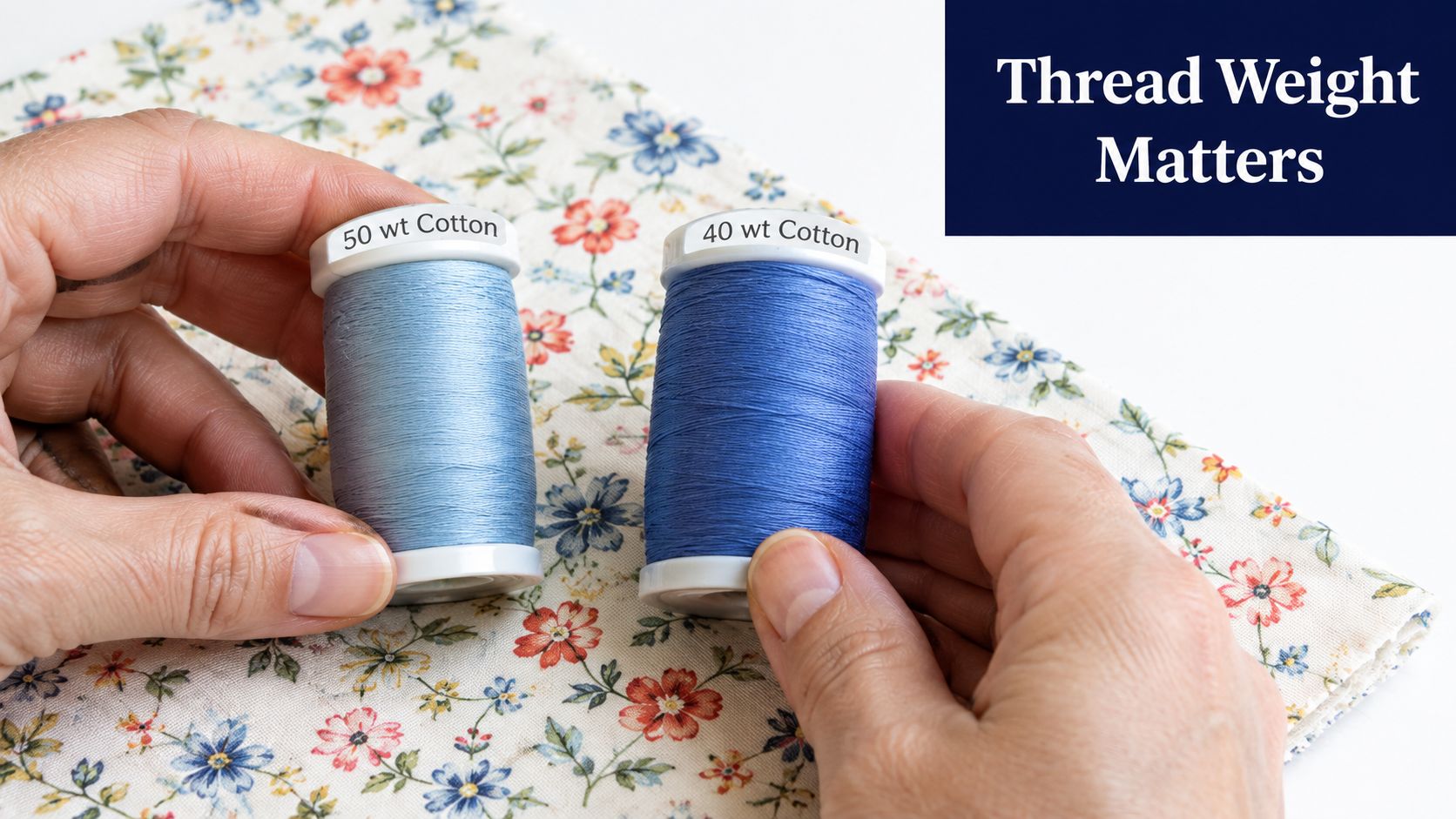
You're at the sewing machine with two spools in hand. The 50 wt thread looks right for piecing, but the 40 wt thread promises quilting lines you can see. The short answer is simple: 50 wt is a common all-purpose choice for piecing, while 40 wt is often chosen for more visible machine quilting. The number system feels backward, though, and the wrong needle or tension setting can turn a good thread choice into loops, puckering, or breakage.
Why Quilting Thread Weight Changes Your Results
A thread choice can change the character of the same quilt. Sew a set of precise blocks with a thicker thread and the seam intersections may feel more crowded. Quilt those same blocks with a finer thread and the stitching may blend into the fabric instead of outlining the design.
That's why quilting thread weight isn't only about thickness or color. It affects seam bulk, stitch visibility, needle choice, tension, and how easily the thread moves through the quilt sandwich. A thread that works beautifully for piecing may not give you the texture you want for quilting.
Start with the result you want
Use your project as the first guide:
- Flat, accurate piecing: Reach for a finer thread that keeps seam allowances less bulky.
- Visible machine quilting: Choose a somewhat heavier thread so the stitched design has presence.
- Bold hand quilting: Consider a heavier thread when you want each stitch to become part of the decoration.
- Subtle detail work: Use a fine thread when you want the fabric, appliqué, or piecing to remain the focus.
The Fabric Company's selection of fabrics, notions, batting, machines, and finishing supplies can support each part of that process. In Our Springfield, Tennessee showroom, you can also compare thread, fabric, and batting in person before committing to a full quilt sandwich.
A practical starting point
Most quilters don't need a separate spool for every possible technique. Begin with a reliable 50 wt thread for piecing, then add 40 wt for machine quilting when you want the lines to show more clearly. If you're working with precuts, a Charm Pack, Layer Cake, or 2.5-inch strips, the finer piecing thread can help keep the assembled blocks smooth at intersections.
Practical rule: Choose the thread for the visual and structural job first, then adjust the needle and tension to match it.
The “What You'll Need” list below keeps the decision grounded in real supplies:
- Precuts for fast-cutting projects and coordinated blocks
- Batting to match the quilt's loft and quilting plan
- PFAFF machines for controlled piecing and quilting
- Thread suited to the technique
- A small fabric sandwich for testing before stitching the quilt
What Quilting Thread Weight Really Means
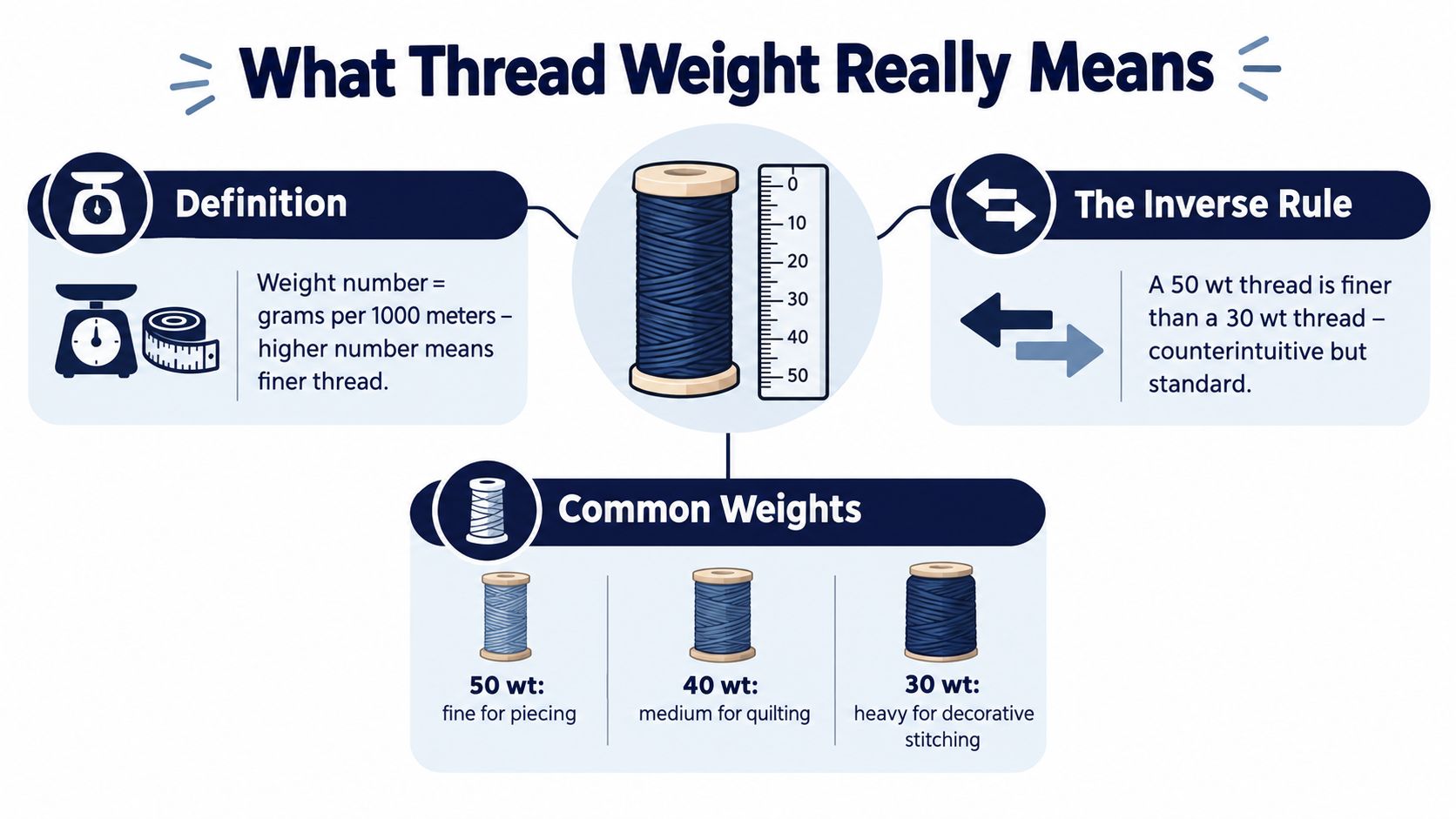
The label doesn't describe how heavy the spool feels in your hand. It describes a length-to-weight relationship. In the metric system, thread weight is often expressed by how many kilometers of thread weigh 1 kilogram. That creates the counterintuitive rule: more kilometers can fit into the same kilogram when the thread is finer.
For example, 40 wt means about 40 kilometers of thread weigh 1 kilogram, while 50 wt means about 50 kilometers weigh 1 kilogram. The 50 wt thread is finer because more length is needed to reach that fixed weight. A simpler explanation uses meters per gram, but the direction stays the same. The higher the wt number, the finer the thread. (YLI's thread-weight explanation describes this length-based measurement.)
Golden rule: Lower wt numbers mean thicker thread. Higher wt numbers mean finer thread.
Read the label in three steps
- Find the wt number. A 40 wt thread is thicker than a 50 wt thread.
- Reverse your first instinct. A larger number doesn't mean a larger diameter.
- Connect the weight to the job. Fine thread generally reduces bulk and visibility, while thicker thread makes stitches more noticeable.
This system has historical roots in textile-mill methods that graded yarn through length and weight. That history is why modern labels can also include wt, tex, denier, and metric equivalents rather than one universal sizing language. The terms overlap in purpose, but they don't move in the same direction.
A quilting thread guide from The Fabric Company can be useful when you're comparing everyday quilting choices. Keep the inverse rule beside your machine until it becomes automatic. After that, the label stops looking like a code and starts acting like a quick prediction of stitch behavior.
Quilting Thread Weight Conversion Made Simple
A spool can say 50 wt, while another lists tex or denier. These labels describe the same thread from different measurement systems, so use them together when comparing brands. Wt remains a practical quilting reference. Tex and denier provide additional ways to check how the thread may behave.
The directions differ: a lower wt number indicates a heavier thread, while tex and denier increase as thread becomes heavier. That reversal can cause confusion when you switch brands or shop for longarm cones.
A common comparison places 50 wt around Tex 30 and about 270 denier, while 40 wt is around Tex 40 and about 360 denier. Typical needle pairings are 80/12 for 50 wt and 80/12 to 90/14 for 40 wt. These are useful starting points, not fixed rules, because fiber, machine, and fabric layers change the result. Linda's thread-size chart lists these commonly used comparisons.
| Weight wt | Tex | Denier | Typical Needle |
|---|---|---|---|
| 50 wt | Around 30 | About 270 | 80/12 |
| 40 wt | Around 40 | About 360 | 80/12 to 90/14 |
How to use the chart
Suppose you are comparing a 50 wt spool from Robert Kaufman with a 40 wt option from Cloud9. The 50 wt is generally finer, so it tends to create less seam bulk and a quieter stitch line. The 40 wt usually shows more clearly and may need more space through the needle eye and fabric layers.
Use the label as a starting point, then test the complete system. Fiber, ply, twist, finish, needle, thread path, tension, and fabric layers all affect stitch quality. A conversion chart can identify likely equivalents, but it cannot predict every machine's response.
- Wt: A quilting-friendly label that runs in reverse.
- Tex: Increases as thread becomes heavier.
- Denier: Also increases with thread weight.
- Needle size: Must suit the thread diameter and fabric layers.
For longarm cones, keep a thread-weight chart nearby. Compare the familiar wt number with tex or denier, then adjust the needle and tension if stitches look uneven, loops form, or the thread struggles through the layers.
Choosing the Right Weight for Every Quilting Technique
The easiest way to choose quilting thread weight is to match it to the stitch's role. Is the thread holding pieces together, adding a visible quilting pattern, or creating a bold hand-stitched accent?
Piecing with 50 wt
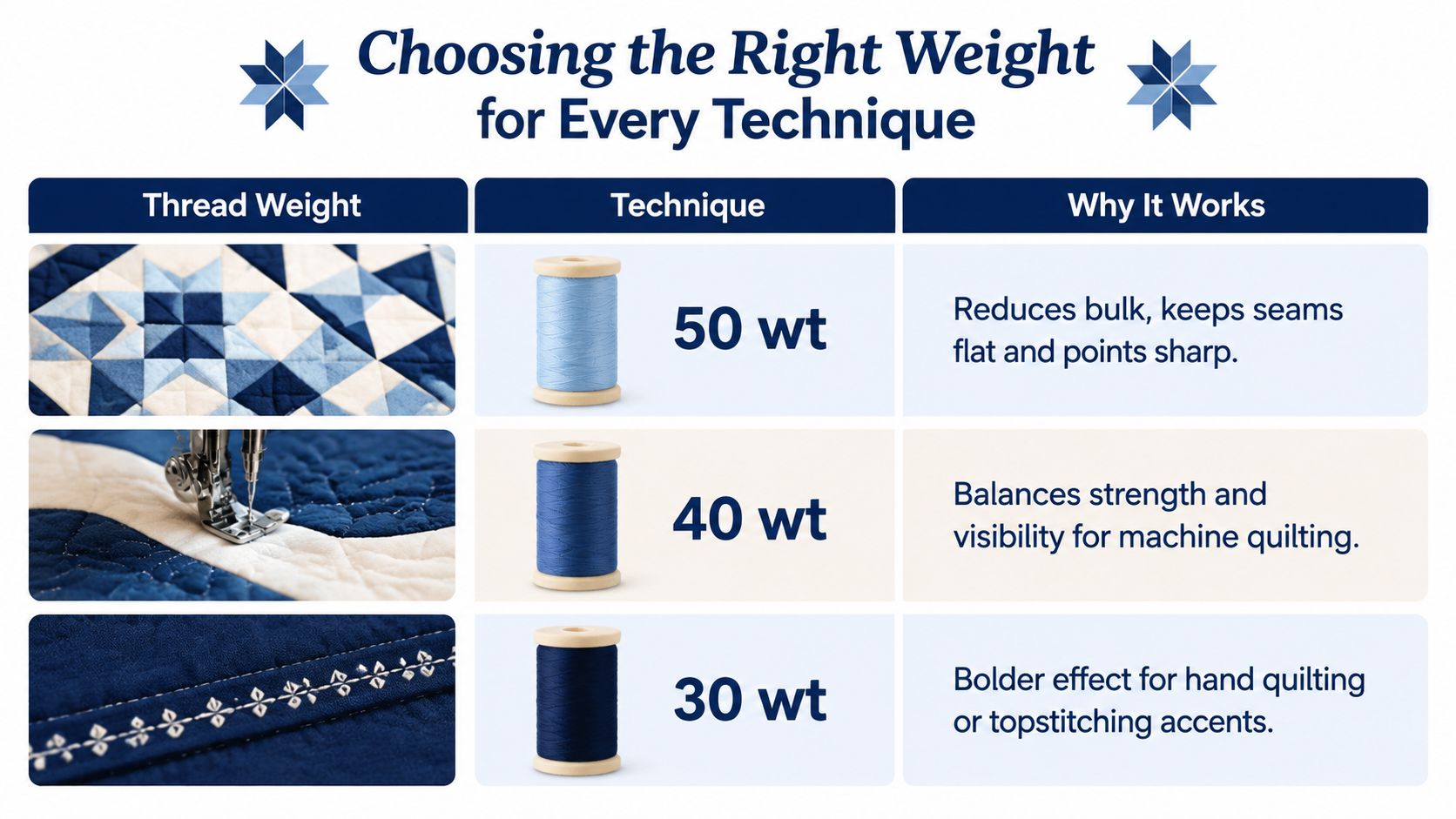
50 wt is widely treated as the standard all-purpose choice for piecing. Its finer profile helps reduce seam bulk, which matters when several seam allowances meet at a star point, flying-geese tip, or chain-pieced intersection. It also helps you press blocks flat and preserve precise alignment.
This is a natural match for precut projects. Whether you're working from Charm Packs, Layer Cakes, Fat Quarters, or 2.5-inch strips, a 50 wt thread usually keeps the construction stitches from competing with the fabric design.
Machine quilting with 40 wt
Choose 40 wt when you want the quilting lines to read clearly. It has more visual presence than 50 wt, so it can emphasize straight lines, walking-foot quilting, free-motion motifs, or simple outline work.
Your fabric and batting still matter. A lofty quilt sandwich may make the thread appear differently from a flatter sandwich using needle-punched cotton batting. For a full-size project, a 108-inch backing can reduce the need for piecing a back, while Hobbs batting rolls can support larger quilting plans.
Hand quilting and bold stitch effects
For hand quilting, 28 wt to 40 wt can suit a more defined line, depending on the look you want. 8 wt or 12 wt is often selected for big-stitch hand quilting, binding accents, and highly visible texture. These heavier threads turn the stitch into a design element rather than something that disappears.
Fine work needs the opposite approach. 60 wt to 100 wt is used for more delicate or subtle applications, including bobbin work and detail where you want less visual competition. Fine thread can also help reduce bulk in intricate piecing and selected appliqué techniques.
Keep a small test sandwich
Before quilting the finished top, layer a scrap of the actual top fabric, backing, and batting. Test the thread with the intended foot, stitch length, needle, and tension. That little sample tells you more about visibility and balance than a spool label can.
For a visual reference, this hand-quilting thread guide connects weight choices to hand-stitching effects.
How Thread Weight Affects Tension Needles and Stitch Quality
A thread can be labeled correctly for your technique and still stitch poorly. Puckering, loops on the back, shredding, and breakage often point to a mismatch between thread diameter, needle size, tension, and quilt-layer resistance.
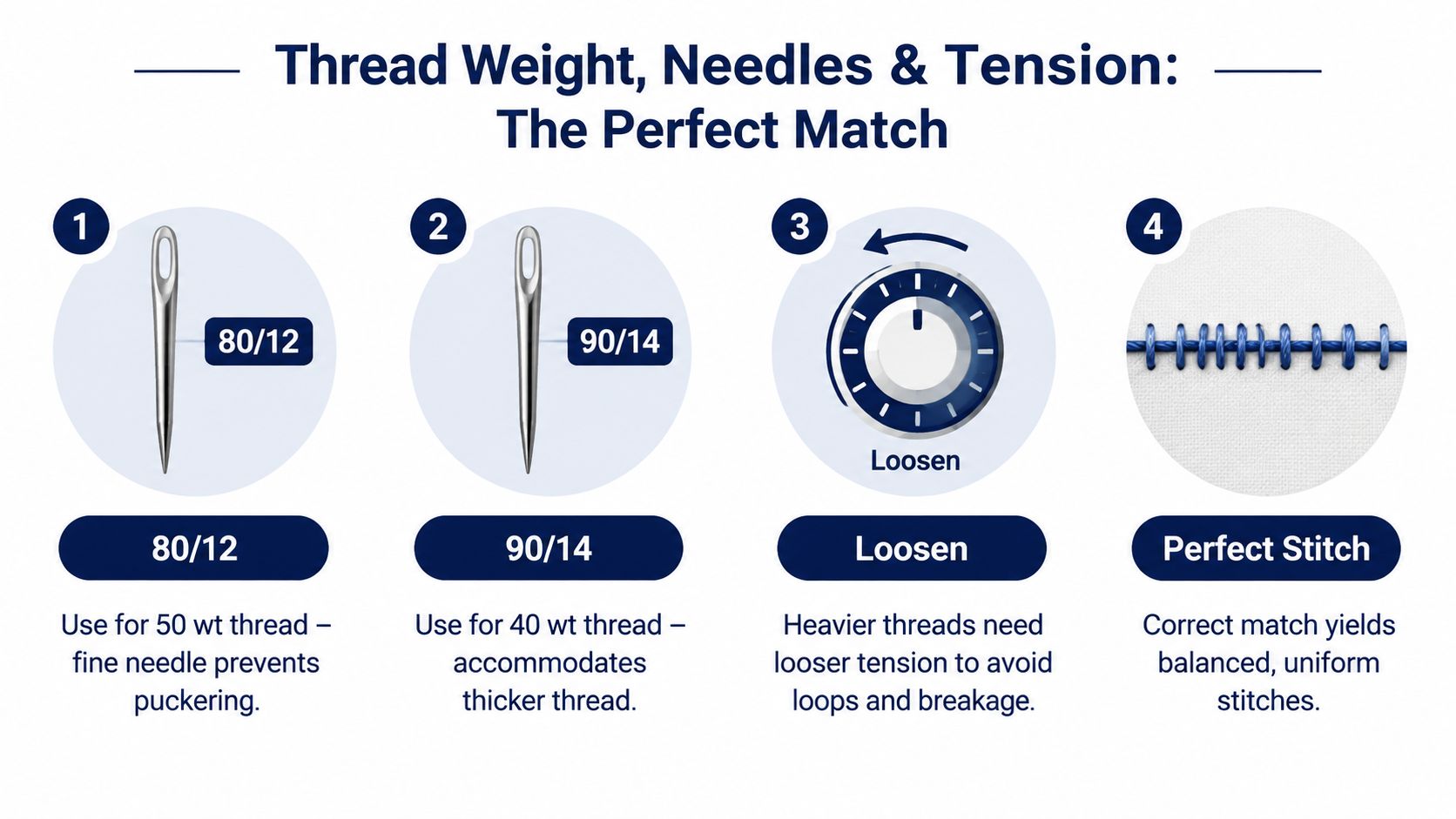
Heavier thread generally needs more space through the needle eye and fabric. Common pairings place 40 wt with 80/12 to 90/14 needles and 50 wt with an 80/12 needle. The heavier choice can also create more friction and tension sensitivity. (Linda's sewing-thread chart lists these needle pairings.)
Use the symptoms as clues
- Thread breakage: Try a larger needle, check the thread path, and reduce excess tension when working with a heavier thread.
- Loops underneath: Check upper threading and bobbin placement before changing several settings at once.
- Puckered fabric: A needle that is too large, excessive tension, or a dense quilt sandwich can contribute. Test a finer thread or rebalance the tension.
- Shredded thread: Inspect the needle eye, needle point, and machine threading path.
- Flat but weak-looking stitches: The thread may be too fine for the visual effect you want, or the stitch length may need adjustment.
Machine check: Change one variable at a time. Test the same thread and fabric sandwich while adjusting the needle or tension.
Batting changes the resistance the needle meets. A quilt with more loft can surround the thread differently from a flatter sandwich. Scrim and needle-punched cotton batting also influence how the layers hold together as the needle passes through, so thread choice shouldn't be separated from the quilt sandwich.
Finer thread is often easier to bury in seams and can suit ditch quilting, bobbin use, or micro-detail. Thicker thread brings stronger stitch definition, but it usually asks more from the machine. In Our Springfield, Tennessee showroom, you can discuss these combinations while comparing machines such as SINGER models and the PFAFF expression™ 710.
A focused machine-quilting thread guide can help you build a repeatable setup instead of treating every tension problem as a thread problem.
Smart Shopping for Thread Brands and Fibers
Two spools can share the same wt number and still feel different in use. Fiber, ply, twist, finish, and color all affect the final stitch. Cotton, polyester, and blends may produce different surface effects, lint levels, strength, and tension responses even when the label suggests a similar size.
Start with the weight, then look beyond it:
- Fiber: Cotton can create a traditional matte appearance, while polyester may offer a different sheen and glide.
- Ply: The number and structure of strands affect roundness, strength, and stitch definition.
- Finish: A smooth finish can move differently from a textured or treated thread.
- Color: A matching thread blends into fabric, while contrast makes quilting easier to see.
- Format: Spools suit smaller projects, while cones can be practical for extended quilting or studio work.
Brands such as Robert Kaufman and Cloud9 may present thread and fabric information differently, so tex and denier can help when the wt label alone isn't enough. The cone-of-thread guide is useful when you're planning for longer quilting sessions or comparing spool and cone formats.
The Fabric Company offers quilting fabric, thread, notions, batting, machines, and finishing supplies through its online shop and Springfield, Tennessee location. For a larger quilt, you can pair a thread choice with 108-inch backings, batting rolls, and quilting thread without treating each purchase as a separate planning problem.
For stash building, compare true-to-color photos with your existing fabric, especially when choosing a thread intended to blend. A small sample is still the safest test because screen color, fabric weave, and thread sheen can change how the finished line appears.
Your Next Steps to Confident Thread Choices
Use this quick decision path at your cutting table:
- Identify the job. Choose 50 wt for general piecing, 40 wt for more visible machine quilting, and heavier hand-quilting weights when you want bold stitch definition.
- Read the label backward. A lower wt number means thicker thread, while a higher wt number means finer thread.
- Match the needle. Start with the common 80/12 pairing for 50 wt and consider 80/12 to 90/14 for 40 wt.
- Test the sandwich. Use the actual top fabric, backing, batting, foot, and stitch style.
- Adjust tension gradually. Heavier thread often needs a larger needle and looser tension, but the test sample should decide the final setting.
You can also make your next project easier by gathering supplies together. Browse precut bundles, compare complete quilt kits, or choose rotary cutting notions alongside the thread and batting your pattern requires.
For local help, visit Our Springfield, Tennessee showroom and bring a sample block or thread label. If you're shopping online, The Fabric Company offers free shipping on orders $49+, as stated by the publisher.
Shop our latest quilting thread collection. Join The Weekly Thread for more tips and 10% off your first order.
The Fabric Company offers quilting thread, precuts, batting, 108-inch backings, notions, and machines to help you move from thread selection to a finished quilt. Visit The Fabric Company online or stop by Our Springfield, Tennessee showroom to compare supplies and get your next project stitching smoothly.