

You've just finished sewing the last side of a baby quilt binding, and the final stitches are skipping. Or perhaps a carefully pinned garment seam is puckering from end to end. Before you rethread the machine or blame the fabric, check the needle. The different types of needles for sewing exist because fabric, thread, and stitch speed place different demands on that small working tool.
Why the Right Needle Changes Everything
A sewing needle looks simple, but its point and shaft control how the machine enters the fabric, forms the stitch, and leaves the material behind. A needle that suits quilting cotton can behave poorly on a knit, leather, metallic thread, or a thick quilt sandwich.
A damaged or unsuitable needle can:
- Skip stitches: A dull, bent, or poorly matched point may fail to form a reliable loop.
- Pucker fine fabric: A needle that's too large can drag or distort a delicate woven.
- Leave holes: A thick shaft can create visible openings in a lightweight knit or sheer.
- Fray thread: A rough eye or an unsuitable needle finish can scrape decorative thread.
- Break: Dense layers, pins, or forced fabric movement can damage the needle or cause it to snap.
The point shape matters as much as the size. A ballpoint or jersey needle uses a rounded tip to separate knit loops rather than cutting through yarns. A Microtex or sharp needle uses a narrow point to pierce dense woven fabrics and fine synthetics cleanly. Denim needles add a modified shaft and deeper scarf for packed layers, while leather needles use a cutting point designed for genuine leather and heavy vinyl. (Singer's needle classification guide explains how point geometry changes for these materials.)
Practical rule: If the stitch problem appears suddenly, replace the needle before changing several other settings.
A fresh needle is a quick, inexpensive test. It's usually faster than removing a whole line of stitching from a quilt block or garment panel. For thread pairing, keep a reference such as this guide to the best thread for hand sewing, then match the needle eye and point to the fabric in front of you.
Needle Anatomy and Sizing Made Simple
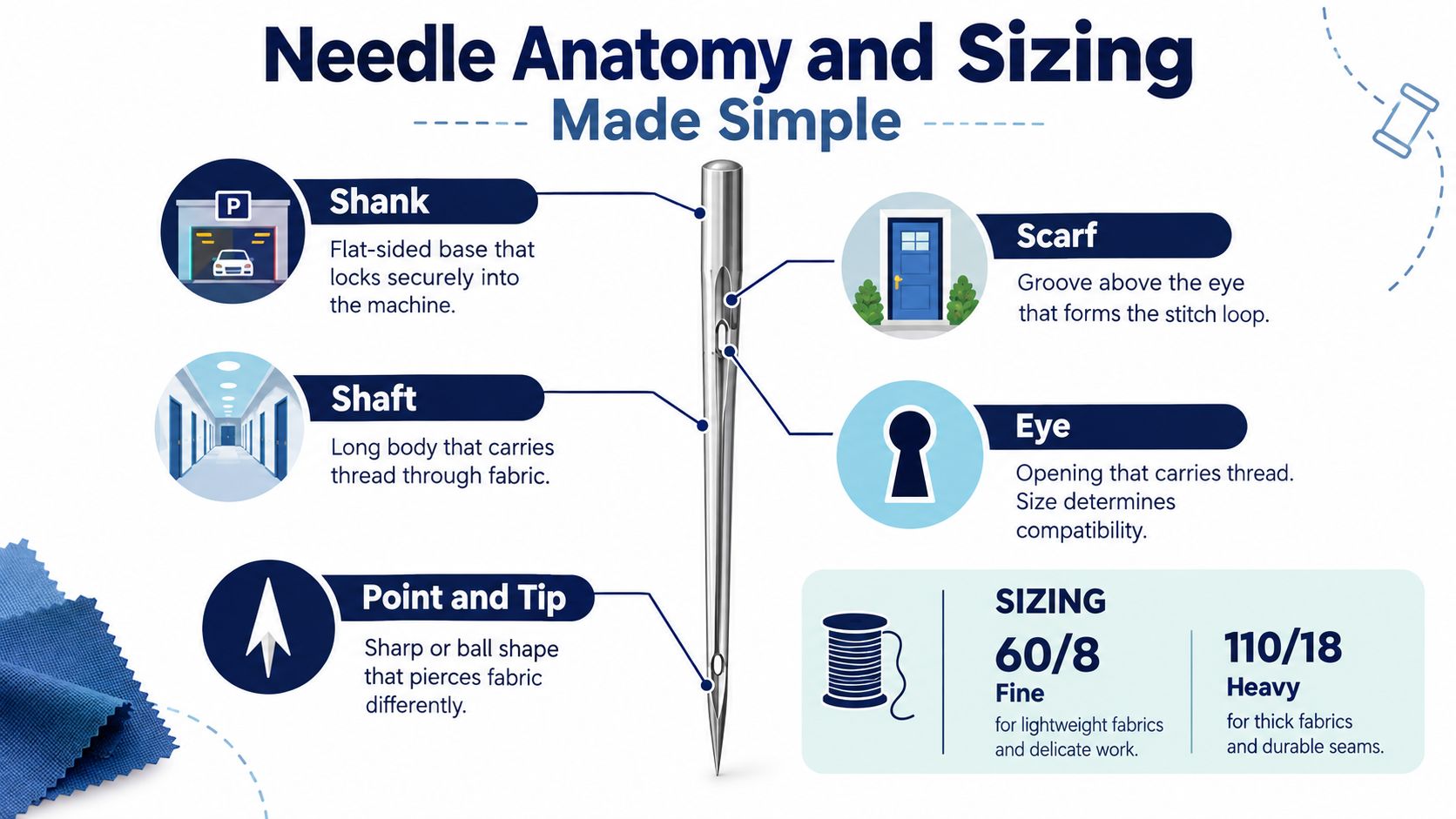
Think of a machine needle as a tiny hallway built for one job. The shank is the parking garage. It seats the needle in the machine, and its flat side helps you install it correctly. The shaft is the long hallway that travels through the fabric. The scarf is the recessed front door near the eye, giving the bobbin hook room to catch the thread loop.
The groove runs down the front and shelters the thread as the needle descends. The eye is the threading window, and its size must suit the thread. Finally, the point and tip do the fabric work. A sharp tip pierces tightly woven cloth, while a rounded tip moves between knit loops.
Hand needles use a simpler arrangement. They don't have a machine shank. Instead, the eye sits at the top, the shaft forms the body, and the point enters the fabric at the opposite end.
Reading the numbers
Machine needle packages often show two numbers, such as 80/12. They represent different sizing systems for the same shaft thickness. In the metric system, the European number gives the blade diameter in hundredths of a millimeter, so an NM 90 needle is about 0.90 mm at the blade. Larger numbers mean thicker needles. (Schmetz's Needle ABC gives the sizing explanation and fabric-matching guidance.)
Common commercial sizes run approximately from 60/8 through 110/18, with finer sizes for lightweight fabric and heavier sizes for dense material. (TextileSchool's needle reference describes NM 70 as fine, NM 80 to NM 90 as medium, and around NM 100 as thicker.)
Some needle packages also use a colored band near the top. That band can help you identify a specialty type at a glance, but always confirm the printed label before sewing.
The Main Machine Needle Families
The easiest way to remember machine needles is to pair each family with the problem it prevents. A universal needle is a helpful generalist, but it isn't a substitute for every specialty point.
| Needle Type | Best For | Problem It Solves |
|---|---|---|
| Universal | Woven cotton and light quilting cotton | General stitching without changing to a specialty point |
| Sharp or Microtex | Batik, silk, tightly woven cotton | Reduces imprecise piercing and helps create clean stitch holes |
| Ballpoint or Jersey | Knits and jersey | Helps prevent pierced loops, runs, and skipped stitches |
| Stretch | Spandex, ponte, and elastic fabrics | Helps maintain stitch formation on highly flexible materials |
| Jeans or Denim | Denim, canvas, and heavy twill | Handles dense layers with a stronger shaft and modified scarf |
| Leather | Genuine leather and heavy vinyl | Uses a wedge-shaped cutting point instead of a cloth point |
| Quilting | Pieced quilt tops and batting layers | Supports controlled penetration through a quilt sandwich |
| Embroidery | Rayon and polyester embroidery thread | Enlarged eye helps reduce thread shredding |
| Topstitch | Heavy topstitch thread and visible seams | Provides room for thicker thread and strong penetration |
| Twin or Double | Parallel pintucks and ready-to-sew hems | Creates two parallel lines in one pass |
A universal needle is a sensible first choice for woven shirts, cotton mending, and light quilting cotton. It has a slightly rounded point, so it's forgiving across everyday woven materials. Don't use it as your first choice for a stretchy T-shirt or very dense batik if you're seeing skipped stitches.
A Microtex or sharp needle is the precise tool. Its narrow point suits silk, batik, tightly woven cotton, and fine synthetic fabric. On a loose knit, however, that sharp tip can pierce yarns rather than separating them.
For knits, choose ballpoint, jersey, or stretch. The rounded tip slides between loops, which helps protect the knit structure. If you're sewing a sweatshirt for a group, a resource such as Custom Mark sweatshirts for teams can help with garment context, but your needle still needs to match the sweatshirt's knit and the thread you're using.
Jeans and denim needles are built for heavy twills, stacked seams, and canvas. Use one when a universal needle deflects, breaks, or struggles to penetrate. Leather needles cut a small path through leather and vinyl, so they aren't appropriate for ordinary fabric. The hole they make remains visible.
For decorative work, an embroidery needle has a larger eye that gives rayon and polyester thread more room. A topstitch needle is better when the thread itself is thick and meant to be seen. Twin needles create parallel stitching, but check your machine's instructions and sew slowly while testing clearance.
For machine maintenance and correct installation, keep a reference such as this overview of sewing machine parts and accessories.
Matching Needles to Your Project
Start with the fabric in your hand, not the names on the needle wall. Ask whether it's woven or knitted, light or dense, stable or stretchy, and whether the project includes batting, vinyl, or several stacked seams.
Quilting
For piecing quilting cotton, a sharp, Microtex, or quilting needle can give you clean penetration and accurate seams. A quilting needle is designed for layered work, with a strong shaft and a sharp point suited to multiple woven layers and batting. For thread planning, this guide to quilting thread for machine quilting can help you think about thread and needle as a pair.
A batik may need the precision of a Microtex point because its weave can be dense. Flannel may sew comfortably with a universal needle during simple piecing, but a quilting needle can become useful once you add a pieced top, batting, and backing.
Apparel
A woven cotton shirt or dress often works well with a universal needle. A T-shirt, leggings fabric, or ponte knit needs a ballpoint or stretch needle so the tip can move between loops instead of cutting them. For a denim jacket, jeans needle is the practical choice, especially at side seams and hems.
Specialty work
Leather and heavy vinyl need a leather needle with a wedge-shaped cutting point. Embroidery with rayon or polyester thread benefits from an embroidery needle with a larger eye. Metallic thread often needs a specialty metallic or embroidery needle with an eye and finish designed to reduce friction and shredding.
| Project Type | Recommended Needle | Example Fabric |
|---|---|---|
| Quilt piecing | Universal, sharp, or Microtex | Quilting cotton or batik |
| Machine quilting | Quilting | Cotton top, batting, and backing |
| Knit garment | Ballpoint or stretch | Jersey or ponte |
| Denim seam | Jeans or denim | Heavy twill |
| Leather accessory | Leather | Genuine leather or vinyl |
| Decorative embroidery | Embroidery or metallic | Rayon, polyester, or metallic thread |
| Fine woven seam | Microtex or sharp | Silk or tightly woven synthetic |
Change the needle when you begin a new project, especially if the previous project involved dense layers, adhesive, or high-speed stitching. A needle can become dull gradually, and the first warning may be a small change in stitch quality rather than an obvious bend.
Troubleshooting Skips Puckers and Broken Needles
Sewing problems become easier to solve when you treat each symptom as a clue. Don't change thread tension, presser feet, and stitch length all at once. Replace or inspect the needle first, then test on a scrap from the actual project.
Skipped stitches often point to a damaged needle or a point that doesn't suit the fabric. On a knit, replace a universal needle with a ballpoint or stretch needle. Confirm that the needle is fully seated, with the flat side facing back according to the machine's setup.
Puckered seams on fine woven fabric can come from a needle that's too large, a damaged point, or thread that's too heavy for the fabric. Try a smaller sharp or Microtex needle, then test with a thread that sits comfortably in the eye and doesn't force the fabric out of shape.
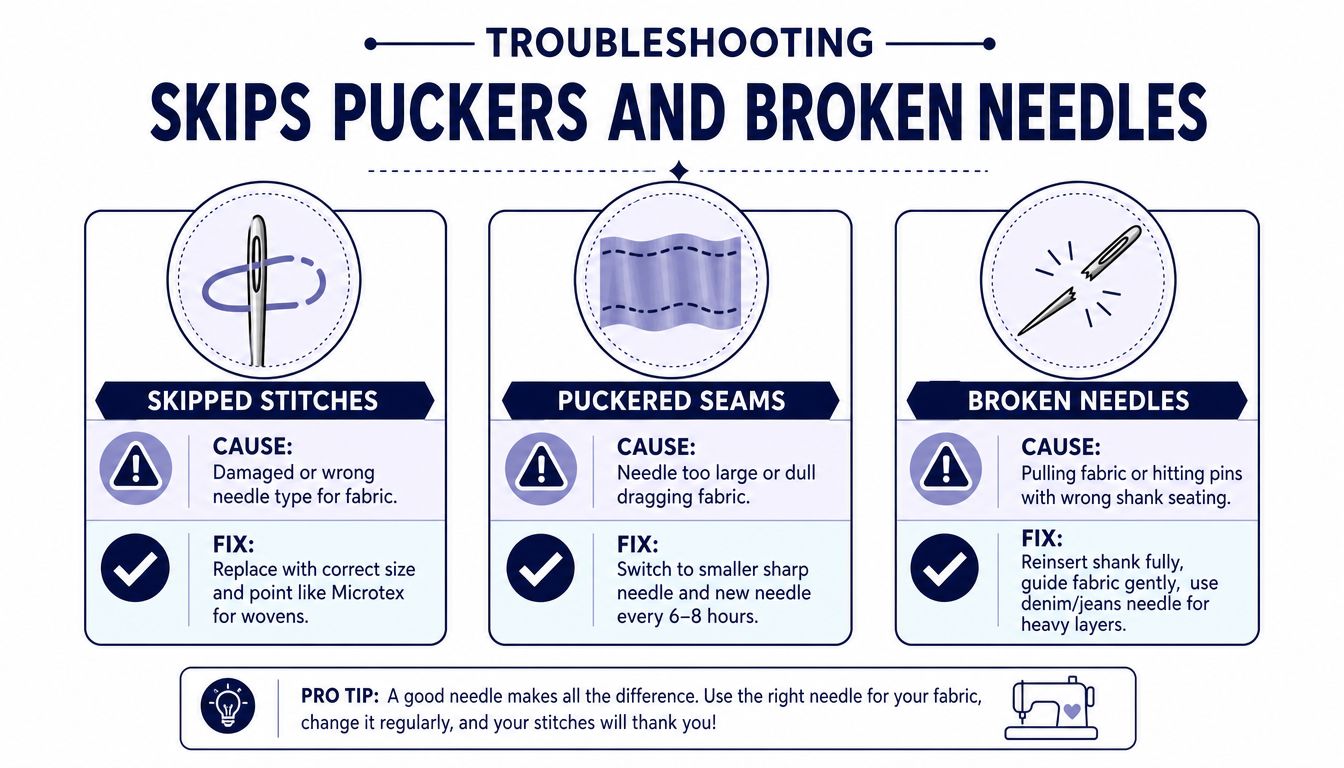
A broken needle needs a safety-first response. The needle may have hit a pin, struck the presser foot, been installed incorrectly, or been forced through thick layers. Stop sewing, remove the broken pieces, and inspect the needle plate and presser foot before continuing.
A quick diagnostic routine
- Stop and raise the needle. Don't keep stitching through a problem.
- Install a fresh needle. Choose the point and size for the fabric.
- Check seating. Push the shank fully upward and verify its orientation.
- Test on scrap. Sew across the same number of layers as the project.
- Guide, don't pull. Let the feed dogs move the fabric.
When a seam contains bulky joins, turn the handwheel to move across the thickest point. For dense denim, switch to a jeans or topstitch needle rather than forcing a general-purpose needle.
If you add labels to finished garments, a practical guide such as Get Spliced sew on labels can help you plan the attachment area and fabric layers before stitching.
Here's a short visual demonstration to reinforce correct needle handling and troubleshooting:
Hand Sewing Needles by Shape and Purpose
Hand sewing needles differ from machine needles because your hand supplies the movement and pressure. Length, eye size, shaft thickness, and point shape affect comfort and control.
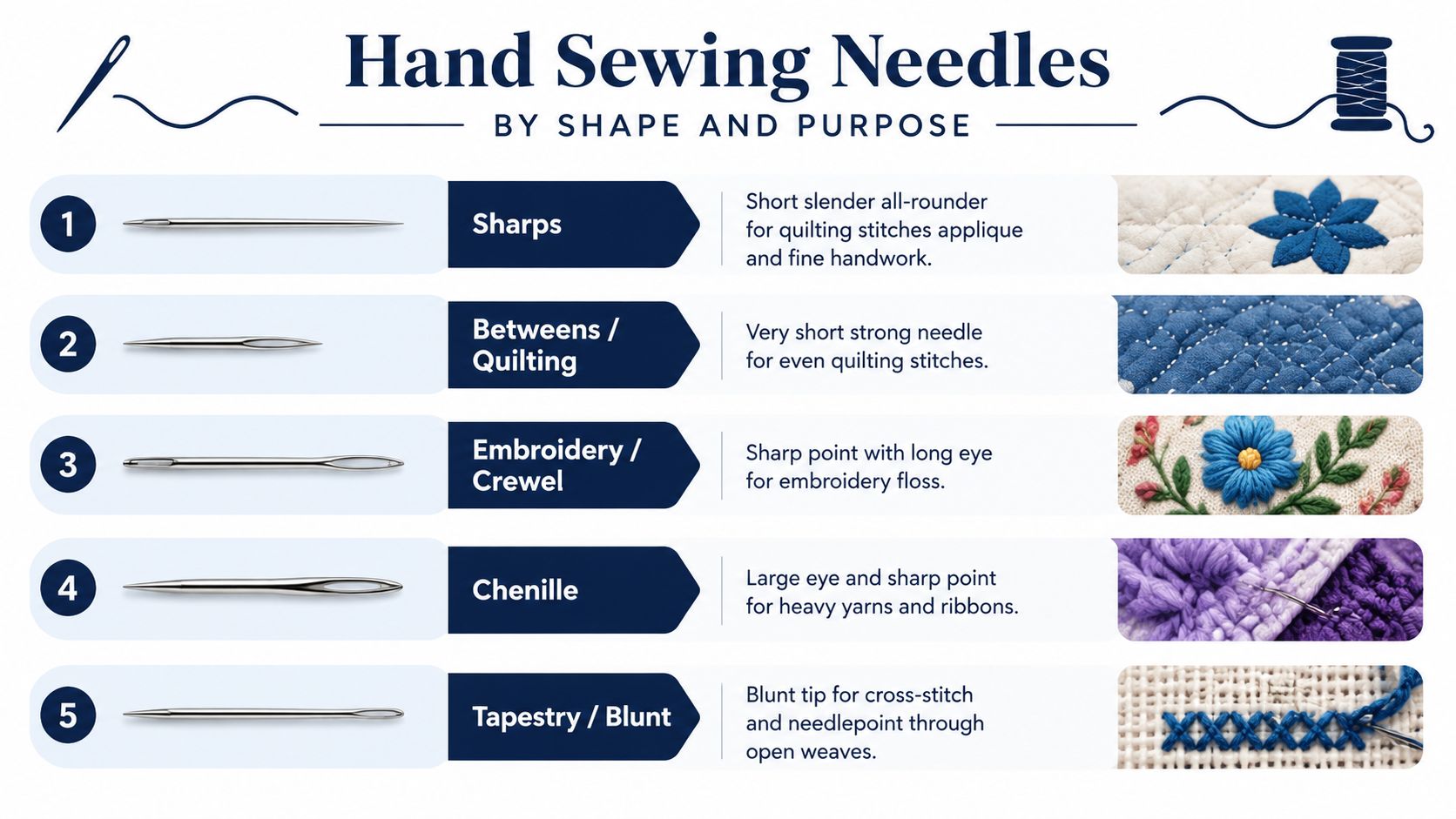
Sharps are the standard all-purpose hand needle. They suit quilting stitches, appliqué, repairs, and ordinary woven fabrics. The Sewing Directory lists sharps in sizes 1 to 11, while betweens range from 3 to 11. (The Sewing Directory's hand needle guide provides those ranges and task distinctions.)
Betweens, also called quilting needles, are shorter than sharps. That compact length gives a quilter control for small, even stitches through a quilt top and batting. If you're hand quilting in a hoop, a between feels more like a short pencil than a long knitting needle.
Matching shape to handwork
Crewel or embroidery needles have a larger, elongated eye for embroidery floss and multiple strands. They work well for decorative stitches, visible mending, and hand embroidery.
Milliner needles, sometimes called straw needles, have long shafts. That extra length helps with gathering, pleating, and long, even stitches where you want to load more fabric before pulling the thread through.
Chenille needles combine a sharp point with a larger eye for heavier yarns, ribbons, and some wool embroidery. They're sturdier than a fine embroidery needle but still enter the fabric decisively.
Tapestry needles have a blunt tip and a large eye. Instead of piercing fibers, the tip pushes them aside, making tapestry needles suitable for cross stitch on Aida and for weaving yarn ends into open knits. Tapestry sizes range from 14 to 26, while chenille needles range from 16 to 24. (The Sewing Directory documents these hand-needle ranges.)
For threading and holding a hand needle comfortably, use this step-by-step guide to threading a needle for hand sewing. Makers adding personalized clothing can also compare sew tags with Quote My Wall before choosing a placement and attachment stitch.
Building a Smart Needle Kit and Caring for Them
A useful needle kit doesn't need every shape on the wall. Build it around the fabrics you sew, then add specialty types when a project calls for them.
Match the kit to your habits
- Beginner: Start with universal 80/12, Microtex, ballpoint 80/12, denim 90/14, and a labeled needle case.
- Precut quilter: Keep quilting 75/11 and 90/14 available for piecing and layered quilting projects.
- Stash builder: Add ballpoint or stretch needles for apparel, denim needles for home décor, and sharp Microtex 60/8 for fine wovens.
- Embroidery maker: Keep embroidery 75/11 nearby when rayon or polyester thread is part of the design.
- Leather worker: Add leather 100/16 for genuine leather and heavy vinyl, and test every combination on a scrap.
The listed machine needle sizes and families are practical starting points, not rigid laws. A lighter fabric may need a finer needle, while dense layers may need a stronger shaft and larger size. One needle-maker notes that a typical needle system may offer 6 to 8 sizes, while popular systems can offer up to 15 sizes. (Coats' needle overview also groups points into round, set, or cloth points and cutting or leather points.)
Replace, test, and store
Replace a working machine needle after roughly 8 to 10 hours of sewing, and replace it immediately after a collision with a pin or presser foot. (Schmetz's Needle ABC offers needle care and application guidance.) A bent or blunt needle can damage fabric, weaken thread, and create inconsistent stitches even when it still appears usable.
Test every new needle on a scrap. Listen for a sharp punching sound, inspect the stitches from both sides, and check whether the thread remains smooth. Store needles in labeled magnetic cases or their original tubes, away from humidity, and discard damaged needles in a sharps container rather than loose in a trash bin.
Schmetz, Organ, and Klasse are familiar names to many sewists. The important comparison is less about collecting brands and more about choosing a clearly labeled needle with the correct point, size, and system for your machine.
For thread, clips, pins, cutting tools, and other supplies that support the needle choice, browse sewing notions and supplies.
Your Starting Needle Game Plan
Use this three-question routine at the machine:
- What is the fabric? Woven, knit, dense, delicate, layered, leather, or vinyl?
- What is the project? Piecing, quilting, apparel, embroidery, mending, or construction?
- What problem must the needle prevent? Skips, puckers, thread shredding, large holes, or breakage?
A practical core kit includes universal 80/12, quilting 75/11, ballpoint 80/12, and denim 90/14. Add Microtex, embroidery, leather, or metallic needles only when your actual projects call for them. That approach keeps your sewing drawer useful instead of crowded with sizes you don't recognize.
Needle choice is one of the quickest ways to improve stitch quality. Start with the fabric, choose the point, confirm the size, and replace the needle before a dull tip creates a larger repair.
The Fabric Company offers quilting cottons, precuts, batting, 108-inch quilt backings, threads, notions, and sewing equipment for projects that need the right needle from the first seam to the final finish. Visit The Fabric Company online or stop by Our Springfield, Tennessee showroom to compare project supplies with experienced quilters, then shop the latest collections and join The Weekly Thread for more sewing guidance and 10% off your first order.