

You've measured your quilt top, chosen a beautiful backing, and then discovered that the fabric estimate doesn't match the width you plan to buy. A quilt backing yardage chart prevents that frustrating surprise. As a quick guide, standard 44-inch fabric needs more yardage and usually requires piecing, while 108-inch and 120-inch wide-backs can cover large quilts with far fewer seams. This reference shows how the math works, how much extra a longarm quilter needs, and how to choose between standard cotton and wide backing.
Introduction to Quilt Backing Yardage Charts
Backing is easy to underestimate because the finished quilt top is only part of the measurement. A queen quilt may look close to a standard fabric width when folded, but the backing must extend beyond the top for quilting, trimming, and loading. If you buy only enough fabric to match the top, you may end up short before the quilt reaches the frame.
A reliable chart turns that decision into a quick lookup. It connects three details:
- Finished quilt size, such as crib, throw, twin, full, queen, or king
- Fabric width, usually standard 44-inch cotton, 108-inch wide-back, or 120-inch backing
- Working allowance, including overhang, seam loss, and rounding
A widely used backing reference shows the difference clearly. A baby or crib quilt needs about 2.75 yards of 44-inch fabric but about 1.5 yards of 108-inch wide-back. A queen drops from about 8.25 yards of 44-inch fabric to 3.25 yards of 108-inch backing, while a king falls from about 9.75 yards of 44-inch fabric to 3.25 yards of 120-inch backing. These figures come from the Nifty Fifty Quilting backing chart.
That change affects more than the cutting table. Wide backing can reduce the amount of fabric purchased by roughly 50% to 70% for large bed quilts, according to the same reference. Fewer panels also mean fewer seams to press, match, and quilt over.
For fabric selection, quilters may compare a standard quilting cotton with a dedicated 108-inch quilt backing, a printed wide-back, or a pieced design made from stash fabric. The backing should also work with the quilt's Loft, Batting, and quilting plan. The Fabric Company's guide to the best fabric for quilting is useful when you're weighing texture, weight, and intended use.
Keep this guide nearby when you:
- Estimate fabric before cutting your quilt top
- Compare standard cotton with 108-inch or 120-inch wide-backs
- Decide whether piecing is worth the savings
- Prepare backing for a longarm frame
- Check whether a chart includes enough waste and overhang
How Quilt Backing Yardage Is Calculated
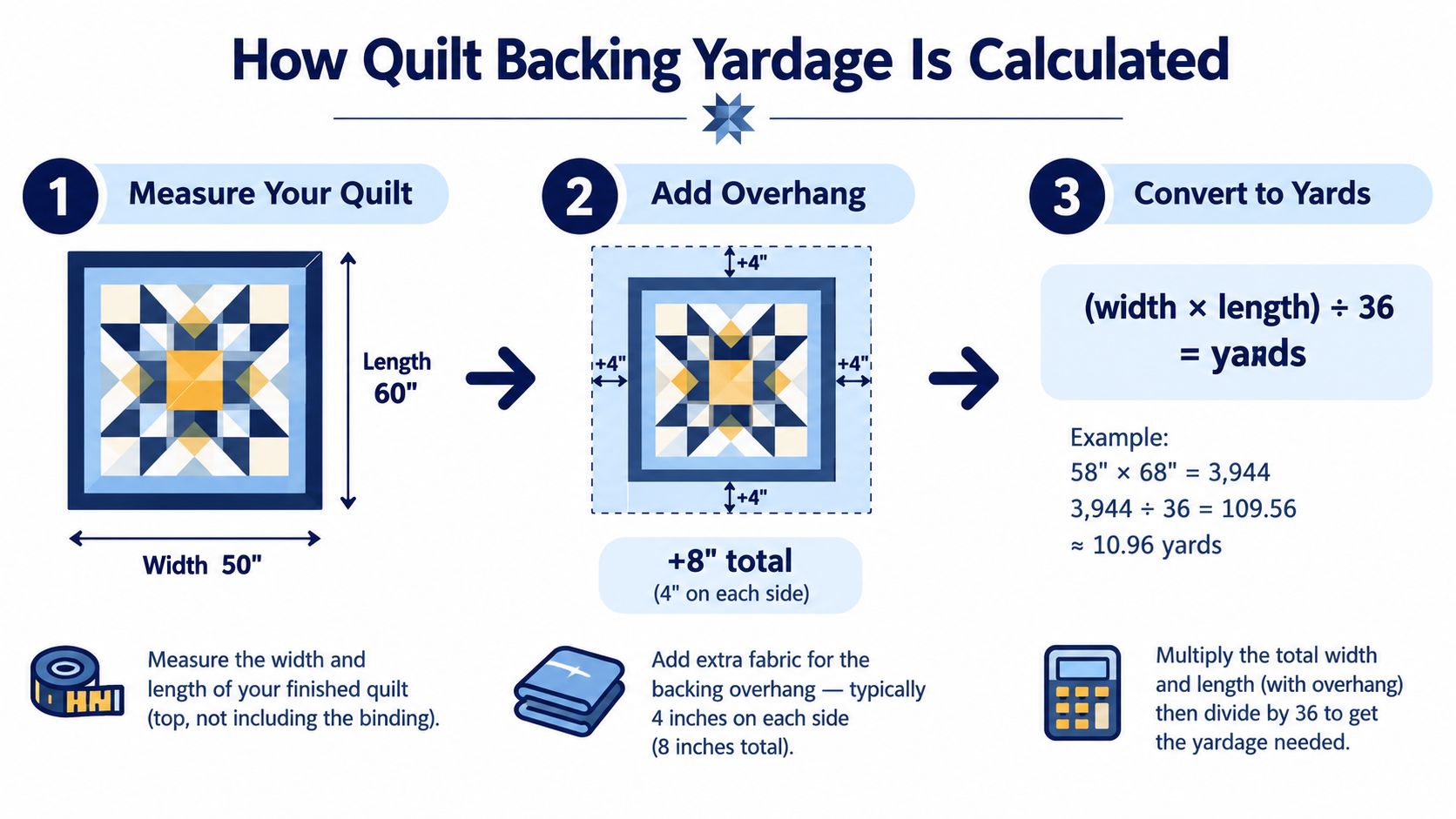
The basic calculation is simple, but the order matters. Start with the finished quilt top, add the working allowance, determine how many fabric widths are needed, and then convert the total inches into yards.
Start with the finished top
Measure the quilt top after borders are attached. Measure both width and length through the middle rather than relying only on the edges, because edges can stretch or wave.
Next, add the overhang required by your quilting method. A common longarm rule is 4 inches on every side, creating a backing that is 8 inches larger in both width and length than the finished top. The longarm backing seam guide describes this allowance and notes that some longarmers request 4 to 5 inches per side.
The working dimensions become:
- Backing width: quilt-top width plus 8 inches
- Backing length: quilt-top length plus 8 inches
Convert the dimensions into yardage
For a traditional calculation, add the quilt dimensions and the extra allowance, then divide by 36 inches per yard. The Fat Quarter Shop backing guide explains that its traditional figures use fabric around 42 inches wide, while 108-inch fabric must be recalculated because the width changes the panel arrangement.
When standard fabric is narrower than the required backing width, calculate the number of panels first. Multiply the number of panels by the required backing length, divide the result by 36, and round up to the purchase increment recommended by your shop or calculator.
Practical rule: A chart is a starting point, not a substitute for measuring your actual quilt top.
What You'll Need
- Precuts for quilt blocks and design planning
- Batting matched to your preferred Loft
- PFAFF sewing machines for accurate piecing and finishing
- A measuring tape, pencil, calculator, and the finished quilt top
Many calculators round to the nearest eighth or quarter yard. That small rounding choice can change the purchase recommendation, especially when the calculation lands close to a cutting increment. The fabric yardage calculation guide offers another explanation of the measuring and conversion process.
Understanding Fabric Widths and Seam Requirements
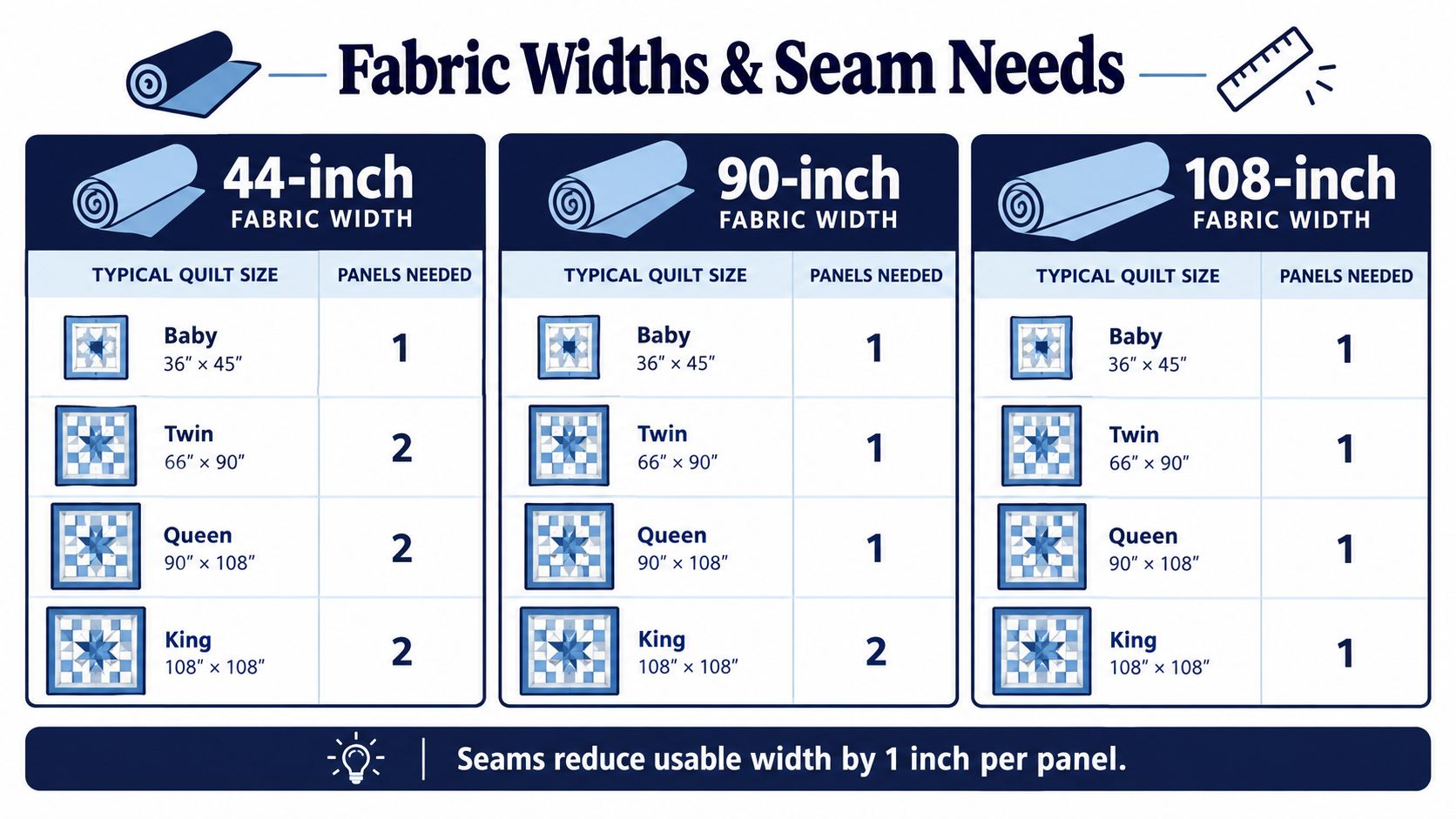
Fabric width changes both the amount you buy and the amount you sew. Standard quilting cotton is commonly sold around 42 to 44 inches wide, while wide-backs are designed for larger quilt surfaces. A wider bolt may cost more per yard, but it can still use less total fabric and create a cleaner finished backing.
Standard 44-inch fabric
Standard-width cotton works well for crib quilts, throws, and many smaller projects. Once the backing becomes wider than the usable fabric, you'll join panels with seams. Selvages are removed before piecing, so the usable width is less than the number printed on the bolt.
The fabric bolt size guide helps clarify why the labeled width and working width aren't always identical. A standard backing may require two panels for a throw or twin quilt and three panels for larger bed quilts, depending on the finished measurements and allowance.
108-inch wide-back
A 108-inch wide-back can cover many bed quilt backings in one broad cut. That means less cutting, less seam pressing, and fewer interruptions across the quilt back. Wide-back fabric is especially useful when you want a continuous print, a large-scale motif, or a smooth surface for dense quilting.
It also reduces the need to match repeated panels. With a standard directional print, every added panel creates another opportunity for the design to shift or appear upside down.
120-inch backing
A 120-inch backing provides even more width for very large quilts. It can be a practical choice for king projects where a 108-inch fabric may still require careful checking of the finished backing dimensions.
| Width | Main advantage | Main caution |
|---|---|---|
| 44-inch | Often useful for small quilts and stash piecing | More panels and seams on large quilts |
| 108-inch | Broad coverage with fewer seams | Requires a separate wide-back yardage calculation |
| 120-inch | Extra room for large bed quilts | The print direction and finished dimensions still matter |
Print direction can override the math. Stripes, border prints, and motifs with a clear top and bottom may need to run in a specific direction. A slightly less efficient layout can be the right choice if it keeps the design upright.
Complete Quilt Backing Yardage Chart by Quilt Size
Use this chart as a starting point, not a final cutting plan. The figures come from the Nifty Fifty Quilting backing reference, which compares standard-width fabric with 108-inch and 120-inch wide-backs. Your final amount can change after measuring the finished top, adding longarm overhang, checking usable width, and considering print direction.
Master chart
| Quilt Size | 44-Inch Fabric | 108-Inch Wide-Back | 120-Inch Wide-Back |
|---|---|---|---|
| Baby / Crib | About 2.75 yards | About 1.5 yards | About 1.25 yards |
| Throw / Lap | 4 yards | 2 yards | About 1.75 yards |
| Twin | 5.5 yards | 2.25 yards | About 2 yards |
| Full / Double | 7.5 yards | 2.5 yards | About 2.25 yards |
| Queen | About 8.25 yards | 3.25 yards | About 2.75 yards |
| King | About 9.75 yards | About 3.5 yards | 3.25 yards |
The chart gives you a quick width comparison. 44-inch fabric usually means more panels and more joining. 108-inch wide-back reduces that work for many throws through queen quilts. 120-inch backing gives the widest single-piece option, especially for large bed quilts, but the finished backing still needs enough room for quilting.
How to use the chart
Start with the quilt size, then compare more than the yardage. A twin quilt is a useful decision point. The shorter cut of 108-inch fabric may cost less sewing time because it can reduce the number of panels and long seams. Standard-width fabric can still make sense when you already own the yardage, want to use several prints, or prefer a pieced back.
For throw and lap quilts, compare the fabric cost with the work involved. A wide-back can act like one broad sheet, while 44-inch fabric may need joined sections. Fewer seams also mean less pressing and fewer places where a print can shift.
Full and queen quilts need a closer check of usable width. Measure the quilt top, add the overhang required by your longarm setup, and then confirm that the backing width covers that measurement. A chart estimate can be short if the top is larger than the usual size or the fabric has a narrower usable area.
King quilts deserve a bolt-width check before purchase. A 120-inch backing may avoid an added seam, while 108-inch fabric may require a different layout. Compare both options with the batting and quilting setup, then allow for directional designs. Stripes, border prints, and upright motifs may require a less efficient cut so the design stays oriented correctly.
Round up when your calculation falls between purchase amounts. That small buffer is easier to manage than discovering that the backing lacks enough overhang after it is cut.
Piecing Backing and Managing Seam Allowances
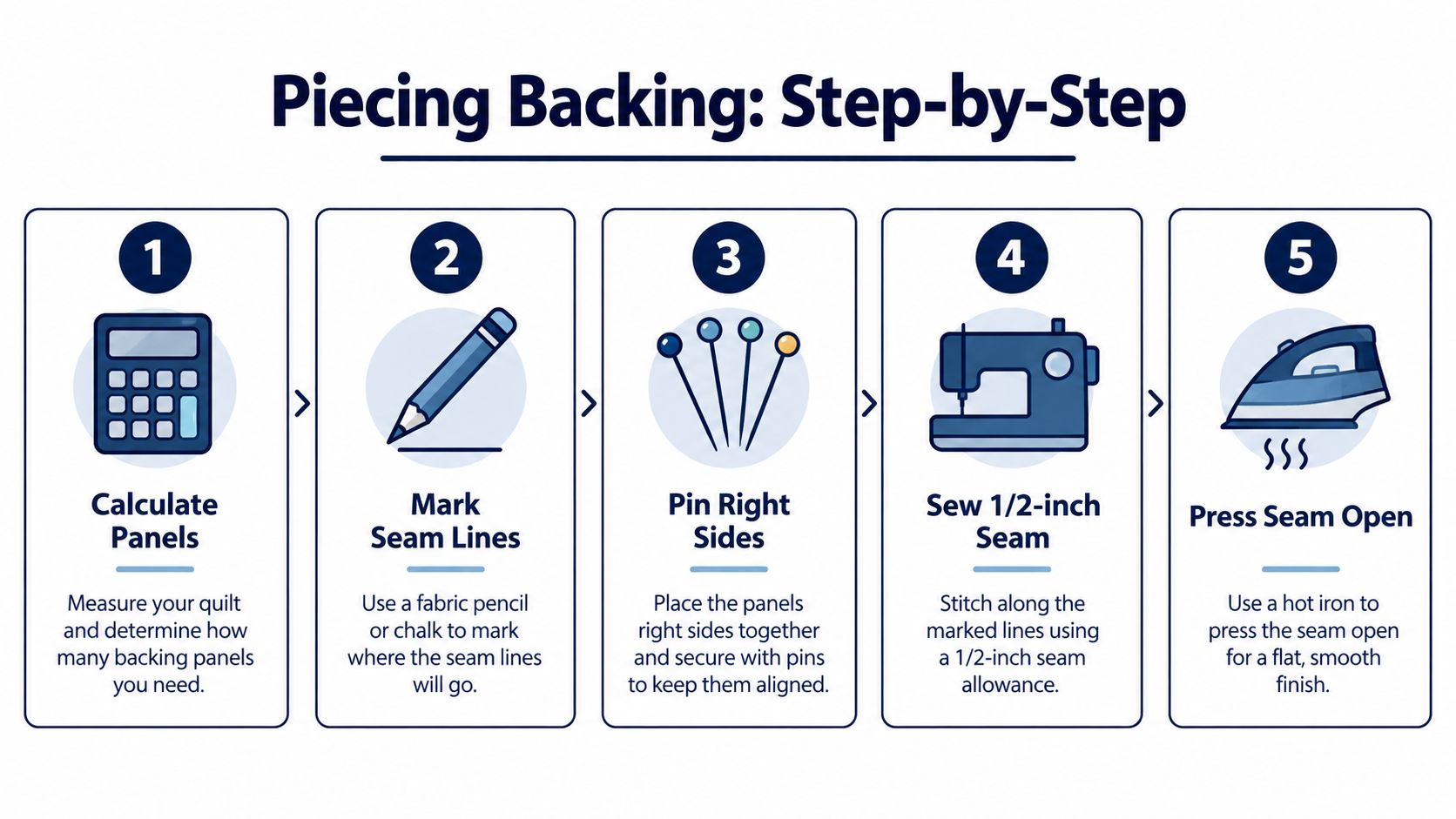
A pieced backing works like a fabric map. Plan the panels, seams, and final measurements before cutting so the finished back remains large enough for quilting. Standard 42 to 44-inch fabric often needs several panels for a large quilt, while wide backing can reduce seam work.
Calculate the panels
Suppose the backing requires two panels, each cut to the needed length. Join them along their long edges when that layout suits the quilt and fabric design. If a directional print looks better with a crosswise seam, compare that arrangement before cutting. The panel direction changes both the seam placement and the amount of fabric you buy.
Each joined seam loses 1 inch total when pieces use a 1/2-inch seam allowance on each side. The quilt calculator seam guidance explains this treatment for backing calculations.
For a practical example, the QuiltCalc backing calculator shows that a backing measuring 52 inches wide by 96 inches long needs two width panels. Its result is about 4.9 yards of fabric before rounding up to 5 yards at the cutting counter. The final amount can change with panel orientation, usable width, and the seam allowance entered.
Sew and press for a stable back
Trim the selvages before joining panels. Selvages may behave differently from the fabric body, creating puckering or uneven tension along the seam.
Use a strong 1/2-inch seam allowance. Press the seam open to reduce the ridge under the quilt top and help the longarm needle pass over the join without extra bulk.
Keep these checks beside your cutting table:
- Check the print direction: Stripes, border prints, and upright motifs may require a specific panel orientation.
- Stagger visual elements: Matching a large repeat can use extra fabric and change the cutting plan.
- Mark the top edge: A note helps prevent loading the backing sideways.
- Avoid crowded intersections: Spread multiple seams instead of stacking them at one point.
The guide to piecing quilt backing offers practical instructions for joining panels and preparing the finished back. Compare its layout advice with your fabric width and quilting setup before making the final cuts.
A demonstration can help you see how a wide backing behaves during preparation:
Overhang Shrinkage and Extra Yardage Guidance
A bare chart number may be enough for a simple project, but quilting changes the dimensions of the materials. The top, Batting, and backing move through handling, pressing, quilting, and trimming. Longarm loading also requires fabric beyond the edge of the quilt top.
Use the longarm allowance
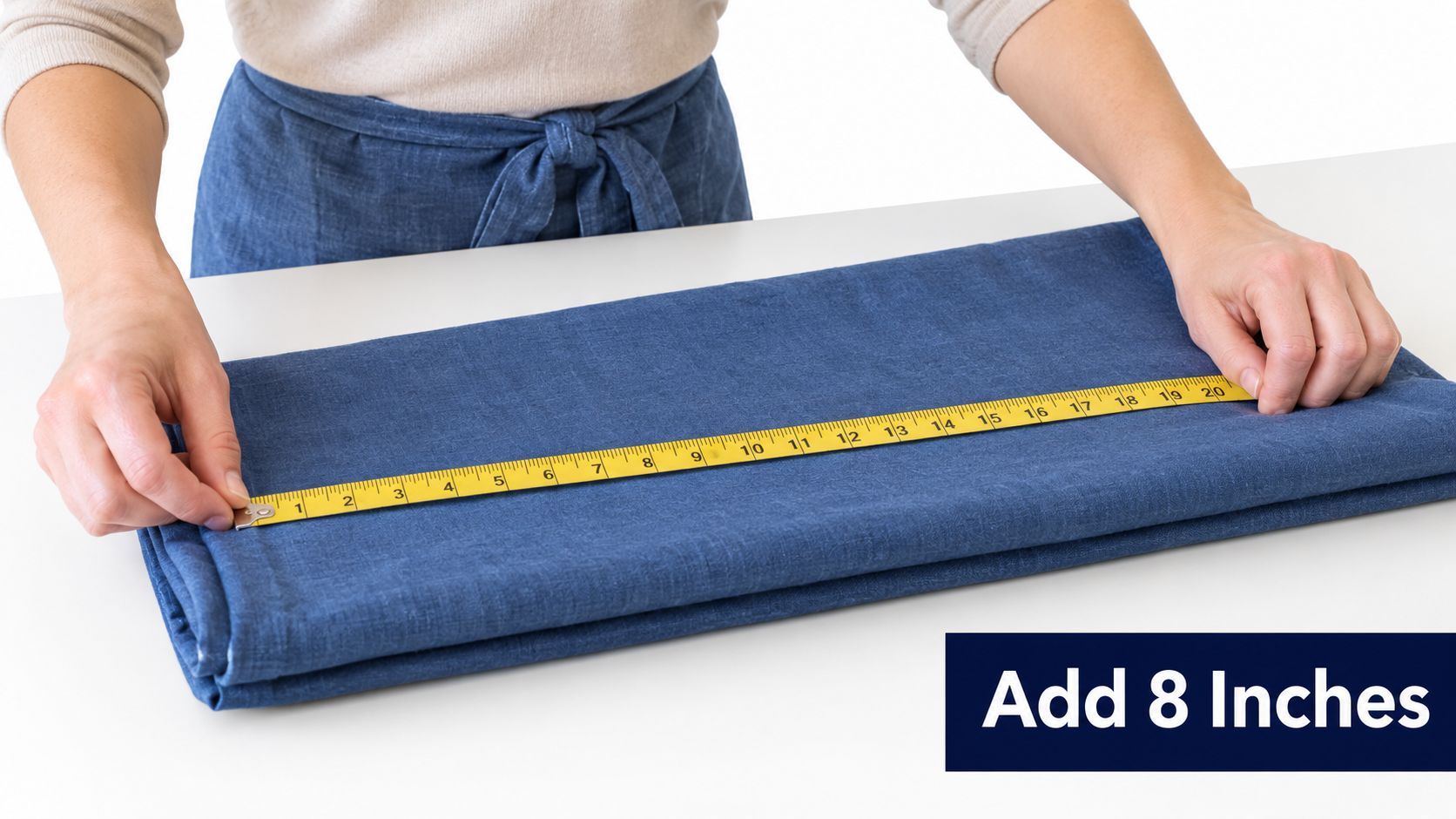
A common rule is 4 inches of extra backing on every side, which makes the backing 8 inches larger in both width and length than the finished quilt top. Some longarm quilters request 4 to 5 inches per side, so always check the requirements of the person or studio quilting your project. The longarm backing allowance guide covers this common frame requirement.
The allowance gives the quilter material to attach and tension on the frame. It also leaves room for the backing to shift slightly during quilting without exposing the quilt top.
Account for fabric preparation
Prewashing can change the final working dimensions. If you prewash the quilt top, prewash the backing as well so the layers respond more consistently. The fabric preshrinking guide offers preparation advice before cutting.
Modern calculators may include a 10 percent waste allowance, while others provide a bare minimum and leave the decision to you. That difference matters when fabric will be squared up, when the cut lands between purchase increments, or when the material has a loose or uneven weave.
Decide how much extra to buy
Use this simple decision guide:
- Basic quilting cotton: Follow the chart, then round up according to the shop's cutting increment.
- Prewashed fabric: Include the calculator's shrinkage or waste setting when available.
- Flannel or Minky: Allow more flexibility because the surface and handling can make accurate squaring more demanding.
- Heavily quilted projects: Confirm the longarm allowance and avoid buying the bare minimum.
- Directional prints: Add planning room if pattern matching or orientation will limit the cutting layout.
A quarter yard can prevent a stressful shortage when the calculated amount lands just below the next purchase increment. For hands-on measuring and frame questions, quilters can bring their project details to Our Springfield, Tennessee showroom.
Choosing the Most Efficient Backing Width for Your Project
The lowest price per yard isn't automatically the lowest project cost. A standard fabric may have a lower yard price but require several panels, additional seams, more pressing, and more cutting. A wide-back may cost more per yard while using far fewer total yards.
Compare the full decision
| Your priority | A practical starting choice |
|---|---|
| Use fabric already in your Stash | 44-inch cotton, pieced carefully |
| Keep seams to a minimum | 108-inch wide-back |
| Cover a very large bed quilt | Check 120-inch backing |
| Preserve a directional design | The width that keeps the print upright |
| Reduce cutting and pressing | Wide-back fabric |
| Coordinate a scrappy quilt | Standard cotton panels or a planned pieced back |
Stash Builders may choose standard cotton when they already own enough yardage or want to use Remnants. In that case, seam placement becomes part of the design. A planned center seam, a contrasting strip, or a simple panel arrangement can make the piecing look intentional.
Precut enthusiasts often have a strong sense of color and motif from Jelly Rolls, Fat Quarters, Charm Packs, and Layer Cakes. A 108-inch backing can preserve that coordinated look without asking the quilter to assemble several unrelated yardage cuts. Pair the backing with Riley Blake Designs fabrics when you want a coordinated collection approach.
Match the backing to the quilting plan
Professional Longarmers and studio owners often value efficient loading and predictable seam placement. A broad backing can simplify preparation, but the fabric still needs to be squared and large enough for the specific frame requirements.
Brand and fabric behavior matter, too. Compare Robert Kaufman fabrics, Cloud9 fabrics, and Hobbs batting as separate parts of the project plan. The backing, Batting, and quilt top should work together in weight, Loft, and quilting density.
The efficient choice balances total fabric, seam work, print direction, and quilter requirements, not price per yard alone.
Quick Reference Tools and Related Resources
A simple worksheet keeps the backing plan with the quilt. Record the finished top size, backing size, fabric width, panel count, seam direction, and required overhang. If the quilt waits between piecing and quilting, these notes prevent a second round of measuring.
Printable quick-lookup checklist
- Measure: Record the finished quilt top after attaching the borders.
- Add allowance: Use the longarm requirement supplied by your quilter.
- Check width: Identify whether the fabric is standard cotton, 108-inch, or 120-inch wide-back.
- Plan panels: Decide whether one broad cut covers the backing or panels must be joined.
- Allow for seams: Use the larger allowance required for backing seams, rather than the allowance used for block piecing.
- Round carefully: Follow the calculator's eighth-yard or quarter-yard increment.
- Prepare the layers: Match the backing with suitable Batting, Loft, Scrim, and needle-punched cotton options.
- Protect the edges: Keep the Selvage out of finished backing seams, then square the fabric before loading.
A quick width check can prevent waste. A 108-inch or 120-inch wide-back may reduce the number of seams, while standard cotton can work well when the quilt dimensions fit planned panels. The lower seam count is helpful, but confirm the print direction and the overhang required by your longarm quilter.
For a pieced back, support the fabric on a large table while sewing and pressing the long seams. Keep the seam direction and finished dimensions on the worksheet so rounding does not hide a shortage.
If you are comparing wide-back choices, Color Waves 108-inch Supreme Backings provide one example of a broad fabric option. The Springfield, Tennessee showroom also offers a place to compare fabric width, feel the backing texture, and discuss the amount needed before cutting. Bring the finished top measurements and longarm requirements.
The Fabric Company offers quilt backings, 108-inch wide fabrics, Batting, Precuts, sewing equipment, and quilting supplies for projects of many sizes. Shop our latest Quilt Backings collection here, then visit The Fabric Company online or in Our Springfield, Tennessee showroom to gather materials for your next quilt back. Join The Weekly Thread for more tips and 10% off your first order.