

You're standing in front of a wall of beautiful solid colors, ready to start a quilt tonight, but the thought of measuring and cutting yardage slows you down. Kona fat quarter bundles solve that first hurdle with coordinated Robert Kaufman Kona Cotton Solids, already cut into project-friendly precuts. A typical 12-piece bundle contains about 3 yards of fabric in total, making it useful for stash builders, precut fans, and gift-driven beginners who want a clear place to begin. This stash-building guide offers another helpful way to think about coordinated fabric purchases.
Why Kona Fat Quarter Bundles Belong in Every Stash
The best part of opening a bundle is the immediate sense of direction. Instead of pulling bolts from the shelf, checking each selvage, and wondering whether two shades will fight once they're stitched together, you can spread the precuts across your cutting table and start arranging a palette.
Robert Kaufman Kona Cotton Solids were introduced in 1984 as a solid-color counterpart to the company's Kona prints. The original palette began with a dozen colors, developed in response to demand for solid quilting cottons and aimed at the mid-1980s sportswear market. By the time of a 2014 Kona lookbook, the line had reached 271 SKUs, with 32 new colors planned to bring the total to 303 colors. The same lookbook included a 32-piece fat quarter bundle among its precut offerings. Robert Kaufman's Kona Cotton lookbook documents that early development.
Why precuts make starting easier
A bundle removes several small jobs that can keep a project in the planning stage:
- Less first-day cutting: The fabric is already divided into useful rectangles.
- A ready-made palette: The colors have been grouped for you, so you can move more quickly into block design.
- Flexible cutting: Each fat quarter can become patchwork squares, strips, appliqué pieces, or small sewing projects.
- A useful stash foundation: Leftovers remain large enough for future blocks, bindings, pouches, and other accessories.
A 12-piece set isn't automatically enough for every quilt. It may be ideal for a baby quilt or lap-sized project, while a larger design may need additional background fabric, borders, backing, and binding. That's why bundle shopping works best when you begin with the pattern's cutting requirements rather than the prettiest stack alone.
Practical rule: Treat a bundle as a coordinated starting palette, not as a complete quilt kit unless the listing or pattern says it includes every required material.
In our Springfield, Tennessee showroom, quilters often find it helpful to lay colors side by side before choosing a background. A warm white can soften bright solids, while a dark neutral can make them look sharper. Online photos are convenient, but true color can be difficult to judge on different screens, especially when you're matching a solid to fabric already in your stash.
What Makes Kona Cotton Different
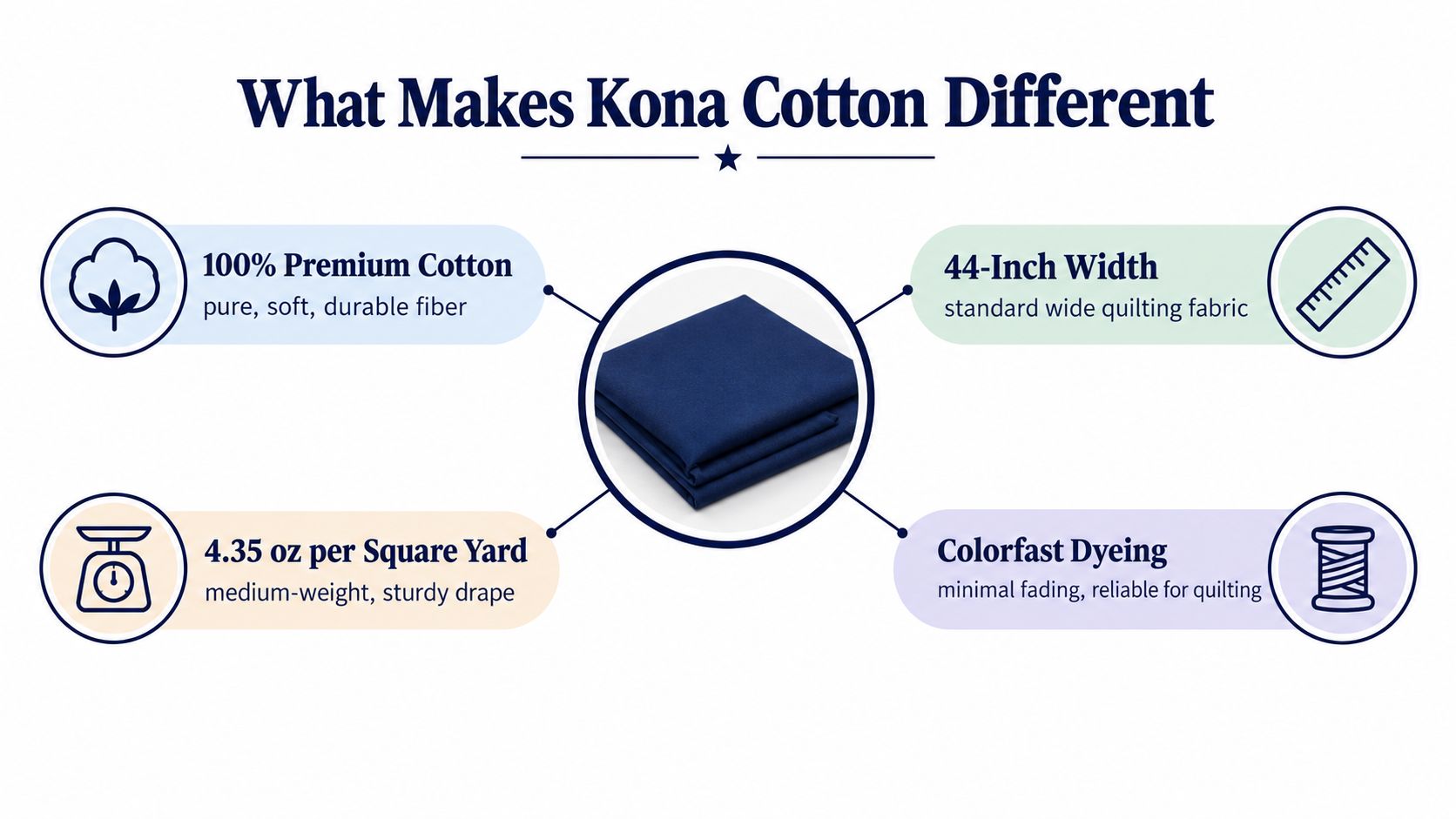
Kona Cotton has earned a lasting place in quilting because it gives makers a dependable solid fabric with a broad color vocabulary. The cloth is specified as 100% cotton, 44 inches wide, and about 4.35 ounces per square yard, according to the Robert Kaufman Kona Cotton fabric specification. In everyday quilting terms, that's a medium-light cotton with enough body for accurate piecing and predictable pressing.
That balance matters at the sewing machine. A fabric with a stable hand helps seams lie flat, supports clean points, and doesn't feel excessively bulky when several patchwork units meet. It also works comfortably with common quilting cotton techniques, including rotary cutting, quarter-inch seams, starching, pressing, and machine quilting.
A color library for quilt design
By the 2020s, independent fabric references described Kona Cotton as one of the largest ranges of cotton solids, with 365 colors in the full line. Those references place the fabric weight at about 4.3 to 4.5 ounces per square yard, or roughly 147.5 to 152.5 GSM. Sewfinity's Kona milestone discussion explains why the wide, matched range makes coordinated precuts useful.
Think of Kona as a paint swatch library for quilting cottons. A rainbow bundle gives you many directions at once. A named palette narrows those directions into a mood, such as citrus, pool blues, peacock tones, or deep midnight shades. Either way, the fabric gives solids a role beyond background duty. You can use value changes, contrast, and neighboring hues to create movement without relying on printed motifs.
That consistency also helps when you return to a project later. A solid from your original stack can become a binding, replacement piece, or coordinating block when the color name and manufacturer are known. It's still wise to keep a labeled scrap or selvage note, since screen color and dye lots can vary.
For more guidance on selecting a dependable quilting cotton, see this overview of cotton fabric for quilting. In our Springfield, Tennessee showroom, you can compare the weave, hand, and shade under the same lighting before committing to a full project palette.
Fat Quarter Sizes and Cutting Yield Explained
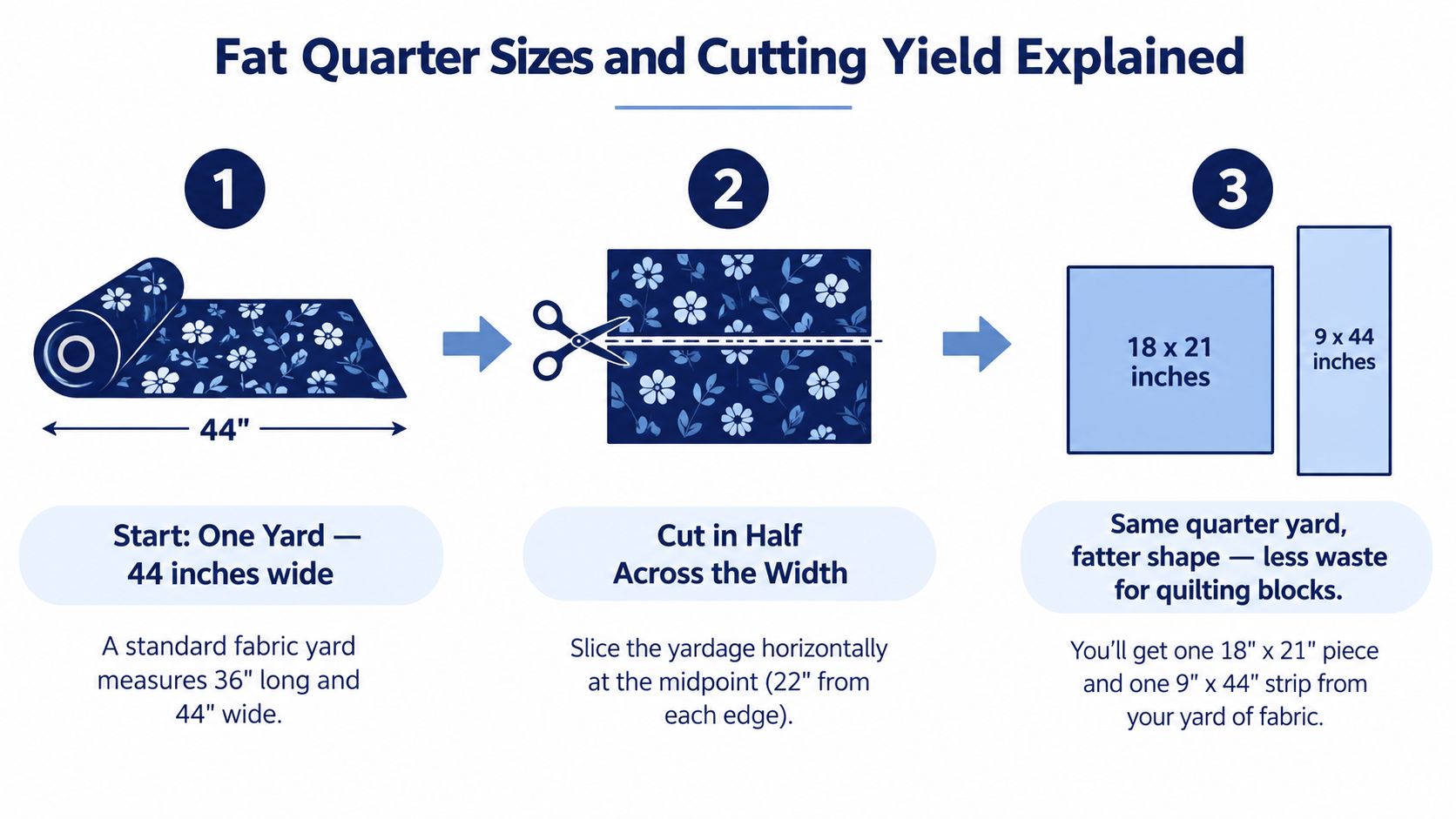
A fat quarter is about 18 x 21 inches, as explained in this fat quarter precut guide. The shape comes from dividing a yard of fabric differently than a traditional quarter-yard cut. Instead of receiving a narrow strip measuring about 9 x 44 or 45 inches, you get a wider rectangle.
A useful comparison is a narrow pizza slice beside a broad slice with the same amount of topping. The quantity is similar, but the wider shape gives you more freedom to place quilt units, directional motifs, and larger shapes. That's why fat quarters are so popular for patchwork.
What one piece can do
The exact yield depends on the pattern, seam allowance, grain placement, and whether the fabric is prewashed. A single fat quarter may provide:
- Patchwork squares: Useful for traditional blocks, four-patches, and alternating units.
- Half-square triangle pieces: A practical choice when the block uses smaller paired units.
- Short strips: Handy for strip piecing, sashing accents, bindings on small projects, or improv work.
- Larger motifs: The broad rectangle gives you more room to center a directional design.
- Small sewn goods: Pouches, placemats, coasters, and accessories often use the remaining pieces efficiently.
Before cutting, check the usable area between the selvages and remove any uneven edge. Keep the grain straight on the cutting mat, then cut the largest pieces first. Smaller units can come from the remaining sections, and the leftover selvage-side strips can become leaders, labels, or scrap-bin material.
Bundle counts vary widely. Common sets range from 6 to 42 pieces, with shops and guides frequently listing sets of 18, 20, 30, and 42 fat quarters. This fat quarter bundle guide outlines that range.
A 12-piece bundle listed at 18 x 22 inches per piece adds up to about 3 yards of fabric. That total is useful for planning, but it doesn't mean every inch will become a finished block. Seams, trimming, directional layouts, and cutting mistakes reduce practical yield. For a precise project, follow the pattern's requirements and keep a little flexibility for matching.
Watch the cutting demonstration here:
You can also review fat quarter sizes and cutting considerations before choosing a pattern.
How to Choose Coordinating Kona Bundles
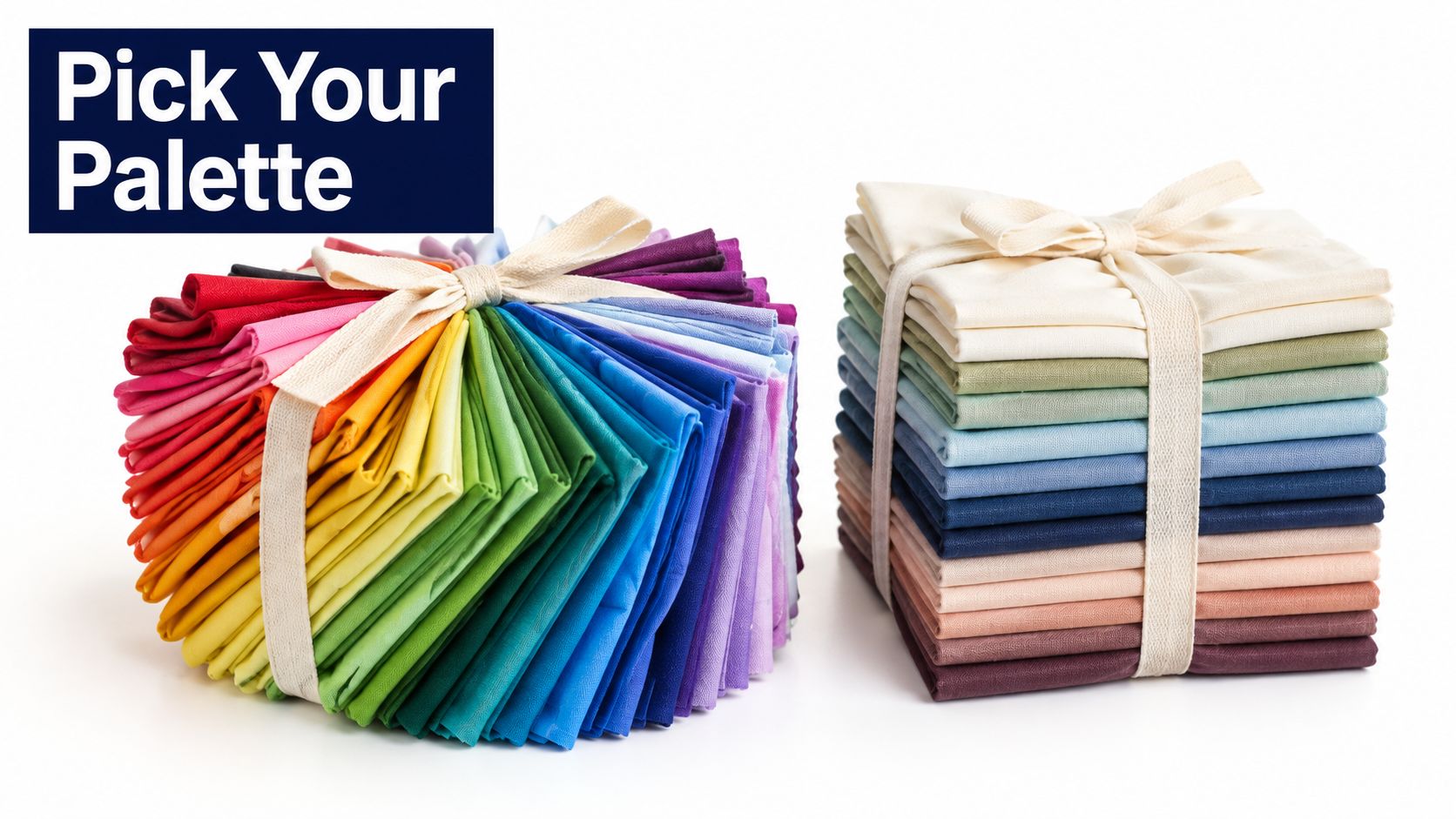
The bundle that catches your eye isn't always the bundle that fits your project. Most shoppers encounter two broad choices: rainbow assortments, which offer a wide spread of hues, and curated palettes, which group colors around a defined mood.
Rainbow sets are useful when you want maximum variety. They suit scrap-style quilts, color studies, children's projects, and a stash that needs more range. Curated sets, such as Citrus Fruit, Pool Party, Midnight Oasis, Birds of Paradise, and Peacock, make a different promise. They give you a tighter relationship between shades, which can be valuable when solids carry the visual structure that prints normally provide.
Rainbow or curated palette
Use this quick comparison:
| Choose a rainbow assortment | Choose a named palette |
|---|---|
| You want many contrasting hues | You want a defined project mood |
| You're building a flexible stash | You're making a gift with a clear color story |
| You enjoy arranging your own combinations | You want less decision-making |
| You expect to mix in scraps | You want shades that already relate |
Large precuts may include duplicate colors, so read the listing carefully before assuming every piece is unique. The Kona lookbook also notes that some precuts contain duplicates, which makes bundle contents important to verify before you plan exact block counts. Curated fat quarter sets for color matching offers a useful perspective on palette-based buying.
A simple cart checklist
Ask yourself:
- What is the project mood? Cool shades can create a calm throw, while bright colors can energize a child's quilt.
- Do I need contrast or harmony? A low-volume or dark background may be necessary to separate similar values.
- Are there duplicates? Count unique colors if each block needs a different shade.
- What prints are already in my stash? Solids can support a feature print instead of competing with it.
- Can I inspect the color? Online photos help, but our Springfield, Tennessee showroom lets you see the fabric in person.
Solids also suit modern quilting, fabric mixing, and slow-fashion sewing because the fabric doesn't dictate a motif. You can pair a Kona palette with a print from your stash, use one shade for an apron panel, or build a garment around a carefully balanced group of colors.
Ideal Projects and Simple Care for Your Bundles
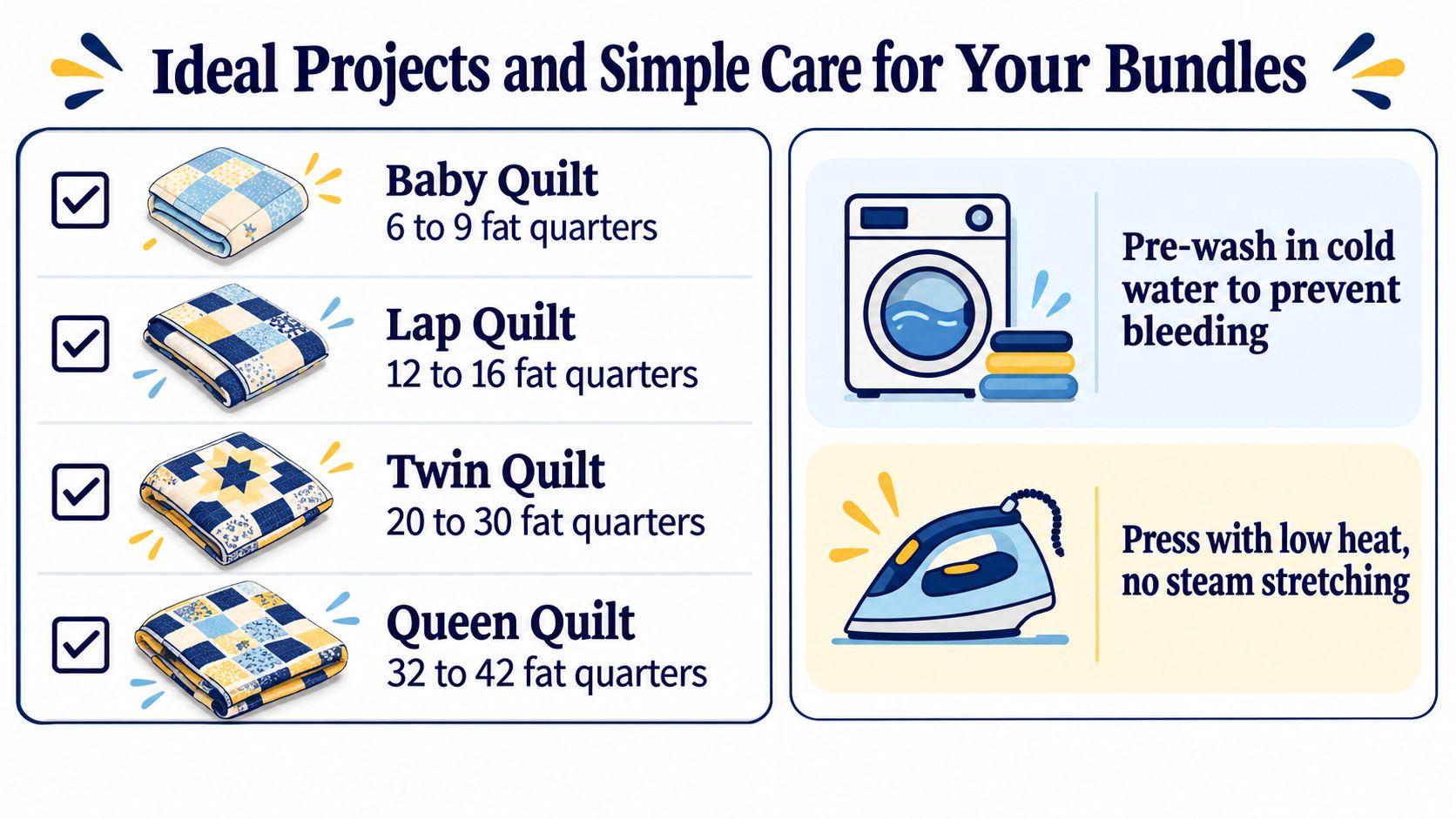
A bundle becomes easier to shop for once you connect the piece count to a project size. One quilting guide estimates 6 to 9 fat quarters for a baby quilt, 12 to 16 for a lap quilt, 20 to 30 for a twin quilt, and 32 to 42 for a queen quilt. This fat quarter project guide provides those planning ranges.
Those figures are starting points, not guarantees. Block size, sashing, borders, background fabric, and the pattern's cutting layout all change the requirement. A pattern that uses large units may consume fabric differently from one built with small half-square triangles.
Three approachable ways to use a bundle
Patchwork baby quilt: Choose a smaller coordinated set, add a background, and use the solids in a repeating block. Extra trimmings can become a label or small matching accessory.
Quilted placemats or a table runner: This is a good way to practice straight seams, pressing, batting placement, and binding without committing to a bed-sized quilt. Alternate bright and quiet shades to create rhythm across the table.
Aprons and zip pouches: Modern slow-fashion sewists can turn larger remnants into simple accessories. A solid palette makes coordinating pockets, straps, and panels straightforward, especially when you want a handmade gift that doesn't look randomly assembled.
Keep the colors and cloth in good shape
Prewashing is a personal choice, but it can help you see how the cotton behaves and reduce surprises from shrinkage or bleeding, particularly with highly saturated solids. If you prewash, handle the pieces consistently and press them before cutting.
Store the bundle folded so you can see the color stack at a glance. Keep it away from direct sunlight, which can alter fabric shades over time. Save the selvage or a labeled swatch if you expect to buy a matching color later.
Before cutting: Add the batting, thread, ruler, rotary blade, and binding plan to your project list. A beautiful bundle still needs the right loft and finishing supplies to become a usable quilt.
For finishing, match the batting's loft to the quilting style and desired drape. Needle-punched cotton with a stable scrim can give a traditional hand, while a lighter loft may suit close machine quilting. In our Springfield, Tennessee showroom, you can compare batting packages and rolls alongside your fabric rather than guessing at the finished feel.
Bundle Value Versus Buying by the Yard
The money question has two parts. First, how much fabric are you receiving? Second, how much of that fabric matches the project you want to sew?
A 12-piece Kona fat quarter bundle is typically listed as 18 x 22 inches per piece, totaling about 3 yards. Similar marketplace bundles range from about $40 to $52, so the simple bundle price works out to roughly $13.33 to $17.33 per total yard, before shipping or other local purchasing differences. The bundle listing and price range are documented on this 12-piece Kona bundle page.
That calculation is useful, but it isn't the whole value story. You're also paying for coordinated color selection, precutting, and the ability to use many shades without buying a full yard of every color.
Kona fat quarter bundle value at a glance
| Bundle Size | Approx. Total Yardage | Typical Price Range | Best For |
|---|---|---|---|
| 6 fat quarters | About 1.5 yards | Varies by seller and palette | Small accessories and test projects |
| 12 fat quarters | About 3 yards | About $40 to $52 | Baby quilts, lap projects, and stash building |
| 18 to 20 fat quarters | Varies by cut size | Varies by seller and palette | Larger patchwork tops and gift projects |
| 30 fat quarters | Varies by cut size | Varies by seller and palette | Twin-scale planning and broad color stories |
| 42 fat quarters | Varies by cut size | Varies by seller and palette | Large quilts or a substantial solid stash |
The smaller rows use approximate yardage relationships for planning, not a promise that every seller cuts the same dimensions. Always check the product listing.
When yardage is the smarter choice
Bundles usually make sense when you want variety, coordinated shades, and quick access to many colors. They can also reduce the temptation to buy full yardage of colors that will only appear in a few blocks.
Buying by the yard is often better for a large background, borders, binding, garment panels, or a backing where you need continuous length. It also makes sense when the pattern calls for one exact shade throughout, or when you already own most of the palette and only need a specific color.
For a complete project plan, pair the precuts with the correct batting and a 108-inch quilt backing when the finished size calls for it. A batting roll can also be efficient for makers finishing several quilts, but check the pattern's loft and quilting recommendations before purchasing. Cotton fabric by the yard is a useful reference when you're comparing continuous yardage with precut options.
Start Your Next Project With Kona
The hardest part of many quilts is choosing colors before the first cut. Kona fat quarter bundles move that decision to the easiest part because the shades arrive already grouped into a workable palette.
Choose a rainbow set if you want creative freedom across several future projects. Choose a named palette if you have a specific mood, recipient, or feature print in mind. Then check the pattern, count the required pieces, and leave room for background fabric, batting, backing, and binding.
Browse online or visit Our Springfield, Tennessee showroom to compare Kona colors in person. Bring a swatch from your stash if you're matching a border or background, and don't be afraid to rearrange the stack on the cutting table before you decide.
What You'll Need:
- Precuts: A Kona fat quarter bundle or other Precuts for coordinated patchwork.
- Batting: The right Batting loft for your quilting method and desired drape.
- Backing: A suitable 108-inch quilt backing when the quilt size calls for wide fabric.
- Cutting tools: A rotary cutter, acrylic ruler, cutting mat, and fresh blade.
- Finishing supplies: Thread, needles, binding fabric, and a dependable iron.
Start with one bundle, make a manageable project, and save the useful remnants in your stash. That first finished block will tell you more about your preferred palette and cutting style than another hour of scrolling.
The Fabric Company offers Kona fat quarter bundles, other precuts, batting, 108-inch backings, and sewing supplies for planning a project from first cut through binding. Visit The Fabric Company to shop the latest Precuts collection, or stop by Our Springfield, Tennessee showroom to see color and fabric hand in person. Join The Weekly Thread for more quilting tips and 10% off your first order.