

You're probably here because you need a blanket that feels thoughtful, but you don't want to get stuck in a complicated project. That's exactly where fleece fabric blanket kits shine. They're approachable, gift-friendly, and much easier to choose once you understand one key difference: no-sew kits are built for speed, while sewn kits are built for a more finished edge and longer wear.
Why Fleece Fabric Blanket Kits Are Perfect for Every Quilter
A common sewing moment goes like this. A baby shower is next week, a college student needs a dorm throw, or a holiday gift still isn't handled. You want something handmade, but you don't want to start a full quilt top, choose batting, piece backing, and hope you finish in time.
That's why fleece blanket kits have stayed popular. They're a well-established craft category that usually include two pre-cut fleece layers plus instructions or templates for tying or fringe assembly, which makes them much more beginner-friendly than a sewing-intensive project according to this fleece blanket kit market overview. That same analysis says no-sew fleece kits represented 20 to 24% of baby blanket kit sales volume and were growing 8 to 10% annually, with their appeal tied to completion times under an hour in that category, which helps explain why so many gift-driven beginners reach for them first.
Why they feel less intimidating
Fleece doesn't ask much from you at the start. It's soft, forgiving, and usually doesn't behave like a slippery fabric that shifts all over the table. Many kits are designed so you can open the package and get moving without learning piecing, pressing, or binding first.
That matters if you're new to making gifts.
- Fast payoff: You can see progress almost right away.
- Simple construction: Tied fringe or basic stitching is easier to learn than patchwork.
- Useful result: A blanket gets used, washed, folded on a couch, or packed in a car.
- Flexible style: It can feel playful, cozy, polished, or practical depending on the fabric and finish.
A fleece blanket kit gives beginners a rare win. The project looks homemade in the best way, not homemade in the stressful way.
If you're comparing comfort styles for adults, it can also help to look beyond standard throws. Some readers who want extra coverage may also like this guide to a stylish adult blanket with sleeves, especially when they're choosing between lounge use and traditional gift blankets.
For local makers, Our Springfield, Tennessee showroom can be helpful when you want to feel fleece in person and compare weight, drape, and softness before starting.
Understanding No-Sew Versus Sewn Fleece Blanket Kits
You open a fleece blanket kit for a weekend gift project, and the first real decision is not the print. It is the build. Some kits are made by cutting fringe and tying layers together. Others ask you to sew the edges for a cleaner border.
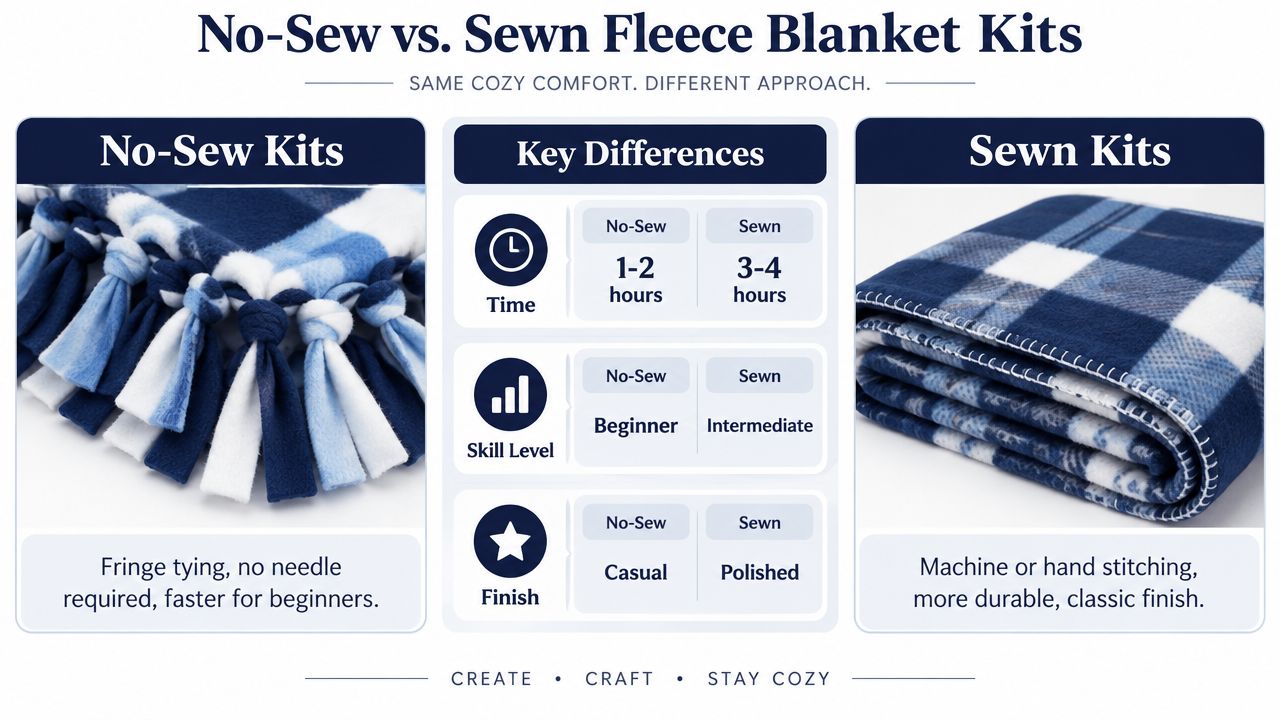
That difference shapes almost everything else. It affects how long the project takes, how polished the blanket looks, and how much blanket you lose at the edges. Beginners often miss that last point. A tied blanket uses up fabric in the fringe, while a sewn blanket keeps more of its finished size because the edge is folded and stitched rather than cut into strips.
What no-sew kits actually are
A no-sew fleece kit usually includes two fleece layers that are joined with fringe knots instead of stitching. Many retail kits follow this familiar format, including common throw-size options shown in this no-sew fleece throw kit overview.
No-sew works well for makers who want a project that feels approachable on day one. You do not need a machine. You do need patience with measuring and cutting, because uneven fringe can make the border look wavy or pull the blanket out of shape.
Choose a no-sew kit if you want:
- Simple setup
- A kid-friendly or group-friendly activity
- A fast gift
- A forgiving first project
A helpful way to picture it is this: no-sew kits trade precision sewing for careful cutting and tying. The skills are different, not lesser.
What sewn kits change
Sewn fleece kits ask for more tools and a bit more control, but they usually give you a more refined result. Many fleece blanket products use anti-pill polyester fleece and finished edge treatments that are designed for repeated washing, as described in this fleece blanket product reference.
In practical terms, sewing changes two things beginners notice right away. The edge looks flatter. The blanket often drapes better because it does not have a fringe border adding bulk all the way around.
That can matter if the blanket is meant for a bed, a nursery chair, or a gift that you want to look a little more polished than crafty.
No-Sew vs. Sewn Fleece Blanket Kits Comparison
| Attribute | No-Sew Kits | Sewn Kits |
|---|---|---|
| Assembly method | Tied or fringed edges | Machine or hand-stitched edges |
| Tools needed | Scissors, ruler, flat surface | Sewing machine or needle, thread, cutting tools |
| Best for | First-time makers, group crafts, quick gifts | Makers who want a neater finish |
| Look | Casual and cozy | More tailored and classic |
| Edge durability | Depends on knot quality and fringe wear | Usually stronger with finished seams |
| Learning curve | Lower | Slightly higher |
The sizing difference beginners often overlook
Here is the part that clears up a lot of shopping confusion. Two kits can start with similar fabric measurements and still finish at different usable sizes.
With a no-sew blanket, the outer border is cut into fringe before it is tied. That means part of the fabric becomes the closure. If you want a blanket with fuller coverage, no-sew kits can feel a little smaller than the package suggests once the fringe is finished.
With a sewn blanket, more of the fabric stays in the body of the blanket. The seam allowance takes a little space, but not as much as a wide tied fringe. For someone choosing between a lap throw and a true wrap-up-on-the-couch blanket, that difference is worth paying attention to.
Practical rule: Choose no-sew for ease and speed. Choose sewn if finished size, cleaner edges, and a more furniture-ready look matter more.
Some readers who enjoy memory-based blanket projects may also like this guide to a DIY T-shirt blanket project, because it shows how construction choices change when the fabric itself carries personal meaning.
Which one should you pick
Choose no-sew if you want a relaxed project with a soft, casual finish and minimal tools.
Choose sewn if you want straighter edges, less bulk around the border, and a blanket that looks more like a finished home item.
Both can turn out beautifully. The better choice is the one that matches your comfort level, your tools, and the amount of finished coverage you want.
How to Choose the Right Fleece Blanket Kit Size and Quality
You find two fleece blanket kits with the same cheerful print family. One says no-sew throw. The other says sewn throw. Both sound close enough until you picture the finished blanket on an actual person, a toddler during story time, a teen in a dorm, or an adult trying to cover both shoulders and feet on the couch.
That is where many shoppers get stuck. Package labels often sound simple, but finished use is not always simple.
Start by matching the kit to the person, not the label
“Throw size” is a useful category, but it is not a promise that every throw will feel equally roomy. Earlier, we noted that no-sew kits can lose more usable coverage at the edges because part of the fabric becomes fringe. Sewn kits usually keep more of the blanket body intact.
A good way to choose is to picture how the blanket will be used:
- Baby or crib use: Smaller and lighter usually feels easier to wash, store, and handle.
- Lap blanket use: A standard throw often works well for reading chairs, wheelchairs, or office naps.
- Couch use: Check whether the blanket needs to cover only the legs or wrap around the body.
- Taller recipients: Extra length matters more than people expect, especially for no-sew kits.
If sizing terms still feel vague, comparing common fleece widths in a guide to fleece fabric by the yard can make kit dimensions easier to judge before you buy.
Use construction type as part of sizing
This is the part many beginners miss.
A no-sew kit and a sewn kit can begin with similar fabric cuts and still finish differently. A tied no-sew edge works like trimming bangs on a haircut. You are using part of the outer edge to create the finish, so the center area ends up a bit smaller. A sewn edge uses seam allowance instead, which usually takes away less visible blanket space.
That means a no-sew kit labeled for lap use may feel just right, while the same starting dimensions in a sewn kit may feel a little more generous. If the blanket is meant for true wrap-up comfort rather than decoration, it helps to size up sooner than you think.
Check fabric weight without getting buried in terminology
Quality starts with how the fleece feels in your hands, but product listings often describe that feel with technical terms. One common term is GSM, or grams per square meter. It refers to fabric weight.
For shoppers, the practical reading is straightforward:
- Lighter fleece feels easier to cut and tie, and it is often a friendly choice for children's blankets or first projects.
- Mid-weight fleece usually gives the best balance of softness, warmth, and manageable bulk.
- Heavier fleece feels plusher and warmer, but it can be bulkier at tied corners, folded seams, and stacked layers.
If you are unsure, mid-weight fleece is often the safest starting point. It behaves predictably and usually suits both no-sew and sewn kits.
Look for anti-pill fleece if the blanket will be used often
Pilling is the fuzzy surface wear that shows up after rubbing and washing. On a gift blanket, that can mean the difference between “still looks nice next winter” and “already looks tired.”
An anti-pill finish helps the fabric stay neater over time. This matters most for couch blankets, kids' blankets, and anything headed to a dorm or family room where it will be washed often. If two kits are close in price and one clearly lists anti-pill fleece, that detail is worth choosing.
A short checklist for confident kit selection
Before you buy, pause and run through these questions:
- Who is using it? A baby, child, teen, adult, or someone tall?
- How will it be used? Lap cover, decor throw, couch wrap, or gift blanket?
- Is it no-sew or sewn? This affects usable finished coverage.
- Does the fleece seem light, mid-weight, or heavy? Mid-weight is often easiest for beginners.
- Does the listing mention anti-pill fleece? Frequent-use blankets benefit from it.
- Will the edges look casual or more finished? Tied fringe and sewn borders create very different final looks.
A pretty print grabs attention first. The better kit choice comes from matching size, construction, and fabric quality to the person who will use the blanket.
Essential Tips for Beginners Starting Their First Fleece Blanket
Your first blanket usually goes best when you slow down before the first cut. Most beginner mistakes happen during setup, not finishing.
What you'll need
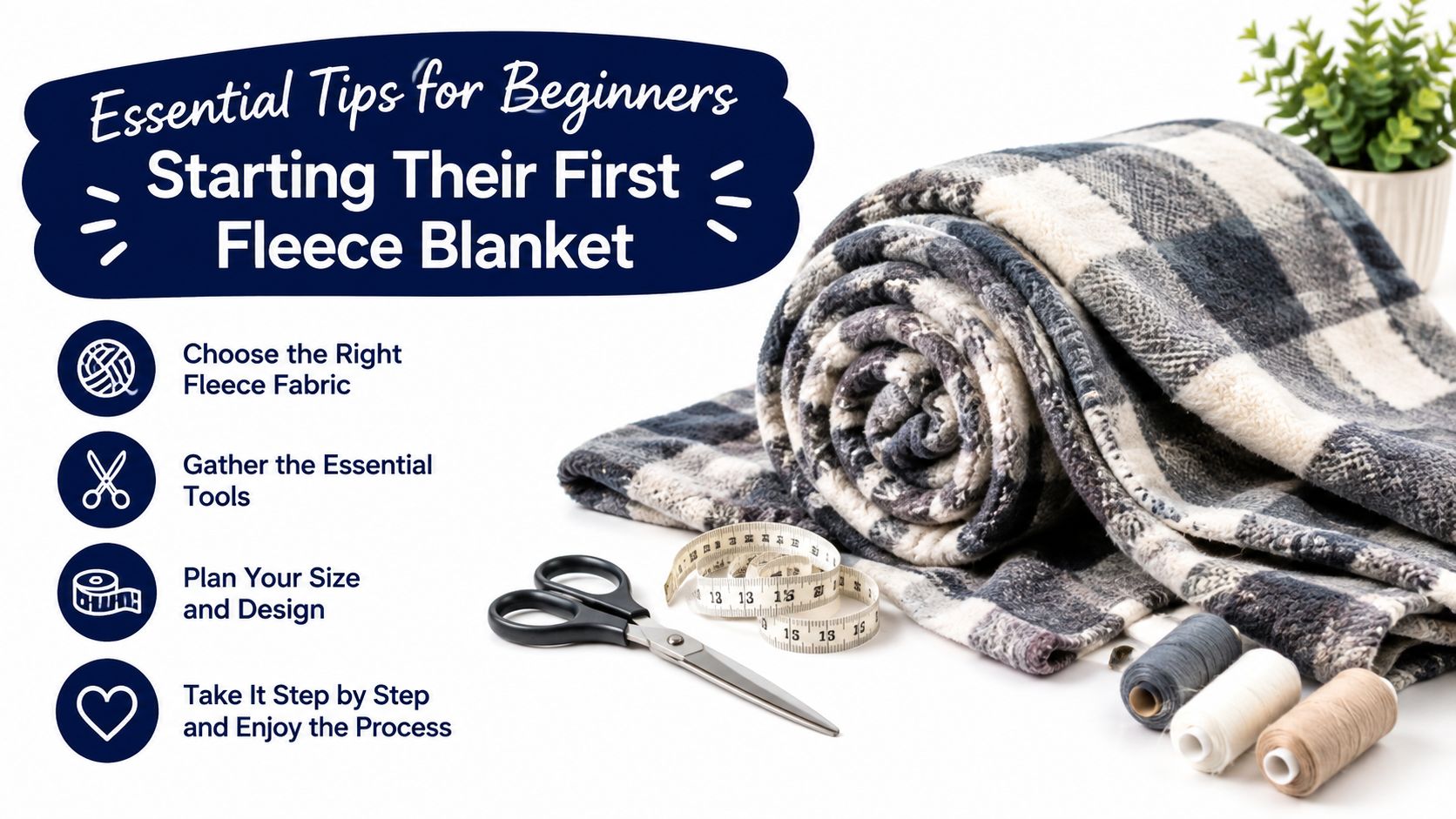
Fleece kits are simpler than quilt kits, but it still helps to gather tools first. For sewn projects, many beginner sewing setups include a rotary cutter, self-healing mat, acrylic ruler, thread, pins, batting, and backing fabric, with one guide recommending a cutting mat at least 18 inches by 24 inches for project handling, as outlined in this beginner quilt-kit supply guide.
For fleece blankets, your list is often shorter:
- Sharp cutting tools: A rotary cutter or fabric scissors
- A flat work surface: Enough room to smooth both layers
- A ruler or measuring guide: Helpful for even fringe
- Pins or clips: Useful if you're sewing
- Thread and machine: Only for sewn kits
If you're building your starter setup, this guide to sewing supplies for beginners can help you sort the must-haves from the nice-to-haves. One practical option is The Fabric Company, which carries fleece, batting, notions, sewing machines from PFAFF and SINGER, and related tools in one place.
Prep first, cut second
Fleece can shift less than quilting cotton, but it still needs careful setup.
- Smooth both layers fully: Ripples lead to uneven edges.
- Match the print direction: This matters more than beginners expect.
- Square the corners: It makes fringe or stitching much easier to keep consistent.
- Test your edge plan: Decide early if you're tying, folding, or sewing.
If a blanket looks uneven at the end, the cause is usually uneven cutting at the start.
A quick visual can help before you begin assembly:
Small moves that make the blanket look better
Beginners often think the difference between amateur and polished is talent. It usually isn't. It's consistency.
Try these habits:
- Cut fringe evenly if you're making a no-sew blanket. Uneven fringe stands out right away.
- Don't pull knots too hard. Tight knots can distort the edge.
- Use a walking pace, not a race pace. Fleece rewards patient cutting.
- Trim lint as you go so you can see your edges clearly.
If you decide to sew the edges, keep seam lines steady and avoid stretching the fleece while it feeds. A simple, calm process almost always beats a fast one.
Inspiring Gift Ideas and Seasonal Options for Fleece Blankets
You are standing in the fabric aisle in early December, trying to choose between a tied no-sew kit for a niece in middle school and a sewn lap blanket for a grandparent. Both could work. The better gift depends on how the blanket will be used, stored, and washed, not just which print looks cute on the bolt.
That is what makes fleece blanket kits such strong gift projects. They are simple enough for a busy season, but flexible enough to feel personal. A college student may want a throw in school colors for a dorm bed. A new parent may prefer a smaller blanket with a soft print that works in a stroller or nursery. Someone recovering from surgery may appreciate a lap-sized blanket that stays easy to fold and carry.
Match the gift to the person, then to the season
A helpful way to choose is to start with daily use.
- For babies and toddlers: Pick a smaller size that is easy for adults to wash and store. Soft prints and low-contrast colors often age well.
- For teens and college students: A throw size usually makes sense. It covers a chair, the end of a bed, or a movie-night spot without taking over a small room.
- For grandparents or anyone wanting comfort seating: Lap blankets are often more practical than full throws, especially if the blanket will live beside one favorite chair.
- For donation or community projects: Simple colors and straightforward finishes are often the easiest choice because they suit many recipients.
Season matters too, but it helps to treat it as the second decision, not the first. Spring gifts often feel lighter with clear colors or small-scale prints. Fall and winter can support deeper tones, plaid, forest prints, or holiday themes. If the recipient prefers a calm room, a solid fleece or subtle pattern usually lasts longer in the home than a novelty print.
Here is where the no-sew versus sewn choice becomes useful again. A no-sew kit often suits casual gifting, kids' projects, group crafting, and quick holiday makes. A sewn kit can feel a little more for keepsake gifts, especially when you want cleaner edges or a size that fits a bed, recliner, or wheelchair more precisely.
A memorable handmade blanket feels chosen for real life, not just chosen from a seasonal shelf.
If you are deciding between a fleece blanket and another soft handmade present, these quilted gift ideas for handmade occasions can help you compare which project best fits the person and the moment.
Our Springfield, Tennessee showroom can also help during gift planning, because seeing fleece colors and prints in person often makes size and style choices easier.
Care and Finishing Advice for Long-Lasting Fleece Blankets
A fleece blanket usually starts to show its future in the first few washes. A well-cut, well-finished blanket stays soft and keeps its shape. One that meets too much heat or rough friction can pill, stretch at the edges, or lose that plush feel people love.
The care plan depends a little on the kind of kit you chose. No-sew fleece blankets have tied or fringed edges, so they benefit from gentler washing and less tugging in the dryer. Sewn fleece blankets often have a more stable edge, which helps them hold their outline over time. That does not make sewn blankets harder to own. It means the finish works like a frame around a picture, while fringe works more like loose tassels that need lighter handling.
A simple routine goes a long way:
- Wash on a gentle cycle to reduce rubbing and surface fuzz.
- Use cool or low-temperature water if the fleece feels especially soft or lofty.
- Dry on low heat or air dry to help the fibers keep their texture.
- Skip heavy ironing unless a seam needs attention.
- Fold the blanket loosely for storage so the pile does not get crushed under heavier items.
Heat causes the most confusion for beginners. Fleece is forgiving in many ways, but it does not like high temperatures. If you need to flatten a seam, corner, or folded edge, read this guide on how to iron fleece fabric safely before putting an iron near your project.
Finishing choices also affect how the blanket ages. A no-sew kit with evenly cut fringe tends to wear better than one with narrow, uneven ties. A sewn kit with straight stitching and a clean edge usually resists curling and stretching better after repeat washing. If your main goal is easy care for a child, pet, or everyday couch blanket, that comparison can help you choose the right style before you ever make the first cut.
Small habits matter. Trim loose threads. Re-tie any fringe knots that loosen after washing. Shake out the blanket before folding it away.
If you're ready to make one, The Fabric Company offers fleece, batting, notions, machines, and project supplies that help you finish a blanket from first cut to final edge. Shop our latest batting collection here, and join The Weekly Thread for more tips and 10% off your first order.