

You're standing in the clearance aisle with a bundle in your hands, trying to decide if it's a real find or just a pretty pile of fabric. Fat quarter bundles clearance can be a smart buy, but only when you know how to judge the cut, the coordination, and the timing. In Our Springfield, Tennessee showroom, I see shoppers make the same mistake over and over, they focus on the markdown first and the bundle value second.
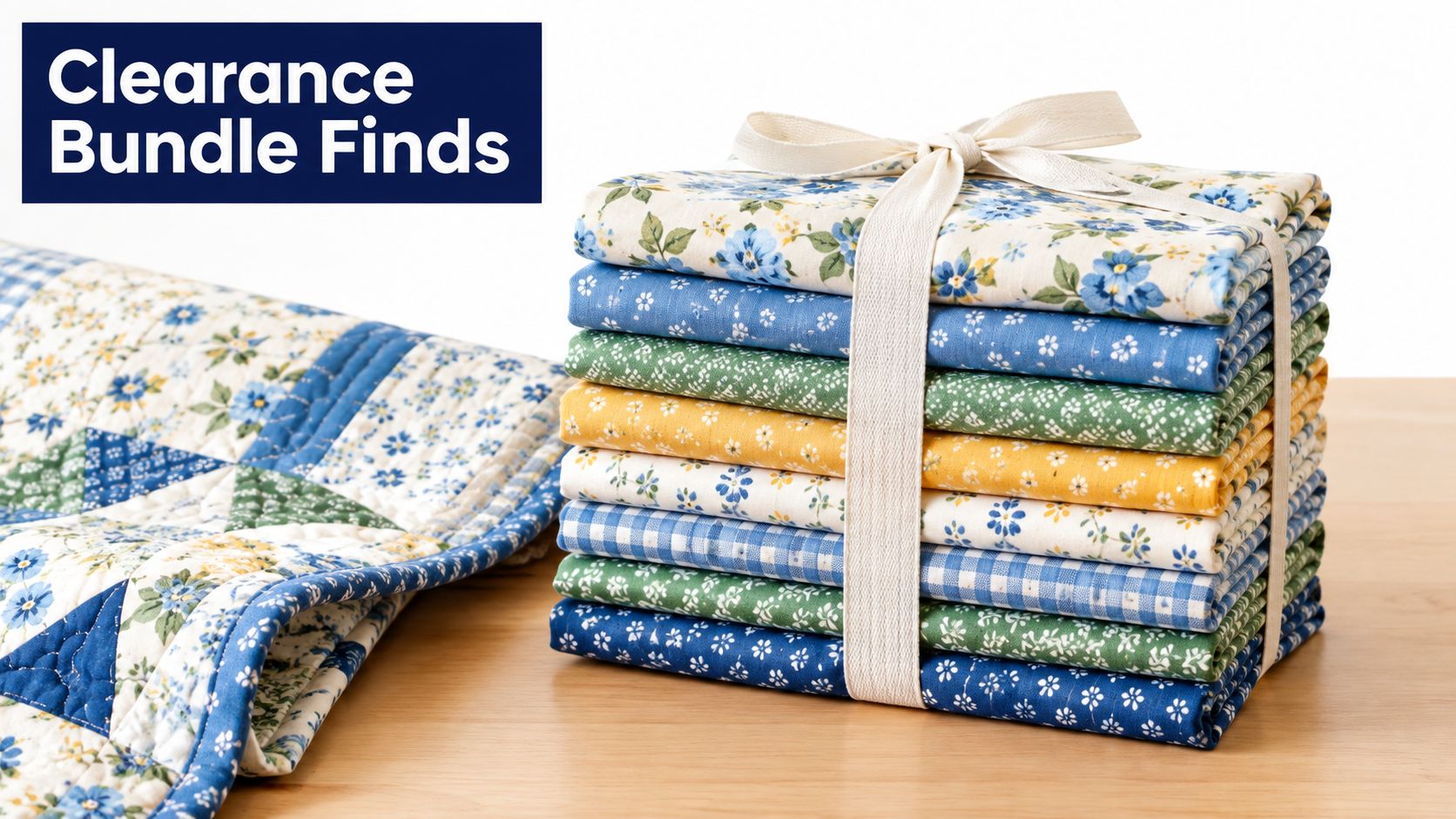
TL;DR: Clearance bundles are worth buying when the prints coordinate, the piece count fits your project, and the stock is low enough that waiting could mean losing the set. A good clearance buy gives you designer-curated fabric, less cutting time, and enough yardage to plan ahead without paying full bundle price.
Introduction to Fat Quarter Bundles Clearance Deals
A lot of quilters spot a clearance bundle and feel two things at once, excitement and doubt. That's normal. The pretty part is obvious, but the question is whether the bundle will help you finish a quilt, build your stash, or just sit there looking nice on a shelf.
A fat quarter is a specific quilting cut, and that matters before you judge the price. One major quilting guide describes fat quarters as the first specialty cut on the market and still the most common, which helps explain why retailers discount them as coordinated sets instead of breaking them into loose pieces Sew4Home. That coordination is part of the value, especially in precuts like Fat Quarters and other bundled groups such as Jelly Rolls.
I like to tell shoppers in Our Springfield, Tennessee showroom to ask one simple question first, “Would I still want this bundle if it were full price?” If the answer is yes, clearance usually makes the decision easier. If the answer is no, the discount may just be distracting you from a bundle that doesn't match your style.
Practical rule: Buy clearance for the prints, the coordination, and the project fit, not just the sticker savings.
You'll get the clearest read on value by understanding what the cut gives you, how bundle pricing works, and when stock moves too fast to wait. That's the path through the clutter, and it's a lot easier once the math stops feeling mysterious.
What a Fat Quarter Bundle Really Is and Why Quilters Love It
A fat quarter is not a regular quarter yard cut into a long strip. It usually comes from a half-yard folded and cut into a rectangle about 18 by 22 inches. A regular quarter yard measures about 9 by 44/45 inches Quilt Keeper Studio. The wider shape gives you a broader cutting window, more like poster board than a receipt strip, so blocks, appliqué pieces, and larger pattern shapes fit more comfortably.
The size makes the math easier
That extra width also explains why fat quarters suit variety-driven projects. You receive a manageable piece of fabric, yet can position templates in several directions instead of working within a narrow strip.
A useful planning shortcut is 1 yard for every 4 fat quarters. A 24-piece bundle therefore represents roughly 6 total yards Polka Dot Chair. Bundle counts commonly range from 6 to 42 pieces, so the amount of fabric can vary substantially by pack size Sew4Home. Check the piece count and dimensions before comparing a clearance bundle with yardage. A bundle's value may come from its coordinated selection, not only from its total fabric area.
For another clear explanation of the cut and how bundles are assembled, see this fat quarter bundle guide.
Why quilters keep buying them
Curation is the main appeal. A bundle supplies prints selected to work together, so you can begin cutting without pulling bolts across the shop to build a color story. That helps with Patchwork, Charm Packs, Layer Cakes, and stash building.
A fat quarter bundle saves time twice. You do not have to find the prints, and you do not have to guess whether they belong together.
The format also suits clearance shopping. If the colors fit a planned project, buying the coordinated group now can be more useful than waiting for a lower per-yard price and losing the assortment. If the prints do not suit your style, the same coordination has little value. Fat quarters remain popular because they balance usable cutting space, manageable quantities, and ready-made color direction.
How Clearance Pricing Works for Coordinated Bundles
Clearance pricing reflects inventory timing as much as shopper demand. Loose yardage helps a retailer move individual fabrics, while a bundle moves a coordinated group before a collection ages out or the assortment is separated. That difference explains why a bundle may cost more per piece than scrap yardage and still be the better purchase for a planned quilt.
Why the markdown looks the way it does
Retailers often discount the remaining set rather than split it apart. Keeping the prints together preserves the coordination shoppers are paying for. In major quilting retail channels, clearance pricing for fat quarter bundles commonly falls about 25% to 40% below regular price, with listings showing markdowns such as $58.99 to $29.99 and $51.99 to $14.99 Shabby Fabrics.
A large markdown can indicate end-of-line or overstock inventory. A smaller one may still offer better value when the colors suit your project and the collection is difficult to rebuild from individual cuts. The right question is not, “How low can the price go?” Ask whether waiting risks losing the coordinated assortment.
Here's why that category matters commercially: one 2026 industry report says pre-cut quilting fabric, including fat quarters and panels, accounts for 35% of sales in the quilting market. The report values that market at $8.7 billion in 2023 and projects a 5.2% CAGR through 2030 WorldMetrics. Those figures help explain why retailers protect bundle structure while rotating inventory.
How to compare bundle cost to yardage
Start with the fabric amount, then price the curation. Four fat quarters provide roughly the fabric area of one yard, but a bundle also gives you several selected prints in one purchase. That selection can save the time and uncertainty involved in rebuilding a color story from bolts.
Use this shopping filter:
- Estimate the yardage: Check the piece count and dimensions before comparing the bundle with yardage.
- Assess the coordination: Decide whether the colors, motifs, and scale fit a project you would sew.
- Review the markdown: A modest discount can be worthwhile when the bundle solves an immediate project.
- Consider inventory rotation: Clearance often marks a change in available stock, not a promise that the price will keep falling.
Discounted quilting cotton bundles show the same pricing logic in practice. Coordinated fabric can retain useful value after it moves into clearance.
Smart buyer note: If the bundle fits your next project, buying at a reasonable markdown may be wiser than waiting for a perfect one. Clearance shopping is a timing decision, not only a price comparison.
How to Evaluate Quality and Coordination Before You Buy
A clearance bundle can look appealing online yet disappoint once it arrives. Before buying, inspect the fabric details that determine how well it will sew and coordinate: hand feel, fiber content, weave, and the accuracy of the product images. Clearance reflects inventory rotation, so a lower price does not make weak fabric a useful purchase.
Start with tactile quality
For quilting, 100% cotton is usually the practical baseline. Check the listing for fiber content rather than assuming every colorful bundle contains quilting cotton. A fabric with a firm, even hand should hold its shape during cutting and piecing. If the description mentions a loose weave, unusually thin cloth, or fabric intended for another craft, pause before adding it to your cart.
The weave should look consistent across the piece. Uneven threads, excessive slubs, or a surface that feels fragile can create trouble with accurate seams and repeated washing. A soft hand can be pleasant, but softness alone does not prove durability. Use the fabric's stated content and weight alongside the photos and return information.
For a fuller explanation of fabric choices, consult this guide to best fabric for quilting, especially when comparing hand feel, weave, and project fit.
Check color accuracy in the photos
Product photography can shift a fabric's apparent color. Warm lighting may make cream look yellow, while cool lighting can push blues and greens toward gray. Compare multiple images when available, looking for a consistent background and for colors that remain stable from the folded bundle to individual fabric views.
Screen settings create another variable. If your project depends on a precise color relationship, contact the shop before ordering or request a cutting reference when that option exists. A clearance bundle can still be worthwhile if the palette is flexible. It deserves more caution when the exact shade must match fabric already in your stash.
Also inspect how much of each print is visible. Folded edges may hide scale, texture, or a large motif. Look for enough information to distinguish focal, supporting, and low-contrast prints, rather than judging the assortment by its brightest fabric alone.
Decide whether the timing suits the fabric
Use the quality check to separate a useful markdown from a false bargain. Buy now when the cotton feels sound, the colors are believable, and the bundle fills a project need. Wait when the description leaves fiber content unclear, the images show a strong color cast, or the fabric appears too fragile for the intended use.
A coordinated bundle earns value through selection and convenience, not only through a reduced per-yard cost. That curation can justify buying before inventory rotates away, provided the fabric itself meets your standards.
When to Shop and How to Catch the Best Clearance Drops
Clearance shopping works best as a timing decision. A bundle may remain available for weeks, then vanish when a shop rotates in new inventory. Retail clearance pages sometimes show “Only 1 unit left” or “Only 2 units left” beside fat quarter bundles, so waiting for a lower price can mean losing the collection entirely RubyJam.
Shop for rotation, not just discount depth
Buy while the print story still supports your project or stash. A guild quilt leader who bought half a collection on clearance may find the matching jelly-roll rolls sold out before the remaining members can reorder. That situation makes coordination, rather than the lowest possible price, the deciding factor.
Major fabric retailers maintain dedicated clearance pages and send regular markdown messages, reflecting faster inventory turnover. Fat Quarter Bundles Clearance shopping therefore rewards a different habit from ordinary sale browsing. Choose a bundle that fills a project need now when its colors, prints, and quantity work together. Wait when you have no plan for it or the curation does not justify the cost compared with buying fabric by the yard.
A simple routine keeps the decision practical:
- Check the clearance section often: New drops may disappear before you return.
- Use email alerts: The Weekly Thread can help you spot markdowns without checking every day.
- Visit in person when possible: Our Springfield, Tennessee showroom lets you judge color and scale before stock changes.
- Set a project trigger: Buy when a bundle matches a quilt you already intend to make.
- Check replacement needs: Exact continuity matters more if several people will sew from the same collection.
For a wider view of price changes, review the cotton quilting fabric sale page across categories. Buy now when the bundle's coordination saves planning time and the fabric suits a specific project. Wait when the set is merely tempting, because a markdown only creates value when you will use what you bring home.
Budget Friendly Projects That Stretch Every Clearance Bundle
A clearance bundle earns its keep when it becomes a finished project, not a stack of pretty prints. The easiest wins come from patterns that match the bundle's built-in coordination instead of asking the fabric to do extra work. If you have a 12- to 24-piece set, you already have enough variety to build something useful.
A 24-piece bundle can support a medium throw when you plan the blocks around the cuts you already have, so the question is less “How much did I save?” and more “What can this collection finish well?” That shift matters in clearance shopping. You are not just buying cheaper fabric. You are deciding whether the curation saves you time, cutting, and color matching.
Five project ideas that use the bundle well
- Scrappy patchwork quilt. This is the easiest match for a mixed bundle because variety is the point. Add remnants from your stash and let the prints carry the layout.
- Charm Pack style sampler. Cut fat quarters into small squares and build a sampler block layout that feels fresh. It works well when you want to mix bold prints with quieter ones.
- Layer Cake inspired quilt top. Fat quarters cut cleanly into larger squares and strips, which makes them a practical stand-in for bigger precuts. That keeps cutting efficient and limits waste.
- Quick gift quilt. A coordinated bundle is helpful when you need a present and already know the color story. You can start sewing sooner because the fabric choices are already sorted.
- Table runner or tote project. Smaller finishes let you use the strongest prints first and save leftovers for binding or pocket accents. They also help you test how the bundle reads in real use.
For beginners who want a clear starting point, the fat quarter projects for beginners guide pairs well with a clearance bundle because it keeps the scope realistic.
What You'll Need
- Precuts: Start with Fat Quarters or Precuts if you want matching prints that are already curated.
- Batting: Use Batting for the quilt's loft and finish, and if you need a flexible option, look at Hobbs batting for needle-punched cotton choices with scrim support.
- Backings: A 108-inch quilt backing saves piecing time on larger quilts.
- Machine and notions: If you're building a sewing setup, PFAFF machines and SINGER machines are both practical starting points for piecing and finishing.
Match the bundle to a pattern you can sew soon, then choose your backing and batting with the same color family in mind. That keeps the clearance buy tied to a real plan instead of a hopeful pile on the shelf.
Your Next Steps to Shop Smarter and Sew More
The smartest clearance buyers do three things well. They understand bundle math, they judge coordination before chasing price, and they move quickly when stock is low. That's the whole game with fat quarter bundles, because value lives in the mix, not just the markdown.
If you're building a stash on a budget, use the bundle as a planning tool. A good clearance find should support your next quilt, not complicate it. That's why I always tell shoppers to pair a bundle choice with a finishing plan, like a 108-inch backing and the right batting roll, so the purchase leads somewhere useful.
Our Springfield, Tennessee showroom is a good place to compare prints in person when you want to see how a color story reads outside a screen. If you shop online, keep an eye on clearance pages, look at low-stock warnings, and remember that replacement risk goes up fast with discontinued lines.
Clearance works best when it helps you say yes to a project you already want to make. A bundle that fits your palette, your time, and your budget is a better buy than a larger markdown on fabric you won't use.
The Fabric Company carries fat quarters, precuts, batting, 108-inch quilt backings, and sewing essentials that help you turn clearance finds into finished quilts. If you want to compare bundle options, check the current clearance fabric and visit The Fabric Company for fabric, tools, and finishing supplies that fit this topic.