

You have a pattern open, a cart full of pretty stacks, and about ten minutes before you either buy or talk yourself out of it. The photo looks coordinated. Your last bundle did not, once it sat on the cutting table in daylight.
Fabric bundles for sewing are sets of coordinated fabrics already cut to one standard size, so the package and the pattern can match before you cut. Read the piece count and the cut size, then check whether the values still separate in grayscale. That single habit stops most bad bundle buys.
Fabric Bundle Sizes and Yardage at a Glance
A bundle's cut size and piece count show how much fabric you have and how you can divide it. Use the table to compare common formats before buying.
| Bundle | Typical contents | Piece size | Approximate yardage |
|---|---|---|---|
| Jelly Roll | About 40 strips | 2.5 x 42-44 inches | About 2.75 yards |
| Layer Cake | About 42 squares | 10 x 10 inches | About 2.75 yards |
| Charm Pack | About 42 squares | 5 x 5 inches | About 0.7 yard |
| Fat Quarter | One piece | 18 x 21-22 inches | 1/4 yard |
| Fat Eighth | One piece | About 9 x 21 inches | 1/8 yard |
| 3-Yard Pack | Three 1-yard cuts | About 36 x 42-44 inches | About 3 yards |
How each row behaves on the table
Jelly Rolls and Layer Cakes contain roughly the same yardage in different shapes. A Jelly Roll has about 40 strips, each 2.5 by 42 to 44 inches. A Layer Cake has about 42 squares, each 10 by 10 inches. A typical 42-square bundle contains approximately 2.75 yards of fabric, roughly comparable to the material in a 2.5-inch strip bundle.
Charm Packs hold less fabric. About 42 squares at 5 by 5 inches add up to approximately 0.7 yard. That can suit a sampler block or pillow, while a larger project may call for additional fabric.
A Fat Quarter is one piece measuring about 18 by 21 or 18 by 22 inches. It has the same area as a quarter yard, but its wider shape gives you more options for subcutting. A Fat Eighth is about half that size, near 9 by 21 inches. Compare fat quarter dimensions and cutting options with the pattern's required pieces before choosing a bundle.
A 3-Yard Pack usually contains three 1-yard cuts, each about 36 inches along the cut and 42 to 44 inches across the width. Collections can divide those cuts in different ways.
Practical rule: Piece counts vary by collection. Use the package label, not the product photo, to confirm what is included.
Match the label's count and cut size to the table before planning your fabric use.
Which Projects Suit Each Bundle Type
The bundle's piece size must equal or exceed the pattern's unfinished unit size, after trimming and seam allowances. Trimming a 10-inch square or a 2.5-inch strip reduces its usable area, and selvages or pinked edges can further reduce yield, which is why the Fat Quarter Shop precut guide tells you to match the unfinished unit before you buy.
Write the pattern's unit size next to each bundle on your list. If the unit is larger than the piece, that bundle is the wrong tool.
Best project for each cut
- Jelly Rolls: Strip-pieced quilts, log cabin blocks, and binding. The 2.5-inch width is already cut, so you sew strips instead of squaring a bolt. A jelly roll explainer walks through that strip width if you are new to the format.
- Layer Cakes: Half-square triangle quilts and large patchwork. Bigger squares mean fewer seams, and you still have room to trim dog-ears.
- Charm Packs: Scrappy quilts, small block samplers, and pillow covers. Five-inch squares suit small blocks. They run out fast on anything wider than a lap.
- Fat Quarters: Quilt blocks, table runners, and bags. The wider shape beats a conventional quarter yard when a pocket or a block needs both length and width.
- Fat Eighths: Accent colors, short binding, and appliqué details. Small pieces add contrast without parking a full quarter in the stash.
- 3-Yard Packs: Aprons, summer dresses, and children's clothing. The yardage can cover garment pieces that precut squares cannot.
Say you are making a log cabin lap quilt. The unfinished logs are 2.5 inches. A Jelly Roll already is that width, so you lose only the selvage and a pinked edge. A Layer Cake can make the same block, but you will cut every log yourself and throw away more scraps.
Before you pay, run three checks. Count the pattern's pieces. Confirm the bundle's piece count covers that list. Subtract the area you will lose to selvages and trims. Duplicate prints do not count as extra designs. They count as less variety.
How to Choose a Bundle That Coordinates
The most common miss is buying from one product photo, then finding the prints clash in person. Screens flatten value. A floral and a dot can share a color name and still sit at the same gray, so the quilt looks muddy once it is pieced.
A 2025 quilter survey found that availability and quality ranked above price, while more than half of fabric and thread purchases still occurred in person, which is one reason the Today's Quilting Trends report still treats hands-on looking as part of a careful buy. Use the checks below when you cannot touch the cloth yet.
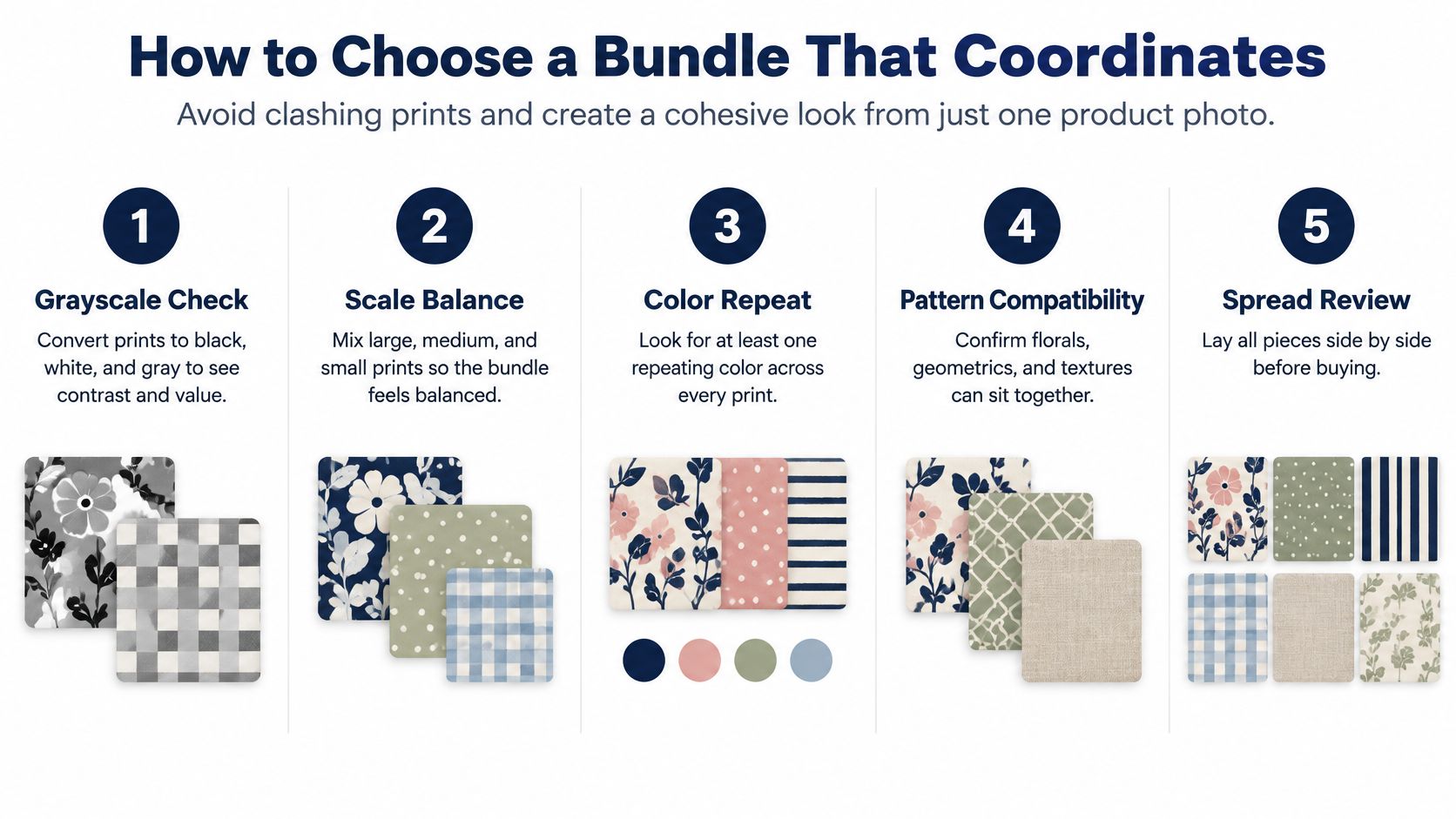
Seven checks before you add it to the cart
- Grayscale check. Convert the photo to black, white, and gray, and confirm each fabric has a clearly different light or dark value. Same value is why pretty bundles go flat.
- Color ratio. Look for a dominant color, a secondary color, and an accent, roughly 50, 30, and 20 percent. Equal amounts of six colors tend to shout.
- Print scale. Mix small, medium, and large prints so no single fabric takes over the block.
- Print direction. Directional prints need extra yardage when the motif has to stay upright, so read the pattern before you cut.
- Color accuracy. Set a normal screen brightness, view the photo in daylight, and compare it with a swatch when you have one. Phone night-mode shifts reds and navies.
- Collection or curated. A manufacturer collection, such as one from Riley Blake, Moda, Free Spirit, or Michael Miller, usually keeps scale and style consistent. A curated bundle often coordinates by color only, and the prints may not share a hand or a scale. These curated fat quarter sets for color matching are a clear example of color-first grouping.
- Weight. Quilting cotton suits quilts. Lighter cottons suit apparel. If the bundle might become a summer dress, read up on choosing breathable or moisture-wicking fabrics before you treat every cotton as the same cloth.
If the grays do not separate, the colors will not save the quilt.
Run all seven checks on one bundle before you buy. One pass takes less time than unpicking a clash.
Are Bundles Worth the Price Compared With Yardage
A bundle can look like a bargain until you divide its price by the cloth you can cut. In the 2017 Quilting in America survey, a dedicated quilter bought an average of 99 yards in the prior 12 months and spent $925, or about $9.34 per yard, according to the Craft Industry Alliance's survey coverage. Use that figure as a comparison point, not a promise that every bolt will cost the same.
Divide the bundle price by its usable yardage. For this example, a Jelly Roll or Layer Cake contains about 2.75 yards.
| Bundle price | Approximate yardage | Cost per yard |
|---|---|---|
| $30 | 2.75 | $10.91 |
| $40 | 2.75 | $14.55 |
| $60 | 2.75 | $21.82 |
| $80 | 2.75 | $29.09 |
At $30, the bundle works out to about $10.91 per yard, above the survey average. At $40, the rate is about $14.55. A $60 or $80 bundle costs more per yard, so the extra value needs to come from the coordinated prints and time saved. Duplicate prints or missing pieces can weaken that value. Discounted quilting cotton bundles can lower the cost per yard, so recalculate before buying.
Bundles against yardage
| Bundles | Yardage | |
|---|---|---|
| Cutting time | Already cut | You cut every piece |
| Waste | Selvage and pinked edges still take up space | You control the layout |
| Variety | Many prints in one purchase | One colorway, in the amount you choose |
| Color control | You accept the selected mix | You choose each fabric |
Choose a bundle when:
- The project is a sampler, a gift, or on a short timeline. Finding matching prints across many bolts takes time.
- Your stash is small. A bundle gives you several prints without leaving you with a drawer of leftovers.
Choose yardage when:
- The quilt needs one colorway or you need a solid background, backing, or many copies of the same piece.
- You need precise color control. A missing shade in a bundle may be hard to replace with a close match.
For charity and guild quilts, mixing both can make sense: use bundle prints with yardage for the background. Compare the bundle's cost per usable yard with the $9.34 survey average.
Budget check: Piece count is not yardage. Forty small squares can cost more per yard than three yards of fabric from the bolt.
Plan Quantity and Backing for Your Project
Add 8 to 10 inches to both the finished length and the finished width of the top. That gives about 4 to 5 inches of extra fabric on each side for mounting and trimming.
A wide quilt backing is usually about 106 to 108 inches wide, compared with approximately 40 to 44 inches for standard quilting cotton, and Linda's uses that width so many queen and king tops need fewer seams. A 90-by-108-inch top needs backing at least 98 by 116 inches under an 8-inch total allowance. Because 108-inch fabric already covers that width, you buy mostly by length.
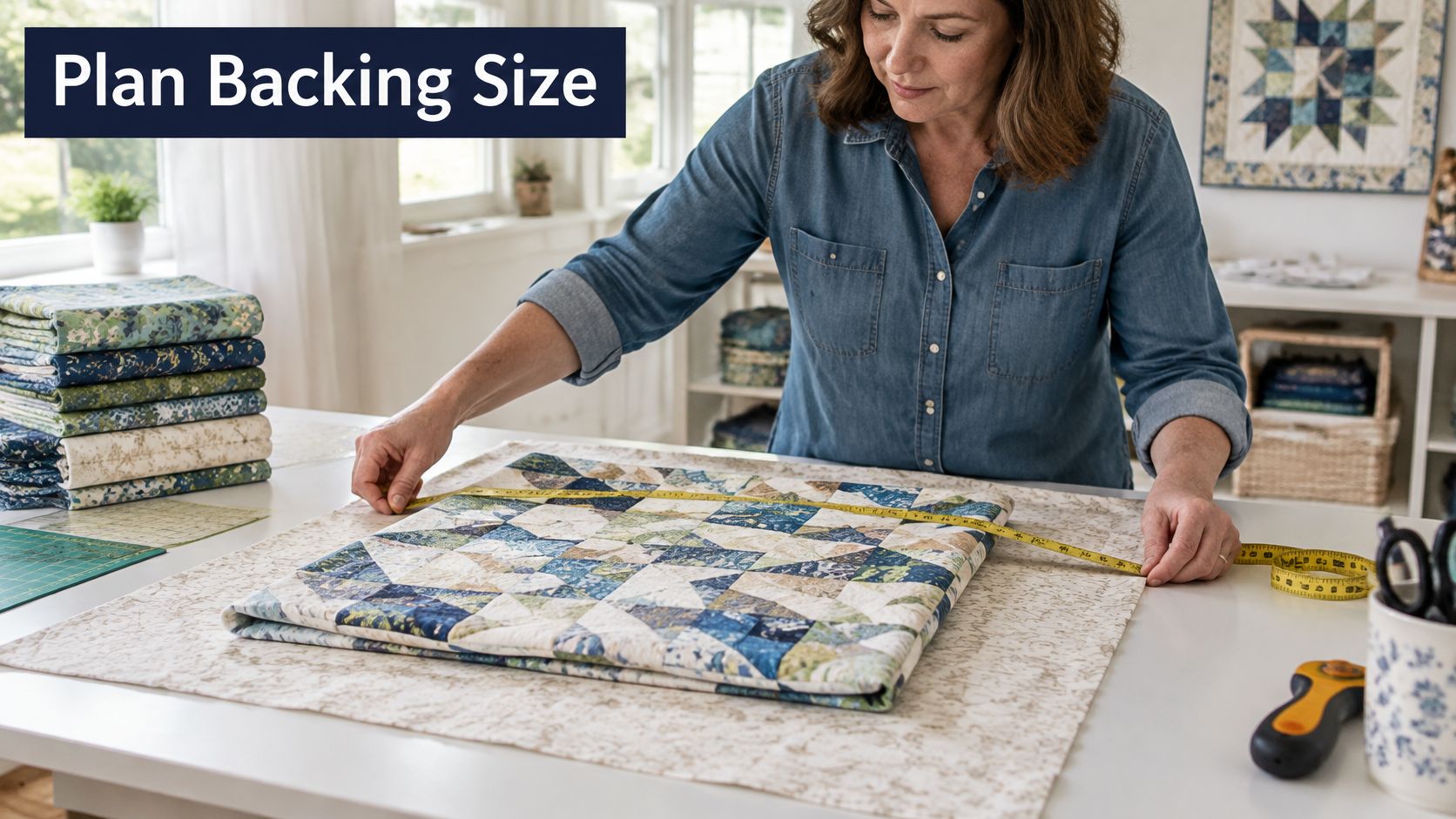
Divide the backing length by 36, then round up to the next quarter yard. Use 108-inch-wide cloth for that figure.
| Finished top | Backing size | 108-inch yardage |
|---|---|---|
| Baby quilt, 36 x 36 inches | 44 x 44 inches | 1.25 yards |
| Queen, 90 x 108 inches | 98 x 116 inches | 3.25 yards |
| King, 108 x 108 inches | 116 x 116 inches | 6.5 yards |
The king row needs two lengths. Both sides are 116 inches, and 108-inch goods cannot cover that in one width. Two lengths at 116 inches, divided by 36 and rounded up, is 6.5 yards. The baby and queen widths fit inside 108 inches, so those rows are length only.
How many bundles the top needs
Count the pattern's pieces. Divide by the pieces one bundle yields after you drop unusable edges. Add about 10 percent for trims and mistakes. A pattern that wants 80 Layer Cake squares is two bundles, not one, because 42 squares do not become 80 after you trim. The yardage calculation walkthrough is the same idea applied to bolt cuts.
What you'll need
- 108-inch quilt backings: Wide goods for the back, bought by the yard after the table above.
- Batting: Rolls or packages. Warm & Natural is needle-punched cotton with a scrim that keeps the loft steady. Soft & Bright polyester is lighter and puffier. Longarmers usually buy batting by the roll and backing by the yard.
- Precuts and kits: The bundles that match the top, not the back.
- Notions: A rotary cutter and a cutting mat, plus a sewing machine such as a PFAFF or a SINGER.
Write one line before you shop: top size, backing size, bundle count, batting size. That line is the whole plan.
Store and Care for Bundles Over Time
Keep bundles dry, flat, and out of direct sunlight. Light fades dyes. Humidity invites mildew. A pretty stack on a sunny shelf is slowly becoming a different fabric.
Use breathable boxes or bins with lids, and keep them in a closet. An attic cooks the cloth. A damp basement wets it. Skip sealed plastic tubs for anything you hope to keep for years.
Leave the original label or tag with the collection name. That tag is how you rebuild a set later, when one fat eighth goes missing and the print name is no longer on the site.
Sort so you can find the cloth
Group pieces by color family or by the project they belong to. Put remnants and leftover selvage in a separate bag so they do not vanish into the next bin. Keep packs sealed until you are cutting. An opened Jelly Roll in a loose pile is how strips get lost and creased.
After you cut, test one scrap for bleeding. Rub it with a damp white cloth, especially reds and navy. If color moves, wash that fabric before it touches a light background.
Prewashing depends on the project. A quilt that will be washed often is safer if the fabrics were washed first, so later shrinkage is smaller. A wall hanging that will never see a machine can stay unwashed, and the sizing can make piecing smoother.
Rotate the bins so older bundles get used first. A home stash ages out when the bottom layer never sees a project. Label each bin with the project it is planned for, even if that project is only "spring table runner."
Frequently Asked Questions by Quilter Type
Which bundle should a beginner buy first
Start with one Layer Cake or one Jelly Roll, and only if the pattern was written for that exact size. The cutting then matches the package, which is the whole point of the project list above. A mix of random precuts looks like freedom and turns into guesswork.
Can a precut fan trust the piece count
Check the package label. Pack counts change by collection, so "about 40" is not a promise. Match that count to the pattern's cut list before you open the wrap. If the label is short, buy the extra pieces as yardage instead of hoping.
Should longarmers build backing from bundles
No. Buy 108-inch backing by the yard and batting in rolls, and keep bundles for the quilt top. Strips and squares make a seam-heavy back that fights a longarm. The quantity plan above is the shopping list, not a stack of Jelly Rolls turned sideways.
How can charity quilters keep a donation quilt uniform
Choose one Jelly Roll collection in a single color family so every block matches and the quilt reads as one piece. Yardage for the background keeps the busy prints from taking over. One collection, one background, one finished quilt that looks intentional.
Our Springfield, Tennessee showroom is the place to see bundles in person before you buy, especially if a screen has fooled you before.
Choose Your Bundle and Start Cutting
Start with the pattern's cut list. Match it to a bundle type, then use the seven coordination checks to confirm the colors work together, including in grayscale.
For a tight budget, compare the bundle's cost per yard with the limit you set. Use your planning line, from the quilt top size through the batting size, to settle the bundle count and backing before checkout.
Choose one bundle for one project. The Fabric Company's Springfield showroom lets you compare fabric colors in person. You can also shop the latest Precuts & Kits collection at The Fabric Company.
The Fabric Company carries precuts, 108-inch backings, batting, and quilting notions. Match the pattern's cut sizes to Jelly Rolls, Layer Cakes, fat quarters, or a 3-yard pack, then check the colors in grayscale. The Weekly Thread offers more tips, and signing up for email brings 10% off your first order.