

Does the fiber name on the package tell you how warm, flat, or wash-stable a quilt will be? It doesn't. Cotton batting is the flatter, natural choice that drapes close and crinkles after washing, while polyester batting is the lighter, lofty choice that holds its size. Loft, stitch spacing, first-wash behavior, and price per size change the result more than the label. Make a small sample and wash it before you commit to a full quilt.
Cotton and Polyester Batting at a Glance
Cotton batting is the flatter, natural option. It drapes close and crinkles after a wash. Polyester batting is the lighter, lofty option. It keeps its planned size and its height.
| Factor | Cotton batting | Polyester batting |
|---|---|---|
| Fiber origin | Plant fiber, natural | Synthetic fiber, petroleum-based |
| Loft | Flatter, lower loft | Lofty, springy, holds height |
| Warmth for weight | Lower; conducts heat faster | Higher; retains warmth at lower weight |
| Weight for same loft | Heavier | Lighter |
| Drape | Soft, close, flattering | Springier, more structured |
| Quilting distance | 2-4 inches | 8-10 inches if packaging allows |
| First-wash shrinkage | About 3-5% | About 0-2% |
| Moisture absorption | Substantial above 70-80% humidity; dries slowly | Low; dries quickly |
| Durability and wash look | Crinkles, may bunch over time | Keeps loft; can bead or migrate |
| Typical twin package cost | $24.10 (72 x 90 in) | $19.80 (72 x 96 in) |
Read the rows as a shopping map, not a promise that every brand matches the middle of the range. A low-loft cotton quilt sits flatter and heavier across a lap. A high-loft polyester quilt looks puffier and often feels warmer for its weight. Construction, loft, and the shell fabric still decide warmth, so the fiber name is only the starting point.
The next sections test loft, drape, washing, and package price one criterion at a time. Before you shop, answer three questions. What is the quilt for? How often will it be washed? What finished size and budget apply? If the quilt sandwich itself is still fuzzy, how to use quilt batting walks through the layers before you pick a fiber.
How Loft and Warmth Differ Between Cotton and Polyester
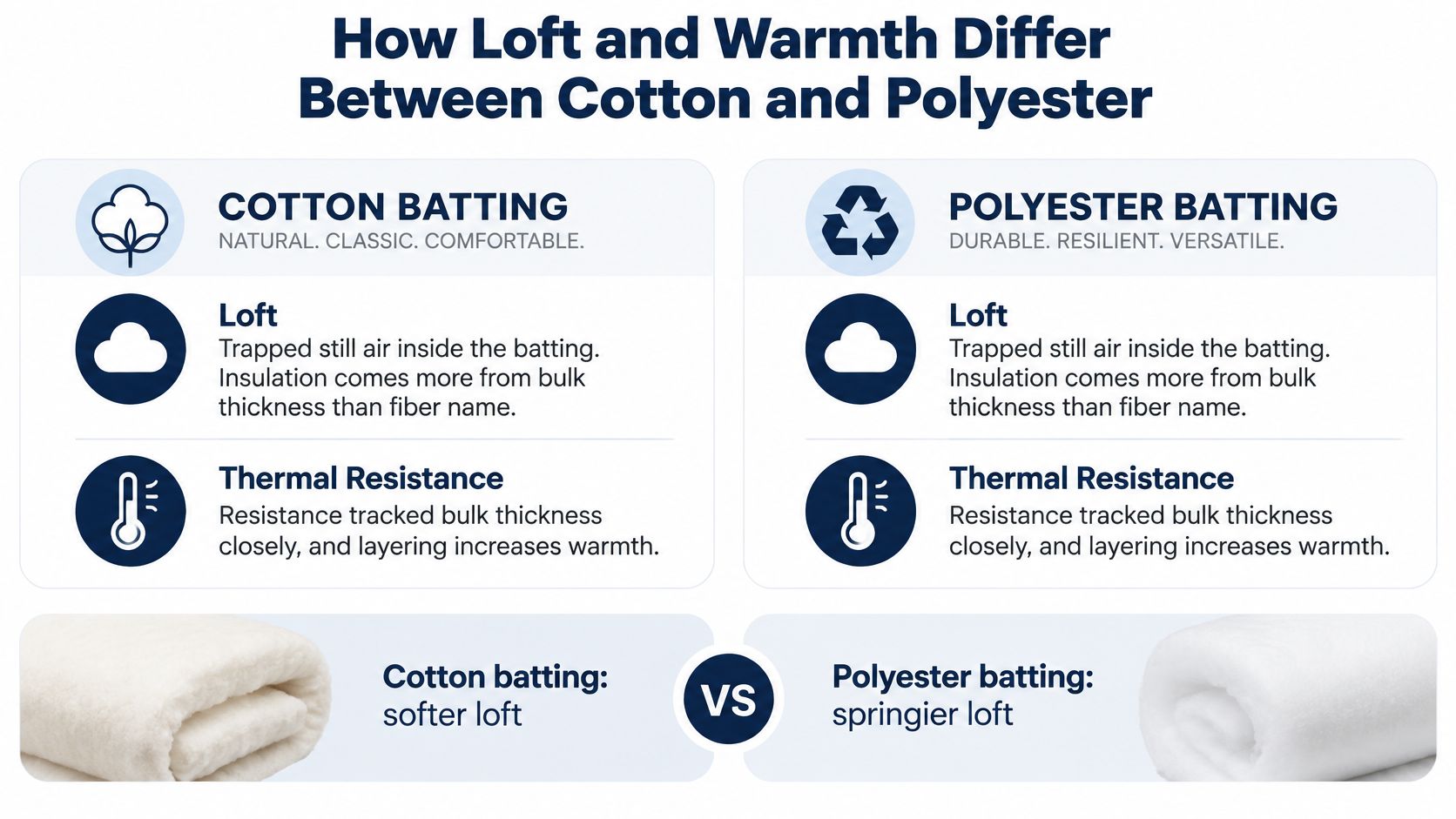
Say you hold a thin cotton batt in one hand and a high-loft polyester batt in the other. The polyester piece feels warmer almost at once. That feeling comes from loft, the trapped still air inside the batting, more than from the fiber name printed on the bag.
A peer-reviewed review of heat and water-vapor transfer tested one, two, and three layers of seven nonwoven batting materials and found that thermal resistance was highly correlated with bulk thickness. Layering raised insulation because it added air spaces without adding weight or thickness in direct proportion to the number of layers. The same review found that two or three layers of high-air-permeability fabric could match one layer of low-air-permeability fabric in wind, and that a low-permeability outer layer cut heat loss.
Fiber heat flow is only half the story
At the fiber level, polyester conducts heat at roughly one-third the rate of cotton. A lofty polyester batt can hold warmth at a low weight, which is why it suits a light bed quilt that still needs to feel cozy. A thin cotton batt lets more heat move through, so it feels cooler when the piece is meant for summer.
Thickness still wins arguments with the label. A dense, compressed polyester batt can feel cooler than a thicker cotton batt. A tight weave or a heavy backing can block airflow and flip the result you expected from the fiber alone. Check the labeled loft, then the finished thickness after quilting, not the word cotton or polyester by itself.
Match loft to the job
- Lightweight summer quilt: Choose low loft so the quilt lies flat and doesn't trap heat on warm nights.
- Standard bed quilt: Mid loft gives enough still air for three-season use without a puffy, stiff hand.
- Heavy winter throw: High loft, often polyester, keeps warmth up while the quilt stays lighter than a thick cotton stack.
Practical rule: Quilt a 12-inch sample, measure thickness with a ruler, wash and dry it once on the care you plan to use, then measure again.
That second measurement is the warmth you will live with. If you quilt by hand, pair this test with batting that needles cleanly for hand quilting so loft doesn't fight the stitch.
Drape, Weight and Quilting Distance
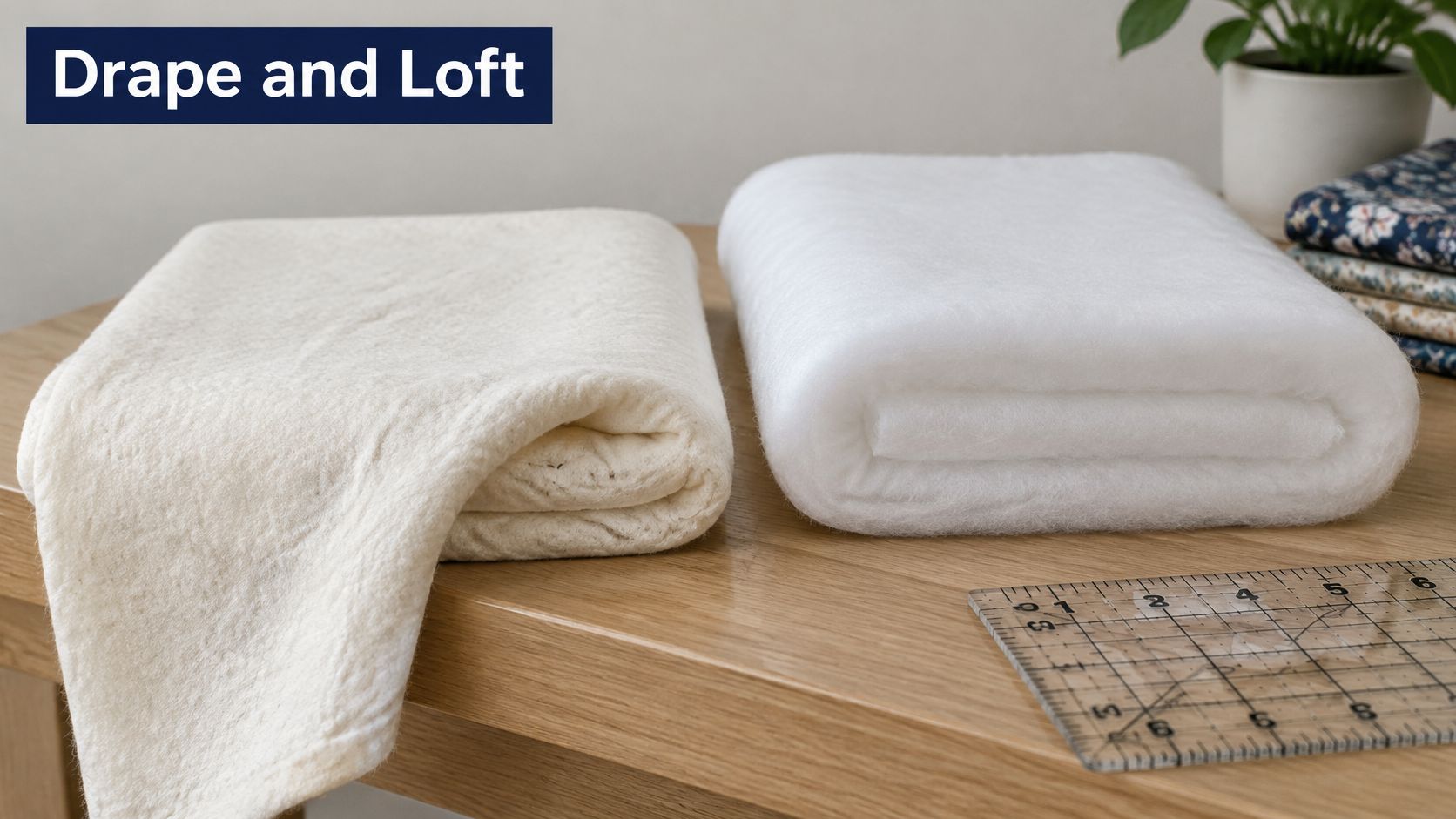
Cotton batting hangs close and soft. That hand suits wall hangings, table runners, and garments such as aprons and summer dresses, where a springy middle would push the fabric away from the body. Polyester has a more resilient feel. It holds shape in a structured bed quilt and makes quilting lines stand up in relief.
Weight follows loft. For the same height, cotton is heavier, so the quilt sits with more substance across a lap. Polyester stays lighter, which helps a large bed quilt that gets folded and moved often.
How far apart you can stitch
A technical batting guide lists about 2–4 inches as a common quilting interval for cotton batting. Polyester may allow roughly 8–10 inches when its bonded structure can hold loft across that span. Wider spacing saves quilting time. Stitch past what that package allows and the layers can shift or bunch.
80/20 blends don't share one standard interval. An 80/20 batt is mostly cotton with a smaller share of polyester, often with a scrim that stabilizes the web. The only reliable spacing is the one printed for that exact product. High-loft polyester packages can differ from one another too. Treat the bag or spec sheet as the construction rule, not a general preference about how the fiber feels.
Set the spacing before you baste
- Read the maximum distance on the package or spec sheet.
- Plan a stitch path that stays inside that limit, including the widest gap in a free-motion design.
- Mark that spacing on the quilt top before you baste, so you don't discover a too-wide pocket after the sandwich is pinned.
A walking foot keeps the three layers feeding together while you follow those marks. If the foot is new to your machine, how to use a walking foot for quilting covers setup before you commit to a full top. I would mark the grid in a water-soluble pen and check one block before I baste the rest.
Washing, Shrinkage and Humidity Care
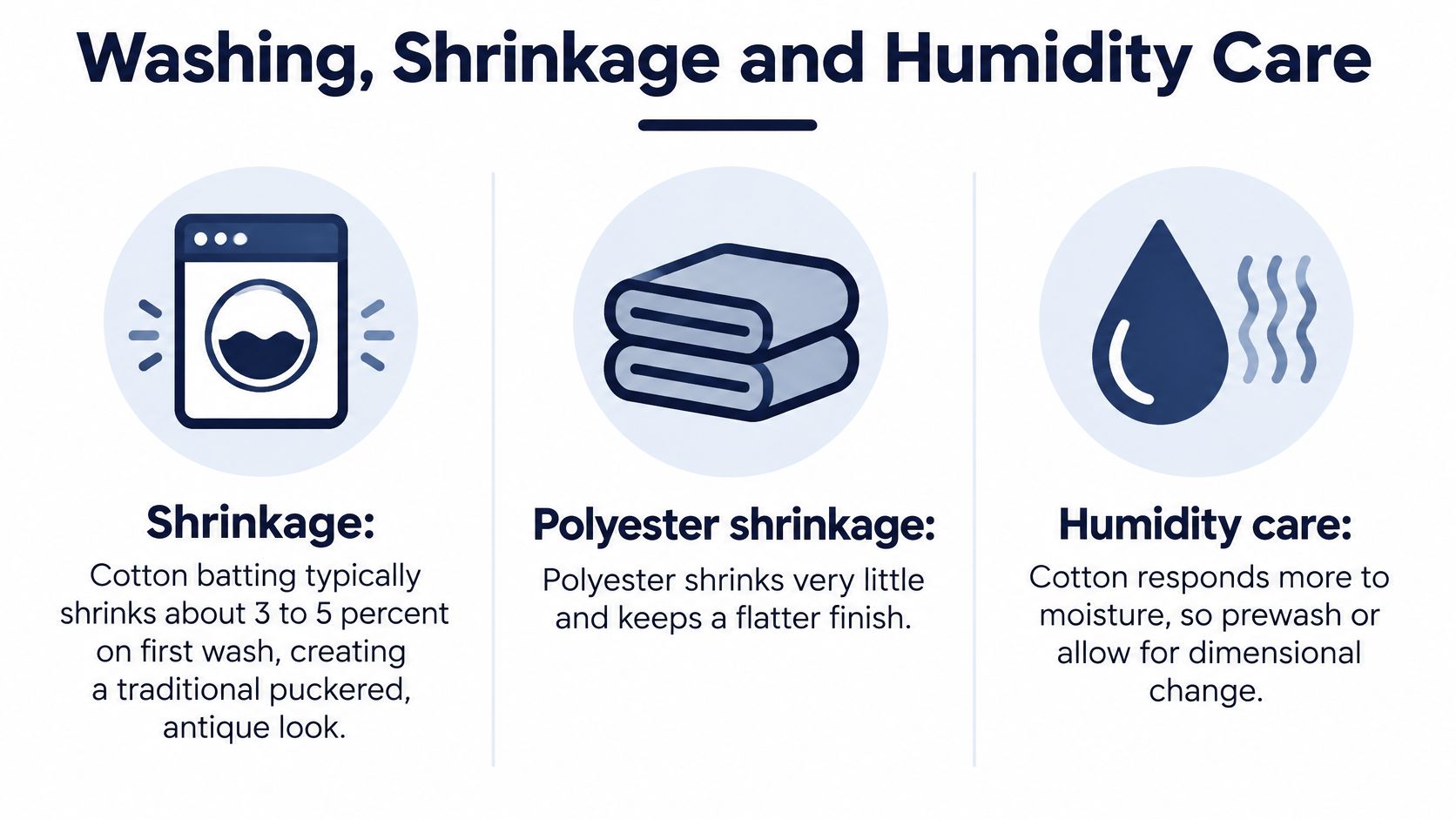
Will the quilt keep its size and feel after its first wash? Cotton batting typically shrinks about 3–5%, while polyester shrinkage is approximately 0–2%, according to this quilting-focused technical guide. Cotton's shrinkage can create the puckered, antique surface many quilters prefer. Polyester generally holds the size and loft established during quilting.
Allow for cotton shrinkage before cutting and binding. Add extra to the top and backing so the finished quilt can tolerate some loss, and leave enough fabric around the batting to keep the edges covered. Polyester calls for less allowance, though a small handling margin still helps.
Humidity, bearding, and heat
NIST technical material notes that cotton moisture uptake becomes substantial above roughly 70–80% relative humidity, while polyester absorbs far less. Cotton can buffer moisture in a humid room, but it holds wash water longer and dries more slowly. Polyester tends to dry faster and maintain loft in damp storage, but that does not make it safer near heat.
Bearding, or fiber migration, is the fuzzy halo that can appear when polyester fibers work through the quilt top. Bonding quality and a tight fabric weave help limit it. A loose weave on a dark print makes pale fibers easier to see. Needle-punched cotton with a scrim tends to stay in place, though repeated washing can still compress the batting.
Machine-washable batting can still change with care. High dryer heat and repeated laundering flatten loft, reducing the air that helps keep a quilt warm. Use low heat and remove the quilt before it is completely dry to help preserve its height.
Fire performance depends on treatment, density, and cover fabrics. Look for documented smolder and open-flame results for the specific batting, rather than assuming safety from the fiber name.
Before committing to a full quilt, wash a quilted sample using the cycle you plan to use. Compare its size, crinkle, edge stability, and surface fibers afterward. To reduce mismatched shrinkage between the top and backing, follow this guide on how to preshrink fabric.
What Each Batting Costs by Quilt Size
Package price is easier to compare once the sizes sit in one grid. These are current sale prices for common cuts.
| Quilt size | Polyester batting | Cotton batting | 80/20 blend |
|---|---|---|---|
| Crib (45 x 60 in) | $12.80 | $9.88 | $11.85 |
| Twin (72 x 90 in) | $19.80 | $24.10 | $18.24 |
| Queen (90 x 108 in) | $28.20 | $32.13 | $22.89 |
| King (120 x 120 in) | $34.95 | $49.80 | Wide 110-inch bolt, not a king package |
Labels don't always match the inches in the bag. The polyester twin package is 72 by 96 inches at $19.80, while Warm & Natural needled cotton twin is 72 by 90 inches at $24.10. The cotton king cut is 124 by 120 inches at $49.80, against a polyester king package of 120 by 120 inches at $34.95. Compare the finished size you need, not the word twin or king alone.
Where the money actually goes
Blends often land between the two fibers, and at queen size the 80/20 package at $22.89 undercuts both. Cotton is the premium once the quilt gets large. Batting is still a small share of a bed quilt next to yardage, a wide backing, and thread. Paying more for cotton makes sense when you want that hand. It doesn't make sense when you only need a stable middle.
At twin size, the polyester package is about $4.30 less than the cotton package. That gap matters for charity runs and guild stacks. Prices move, so confirm the tag before you order. Repeat makers usually spend less per yard on a bolt than on one-off packages.
Cut cotton batting with a generous margin on every side so first-wash loss doesn't shrink the finished quilt. Polyester only needs a small handling margin.
If you are matching a package to a bed, quilting batting sizes lines up common cuts with the top you already pieced. A throw-size polyester package at $14.20 (60 by 60 inches) and a craft-size polyester package at $12.10 (34 by 45 inches) cover small seasonal projects without a bed-size leftover.
Which Batting to Choose for Your Project
Which batting suits the quilt you are making? Start with the finish you want, then weigh loft, quilting distance, washing behavior, and the cost of the right size. The fiber name is only a starting point. A small sample can show how the batt behaves before you commit to a full quilt.
| Maker or project | Better fit | Why it fits |
|---|---|---|
| Heirloom or flat-finish quilt | Cotton | Lower loft and a natural crinkle after washing |
| Warm, high-loft bed quilt | Polyester | More loft for its weight, and loft that holds |
| Charity or donation quilt | Polyester | Low shrinkage and a lower package cost when making many quilts |
| Garments such as aprons or summer dresses | Cotton | Breathable feel and closer drape |
| Lightweight summer quilt | Cotton | Lower loft and a lighter feel than high-loft polyester |
| Baby quilt | Either, with documented safety tests | Fiber type alone does not establish fire performance |
| Wall hanging or table runner | Cotton | Soft, close drape and a flatter profile |
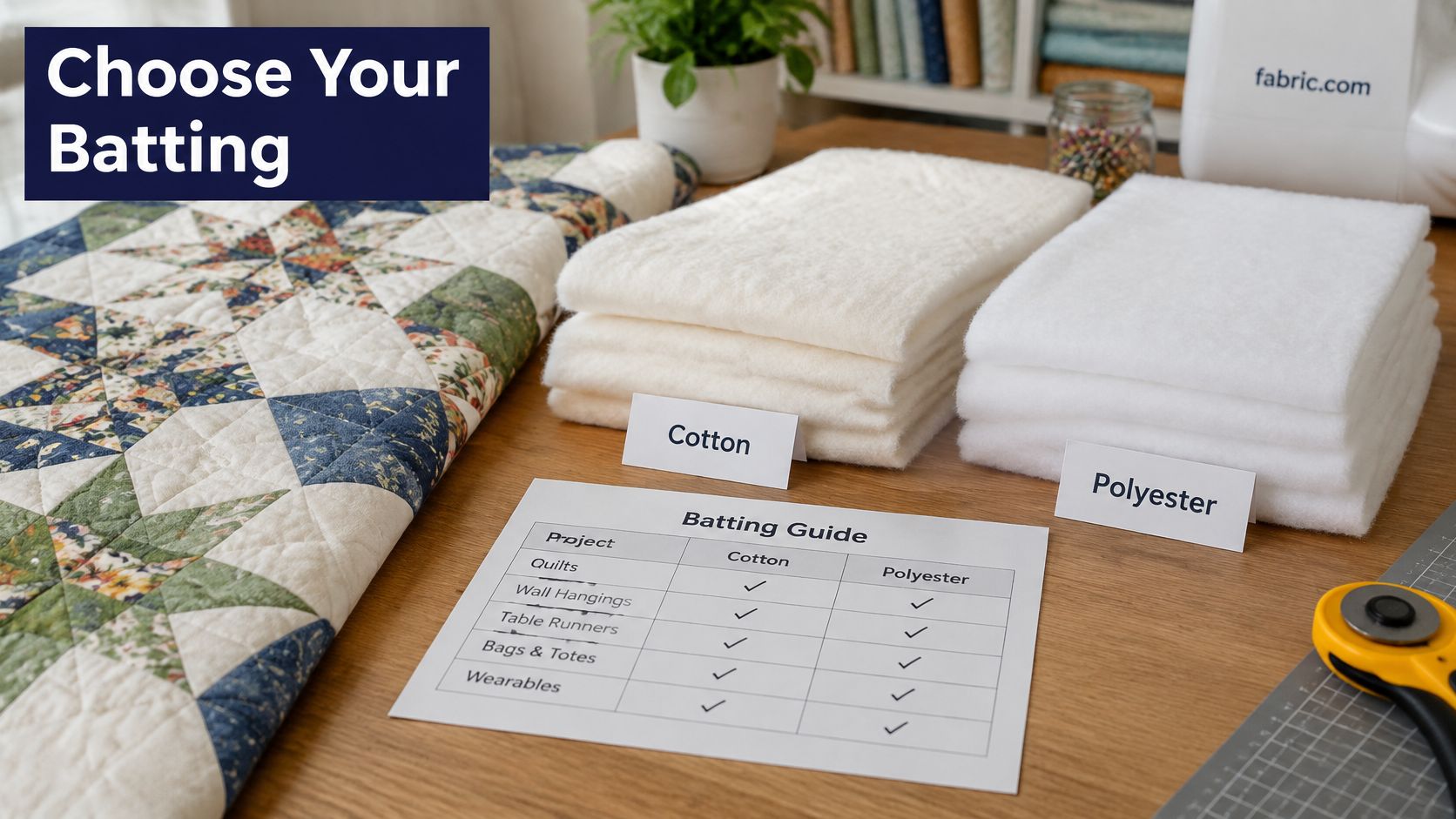
Stash builders can choose cotton when its hand and post-wash crinkle matter, or an 80/20 blend when they want a middle option. Precuts such as Charm Packs, Layer Cakes, 2.5-inch strips from a Jelly Roll, and Fat Quarters do not dictate the batting. Match the batt to the finished quilt, not the fabric bundle.
Gift-driven beginners may prefer polyester for a quilt that keeps its size and is easy to quilt on a domestic machine. A complete kit and a batting package sized for the top simplify fabric and batt matching.
Precut enthusiasts can use the same top formula with either fiber. For a scrappy Jelly Roll twin, choose cotton for more crinkle after washing, or polyester if you want to quilt faster with wider stitching.
Longarmers and studio owners should check roll width and length as well as fiber. The Warm 80/20 Blend cotton and polyester bolt measures 110 inches by 25 yards and is $300.66. Soft & Bright premium polyester bolts are available in 124 inches by 20 yards for $167.74, 90 inches by 25 yards for $161.33, and 45 inches by 50 yards for $179.66. A 108-inch backing can cover a king top in one piece, avoiding a bulky seam under the needle.
Seasonal crafters making summer throws can choose a lighter cotton batt. Slow-fashion sewists making aprons, dresses, and children's clothes may also prefer cotton or a light 80/20 blend for closer drape, rather than a high-loft bed batt.
Charity and guild quilters may favor polyester for its low shrinkage and lower package cost when making quilts in quantity. The smaller change in finished size can also make washing instructions simpler for recipients.
The Fabric Company carries batting from Hobbs, Quilters Dream, The Warm Company, Pellon, Choice Supreme, Katahdin, Linda's, Quilters Select, and The Gypsy Quilter. Its batting selection includes cotton, polyester, and 80/20 blends in pre-cut sizes for baby, throw, twin, queen, and king quilts. Warm & Natural and Warm & White are needled cotton lines, while Soft & Bright is a premium polyester line.
What you'll need
- Batting: A package sized to the quilt top, or a bolt for a run of quilts.
- Precuts or yardage: Jelly Rolls, Fat Quarters, Layer Cakes, or remnants from your stash, plus a 108-inch backing for a king.
- Machine: A domestic machine or a PFAFF with a walking foot, along with thread and a new needle.
A life-cycle assessment of cotton and polyester fabrics found that polyester, particularly recycled polyester, had lower impacts for climate change, toxicity, and resource use in the Sri Lankan fabric system studied. The findings concern fabrics, not finished batting, and recycled polyester differs from virgin polyester. The discussion also notes that polyester makes up 59% of global fiber production, with most still virgin and fossil-based. Check whether a polyester batt contains recycled material. Long use can spread a quilt's material footprint across years of wear and washing, so consider expected use alongside a fiber label.
Before buying a full-size package, make a small sample with the same top fabric and stitching you plan to use. Compare cotton and polyester for loft, drape, quilting ease, and how each looks after washing. That check helps reveal whether the fiber's trade-offs suit your project.
Visit our Springfield, Tennessee showroom or shop batting online at The Fabric Company. Join The Weekly Thread for more tips and 10% off your first order.
This short walk-through shows the same choice in motion, from package to quilted sample, so you can see loft before you cut a full top.
The Fabric Company sells batting in cotton, polyester, and 80/20 blends, in packages and wide bolts. Bring your top measurements, or start with a precut bundle and a 108-inch backing, then choose the batt that suits the quilt's size, loft, and wash needs. Visit The Fabric Company to browse batting packages and plan a sample before cutting the full top.