

You've found a sunflower print you love online, added three yards to your cart, and then paused. Are those blooms two inches wide or six? Is that background cream or bright white? Will three yards still be enough after washing, or will one upside down sunflower ruin your border?
Those aren't small questions. Sunflower fabric by the yard is a buying decision you can measure, test, and get right before you cut.
Sunflower Fabric Types at a Glance
TL;DR: Sunflower fabric by the yard usually means printed quilting cotton, but you'll also find the motif on cotton wideback, linen-cotton blend, and cotton flannel. Pick the type that fits your project first, because the type sets the width, and the width sets all your yardage math.
Sunflower Fabric Types by Width and Best Use
| Fabric type | Typical width | Weight and feel | Best uses |
|---|---|---|---|
| Printed quilting cotton | 42-44 inches | Medium weight, crisp and tightly woven | Quilt blocks, borders, bags |
| Cotton wideback | 108 inches | Same weave as quilting cotton | Seamless quilt backings |
| Linen-cotton blend | 54-58 inches | Heavier and textured, softens with washing | Totes, tablecloths, home decor |
| Cotton flannel | 42-44 inches | Soft, brushed and warm | Baby quilts, pajamas, lap blankets |
Width matters more than the pretty name on the listing. A quilt top pieced from 42-44 inch cotton and a backing cut from 108 inch wideback start from completely different numbers, even when both fabrics show the same sunflower.
- Quilting cotton is your workhorse. It's stable, easy to press, and holds a sharp seam in blocks and borders. If you're new to buying yardage, start with our guide to quilting cotton fabric by the yard.
- Wideback changes the math. One wide cut can back a quilt with no center seam, so you buy length, not panels.
- Linen-cotton adds texture and weight. It's a better match for a tote or tablecloth than for small, precise patchwork.
- Flannel adds warmth, not crispness. Its brushed surface feels cozy, but it can stretch a little and fray more at raw edges.
Practical rule: The word sunflower on a listing names the print, not the fiber. Always check the actual fiber content and width on the product page before you order.
That warning protects you from a common beginner mix up. A fabric can look like quilting cotton in a photo and arrive as a looser, heavier blend that's wrong for tight piecing. Choose the fabric type first, write its width at the top of your project notes, and let every measurement that follows build on that number.
How to Judge Sunflower Print Scale and Color
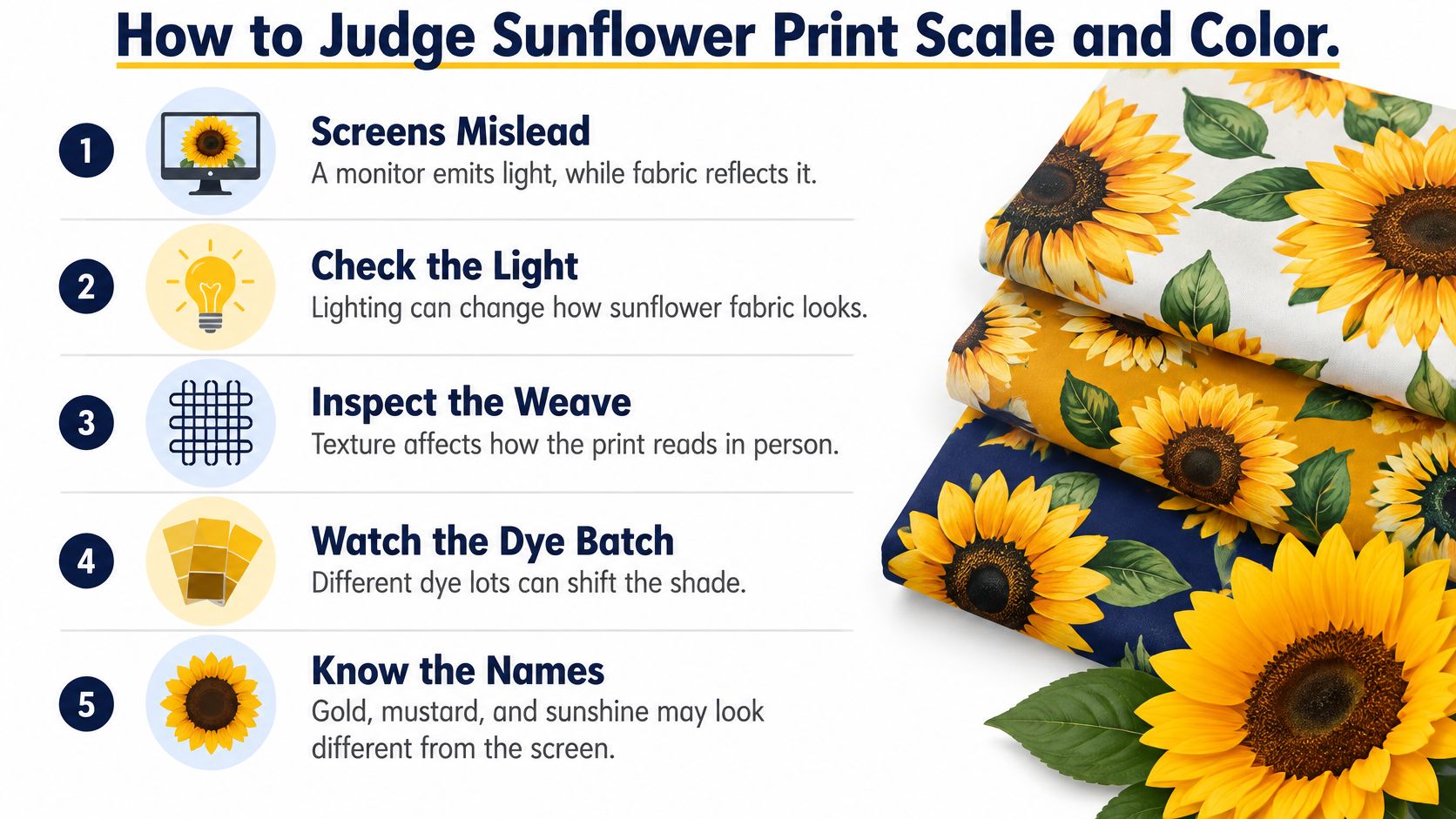
You pin a sunflower print to the design wall and the flower that looked dainty on your phone covers half a block. Screens and bolts disagree for a simple reason. A monitor emits light while fabric reflects it, so lighting, weave, finish, and dye batch all shift the shade you see in person, as explained in this guide to judging fabric colors before buying online. Color names do not rescue you either. Gold, mustard, and sunshine are not standardized across brands. One maker's mustard is another maker's warm gold.
Sorting Prints by Scale
Scale decides where a print can work. Measure one full flower, not the photo.
- Small scale, flowers under 2 inches. These read as texture from a distance and work well in scrappy blocks, narrow borders, and binding.
- Medium scale, flowers 2-4 inches. This is the most flexible range for quilt blocks, because a whole bloom fits inside common cut sizes.
- Large scale, flowers over 4 inches. Save these for backings, a single bold panel, or fussy cutting, where you center one bloom on purpose.
Next, measure the motif repeat. Lay a ruler along the selvage and measure from the center of one sunflower to the center of the next identical one in the same position. That number tells you how much extra length you will need to match flowers across a seam. Also check direction. If every sunflower faces the same way, it is a directional print, and you will need to keep every cut facing up for apparel, pillow fronts, and borders.
Background undertone is the quiet problem. Warm cream can look dingy beside bright white solids, and bright white can look harsh beside buttery yellows. The same care behind maintaining brand colors in custom blankets applies here, because small undertone shifts become obvious once pieces sit side by side. If you are planning garments, botanical print fabric for modern apparel shows how scale and background behave on the body.
A second bolt of the same print can still be a different dye batch. Petals that matched in the cart can look orange next to lemon once both pieces are pressed open. Buy the border length from one continuous cut so you are not splicing mismatched shades into one strip.
A Five Step Buying Routine
- Order a swatch. It costs less than returning three wrong yards.
- Set it beside your solids in indirect daylight. This is your truest read of undertone.
- Look again under evening light. Warm bulbs can push yellows toward orange.
- Ask for a close up photo with a ruler. Weave and fold shadows reveal texture that flat photos hide. Compare that photo with a real swatch before you commit to yards.
- Confirm the cut is continuous. You do not want three separate one yard pieces for one long border.
A close up with a ruler beats a flat, saturated listing photo every time. Compare swatches side by side when you can, and use the ruler photo when you cannot.
Coordinating Sunflower Prints with Solids and Precuts
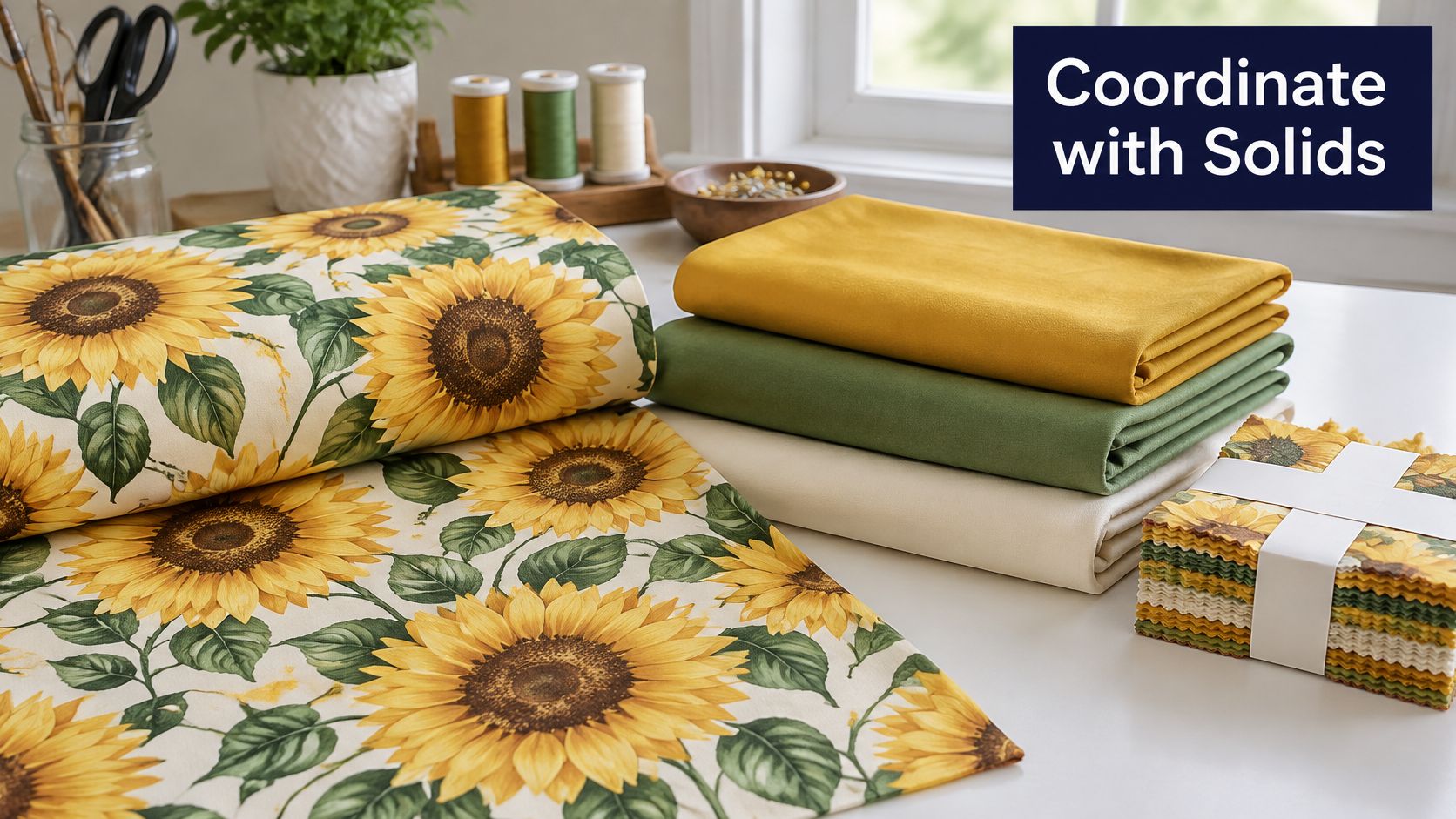
Start with one sunflower print as your anchor, then pull companions straight from its colors. Pick a gold that echoes the petals, a green from the leaves, and a cream or white that matches the background. You're not hunting for new colors. You're borrowing the ones the designer already balanced for you.
Then check value contrast, which is just how light or dark a fabric looks. One light, one medium, and one dark fabric keep your sunflowers readable from across a room. If everything sits in the same medium range, the blocks blur together no matter how pretty each fabric is alone. A quick test helps here. Take a phone photo of your fabric pull and view it in black and white. If you can still tell the fabrics apart, your values are working.
Pairings That Rarely Miss
- Sunflower yellow with chocolate brown. It echoes the flower center and grounds all that brightness.
- Sunflower yellow with sage green. Softer than a true leaf green, and friendly in baby and spring quilts.
- Sunflower yellow with navy. The dark blue makes yellow look cleaner and more modern.
Collections from brands such as Riley Blake and Moda often include matching solids, which saves guesswork. Still, lay the solid against the petal, not against your memory of the petal, and use our guide to choosing quilt fabric when a pull feels close but not quite right.
Precut Formats for Sunflower Quilts
| Precut | Size | Typical pieces | Best for |
|---|---|---|---|
| Fat quarter | 18 x 22 inches | 1 | Fussy cutting one sunflower |
| Charm pack | 5-inch squares | 42 | Scrappy blocks |
| Layer cake | 10-inch squares | 42 | Quick quilt tops |
| Jelly roll | 2.5-inch strips | 40 | Strip quilts and borders |
Precuts save cutting time, but they limit your layout. A 5 inch charm square may chop a large sunflower in half, and you can't shift the cut to center the bloom. If you want full, well placed flowers, buy by the yard and cut them yourself. If you want speed and a scrappy mix where partial blooms look playful, Charm Packs, Layer Cakes, and Jelly Rolls from our Precuts & Kits category earn their keep.
Keep a small Stash of sunflower remnants and selvage pieces too. A leftover strip can become binding, a label backing, or one more block when you're a single square short.
How Much Sunflower Fabric to Buy for Common Projects
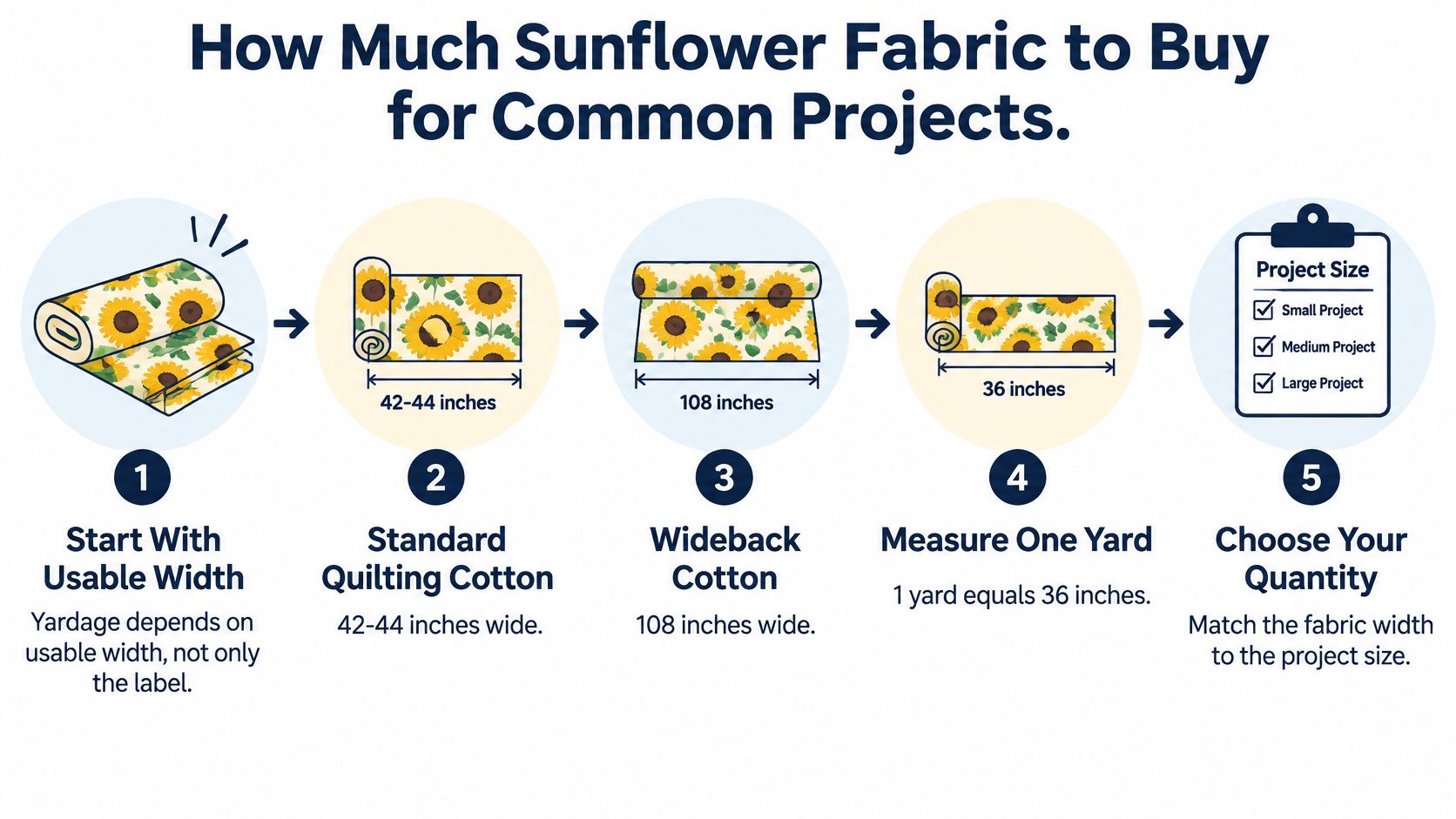
Yardage depends on usable width, not the width printed on the label. Selvages and trimming eat into your cutting area, so plan from what's left after you square up the fabric. According to the Calculator Collection fabric yardage guide, a standard quilting cotton bolt is typically 42-44 inches wide, wide quilt backing is commonly 108 inches wide, one yard equals 36 inches, and quantities are commonly rounded up to the nearest 1/8 yard.
Starting Yardage for Common Sunflower Projects
| Project | Fabric and width | Starting yardage |
|---|---|---|
| Tote bag, about 15 x 15 inches | Printed quilting cotton, 42-44 inches | 1/2 yard |
| Baby quilt top, 36 x 46 inches | Cotton flannel, 42-44 inches | 2 1/2 yards |
| Throw quilt top, 60 x 70 inches | Printed quilting cotton, 42-44 inches | 4 1/4 yards |
| Throw quilt backing, 60 x 70 inches | Cotton wideback, 108 inches | 2 1/4 yards |
| Queen quilt backing, 90 x 108 inches | Cotton wideback, 108 inches | 3 1/4 yards |
Treat these as starting points, not promises. Your pattern, seam allowance, and cutting layout can shift the total, so recalculate for your own cut sizes using our step by step yardage calculation guide. Notice the backing rows. A 108 inch sunflower wideback covers a throw without piecing panels together, which is why its yardage looks so much lower than the top.
The Cutting Count in Plain Language
Divide your usable width by your cut piece width and round down, because a partial piece doesn't count. Then divide the pieces you need by the pieces that fit across, round the rows up, multiply by the piece length, and divide by 36 to get yards.
Say your usable width fits four 10 inch squares across, and one yard gives you three 10 inch rows. That's 12 squares per yard before any buffer. If your quilt needs 30 squares, three yards covers the cutting count, and then you add your safety margin.
Buy about 10 percent extra for shrinkage, directional layout, and matching repeats across seams. That small cushion is cheaper than hunting for one more matching yard later.
Confirm that buffer with a quick prewash test. Cut a 4 inch scrap, wash it the way you'll wash the finished project, press it, and measure again before you cut the full yardage. If the scrap shrinks noticeably, your buffer needs to grow.
Your Four Step Routine
- Measure the finished size. Write down length and width, not a vague size name.
- Pick the fabric width. Use usable width after the selvage comes off.
- Run the cutting count. Pieces across, rows needed, then yards.
- Round up and add the buffer. Then order it all in one continuous cut.
What You'll Need for a Sunflower Quilt
Gather everything before your first cut, and your sunflower quilt stops being three separate shopping trips. This checklist fits on an index card, and each item earns its place for a specific reason with a bright, directional print.
- 108-inch wideback for the backing. A wide back protects the sunflower motif from a visible center seam and saves you a long, fussy join. Look in the 108-Inch Backings category.
- Batting with the right Loft. That's the thickness inside the quilt. Needle-punched cotton gives a flat, traditional finish, while polyester batting gives a puffier look that shows off quilting stitches. Browse the Batting category to compare.
- Scrim-backed batting for stability. Scrim is a thin stabilizing layer that keeps batting from stretching, which matters when you're quilting on a longarm or wrestling a large throw.
- A batting roll for bigger work. If you quilt often or run a studio, a roll beats opening a new package for every project.
- A PFAFF sewing machine with a quarter-inch seam foot. Consistent seams keep sunflower blocks square, so points meet instead of drifting. The Sewing Machines category lists current options.
- Aurifil thread close to your sunflower yellow. Thread that blends with the petals hides stitching on bright areas instead of drawing a dark line across them. Check the Thread category with a fabric swatch in hand.
- Rotary cutter, cutting mat, and a clear ruler. Accurate strips start here, and a ruler lets you fussy cut a bloom dead center.
- A hot iron. Pressed seams sit flat, nest together cleanly, and keep blocks from growing as you join rows.
One habit ties the list together. Press each seam as you sew instead of saving a mountain of pressing for the end. Sunflower prints hide a lot, but they don't hide a twisted seam allowance under a pale petal.
Save your leftover sunflower remnants and selvage pieces in your Stash when the quilt is done. They're perfect for binding, appliqué leaves, quilt labels, and patching a well loved quilt later.
Caring for Sunflower Prints After the First Wash
The sunflower yardage is still stiff on the cutting table, and the first wash is the cheapest place to catch shrinkage and dye movement. Prewashing does three jobs at once. It removes sizing, the stiff finish from the factory. It shows how much the cloth will shrink before you cut. It tests whether dye will transfer onto lighter fabrics. Skip it, and that first wash happens after hours of piecing, when a surprise costs a finished block instead of a scrap.
Prewash and Care by Sunflower Fabric Type
| Fabric type | Prewash | Wash | Dry |
|---|---|---|---|
| Printed quilting cotton | Yes, before cutting | Warm or cold, mild detergent | Tumble medium or line dry |
| Cotton wideback | Yes, for backings | Warm, mild detergent | Tumble medium |
| Linen-cotton blend | Yes, to set shrinkage | Cold or warm, gentle cycle | Line dry or low tumble |
| Cotton flannel | Yes | Warm, mild detergent | Low tumble, remove promptly |
Two sunflower cottons can feel different even when both labels say cotton. Quality depends on fiber content, weave density, finishing, dye chemistry, print registration, and lot consistency. Sizing works like starch on a shirt. It makes the bolt feel crisp, then leaves in the wash, so the fabric you cut is not always the fabric you bought. A looser weave tends to pull in more. A heavy finish can hide that until the water hits it.
The Scrap Test and the Dye Lot Check
Cut a 4 inch scrap, wash it with a white cloth, and check the cloth for color. Yellow prints beside white backgrounds deserve this test every time, because even slight transfer shows. If the white cloth picks up color, wash the yardage again separately before it ever meets your background fabric. Our guide to preshrinking fabric walks through the full routine.
Dye lots are the second trap. The same named print can shift slightly between batches. A flat cut can look fine while joined seams expose the difference, the way two paint cans of the same name look close until you put them on one wall. Buy all your yardage at once, ask for one continuous cut, and check that bolt numbers match when you are buying from more than one bolt.
For finished quilts and garments, keep care gentle.
- Wash cold with mild detergent. Heat is harder on bright yellows than dirt is.
- Skip bleach. It can dull petals and weaken cotton fibers.
- Dry flat when a quilt is heavily quilted. This limits pulling on dense stitching while the quilt is wet and heavy.
Buy the Right Sunflower Yardage Today
You are at the cutting counter with a sunflower bolt that looked perfect on a phone screen. The petals are bigger than your palm, the yellow reads warmer than the photo, and someone is waiting for a yardage number. Three checks decide whether that cut will finish the project.
Does the fabric width match the piece you are making? A throw backing can be one 108 inch cut. A tote needs only half a yard of 42-44 inch cotton. Project size sets the order, the same way a pattern's cutting list sets how much flour goes in a recipe. The print does not.
Does the print pass a full-size check in indirect daylight and again in evening light? Scale and color shift are the risks a thumbnail hides. A large sunflower can swallow a small block. A yellow that looked gold at noon can read orange under a lamp.
Does your total include a buffer for shrinkage, directional cutting, and matching repeats? Order the full amount in one continuous cut so dye lots stay together. If all three answers are yes, you are ready to buy.
Our Springfield, Tennessee showroom lets you compare swatches in person. Our team of experienced quilters can help you think through width and yardage for backings, throws, and totes before you order. Our Fabrics section includes cotton prints, widebacks, flannel, minky, solids, fleece, and upholstery fabric, and our Precuts & Kits category includes 5" Squares, 10" Squares, Jelly Rolls, Fat Eighth, Fat Quarters, 3-Yard Packs, and Quilt Kits. We carry brands including Riley Blake, Moda, Free Spirit, Michael Miller, Aurifil, and Robert Kaufman.
Shop our latest Fabrics collection here.
Join The Weekly Thread for more tips and 10% off your first order.
Pick your sunflower scale, confirm usable width, and order the full yardage with the batting, wideback, and thread that finish the quilt. Visit The Fabric Company to shop sunflower prints, precuts, and 108-inch backings, or stop by the Springfield, Tennessee showroom and compare swatches in real light.