

You've picked the flannel, settled on a pattern, and started imagining that first evening under the finished quilt. Low- or mid-loft cotton is my starting recommendation for a soft, traditional flannel quilt; an 80/20 cotton-polyester blend is my practical pick when frequent washing and dimensional stability matter more than crinkle. Choose the filling for the whole quilt, not just for how fluffy it feels in the package.
Start With the Flannel Quilt You Want
The best batting for flannel quilt projects depends on what you want to pull out of the dryer: a relaxed, crinkled bed quilt, a washable everyday throw, or a lofty quilt that shows off your stitching. Those are different goals, and they don't call for the same batting.
Flannel already contributes warmth and weight. Putting a thick filling between a flannel top and flannel backing can create more bulk than you intended, so I'd start with a restrained loft unless puffiness is part of the design. The practical balance between flannel, cotton batting, and blends is covered in this guide to batting construction and quilt handling.
Keep the intended finish in mind as you plan your layers.
Decide What Matters Most
Before choosing from the batting selection, finish this sentence: “I want this quilt to feel…”
- Soft and familiar: Start with cotton and a modest loft.
- Easy to wash and use: Put a cotton-polyester blend on your shortlist.
- Puffy and decorative: Consider polyester, then check its quilting requirements.
- Warm without unnecessary weight: Investigate wool, provided its care instructions suit the recipient.
Our Springfield, Tennessee showroom gives you an opportunity to handle materials in person. Bring a piece of your flannel, fold it around a batting sample, and compare the combined feel rather than judging the filling alone.
Shop-counter advice: Don't buy maximum loft just because the quilt is for winter. Decide how much warmth and weight the fabric already contributes first.
Budget matters, too. For an everyday quilt, I'd spend on a batting that matches the washing routine before paying for a specialty fiber whose main benefit the recipient won't need.
Understand Flannel Batting Requirements
A quilt sandwich works as a connected system. The top, batting, backing, and quilting all affect the finished result, so a good choice in the middle can't compensate for incompatible fabrics or unsuitable care.
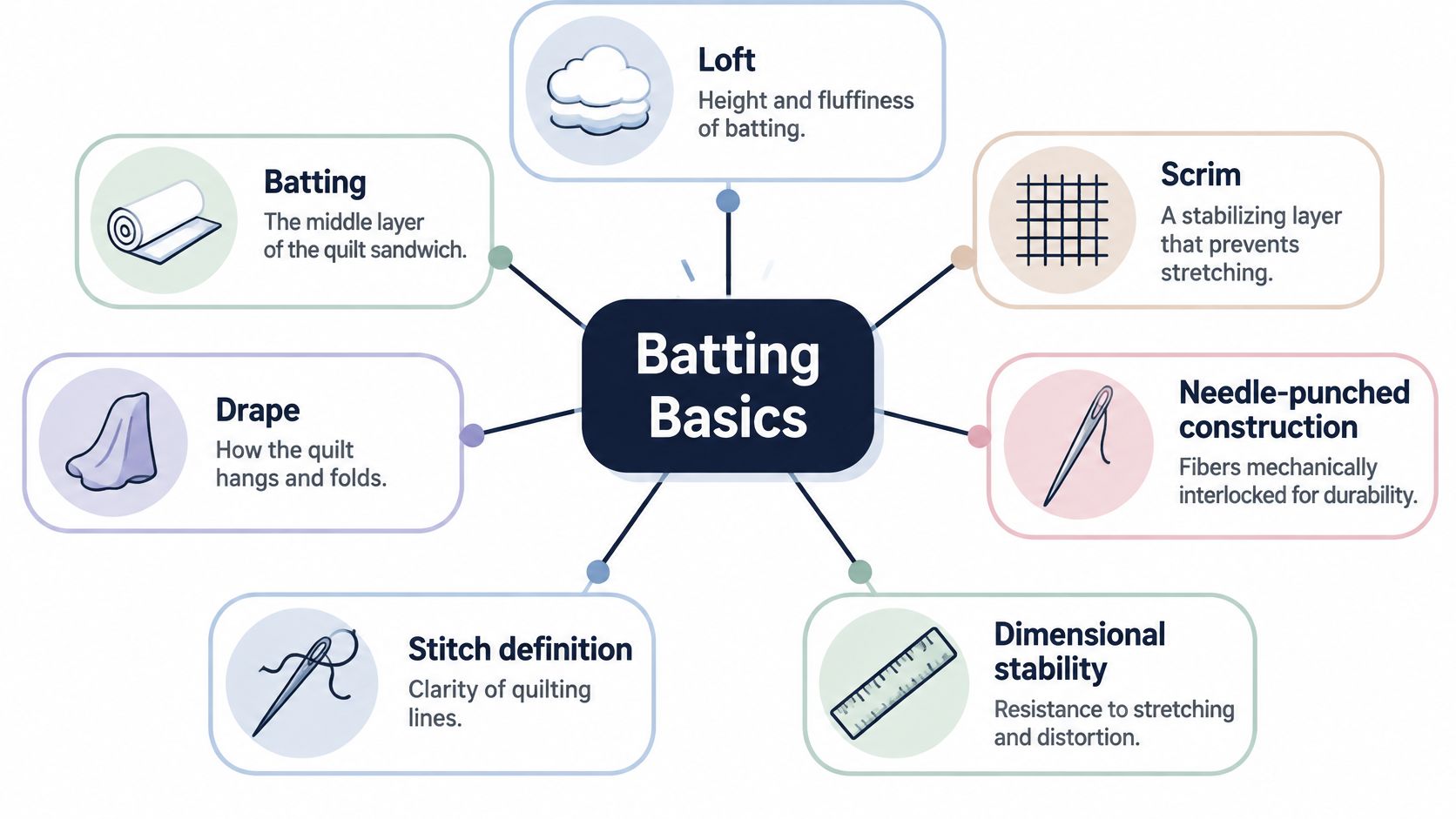
Use these terms to read a batting label with confidence.
Read the Construction Terms
- Batting: The filling between the quilt top and backing.
- Loft: The batting's height or fluffiness, not just its warmth.
- Drape: How easily the completed quilt bends, folds, and settles around you.
- Scrim: A supporting layer that helps stabilize the batting.
- Needle-punched construction: Fibers mechanically interlocked to make a more cohesive batt.
- Stitch definition: How clearly the quilting lines and surrounding raised areas show.
- Dimensional stability: How well the materials resist unwanted stretching, shrinking, and distortion.
These terms describe different characteristics. A stable batt doesn't automatically feel stiff, and a lofty batt isn't automatically the best choice for a warm quilt.
Match the Layers to the Quilting
For a closely stitched utility quilt, I'd look for a manageable, low-loft filling and test how it behaves under the planned quilting. Needle-punched or scrim-supported batting deserves consideration when you want dependable handling, but the finished hand still needs checking.
An openly machine-quilted bed quilt needs a different check: does the batting permit the distance between your quilting lines? Don't choose the design first and assume any filling can support it.
For a soft lap quilt, fold the test sandwich over your arm. If it feels more like a padded panel than a blanket, reconsider the loft, quilting density, or both.
Review the fabric side of the decision with this flannel fabric by the yard planning guide before committing to your top and backing. In particular, decide whether you want flannel on both sides or only one.
This quilting video offers another visual reference while you plan the construction.
Write down the intended use, washing routine, quilting method, and desired drape before shopping. That short project description is more useful than asking which fiber is best without knowing what the quilt must do.
Compare Fibers and Loft Side by Side
Flannel Quilt Batting Comparison
| Batting Choice | Warmth | Loft and Drape | Quilting Behavior | Care and Stability | Best-Fit Project Goal |
|---|---|---|---|---|---|
| Cotton | Moderate warmth with breathability | Usually flatter, with a traditional hand | Suits a less puffy finish and close quilting | Allow for shrinkage and check preparation instructions | Traditional bed quilt |
| Polyester | Adds warmth without cotton's weight | Available in loftier, lighter profiles | Makes quilting contours more pronounced | Generally low shrinkage; follow the label | Puffy throw or decorative quilt |
| Cotton-polyester | Practical everyday balance | Often manageable without excessive bulk | Useful for machine and longarm handling | More dimensionally stable than untreated cotton | Frequently washed utility quilt |
| Wool | Strong warmth for its weight | Resilient loft with a lighter feel | Useful when raised texture matters | Requires product-specific, careful laundering | Lightweight winter quilt |
| Bamboo-containing batting | Verify the actual product | Blend and construction determine the result | Test rather than infer from the fiber name | Follow the marketed product's instructions | A project whose sample passes your handling and wash tests |
| Low-loft construction | Judge warmth with the full sandwich | Flatter and less bulky | Won't create a deeply padded effect | Fiber and finish determine care | Supple, everyday flannel quilt |
| High-loft construction | Can add more warmth than needed | Fuller and puffier | Can require closer quilting | Check spacing and laundering limits | Deliberately dimensional finish |
The table is a starting point, not a substitute for the package. The broad differences between cotton, polyester, and wool are described in this fiber comparison for warmth, loft, and quilt weight.
Cotton and Blends Serve Different Finishes
Choose cotton because you want its finished character, not because tradition makes it compulsory. A published comparison describes cotton batting as approximately 1/16 inch thick, with roughly 3% to 5% shrinkage, a combination that can produce the familiar flatter, crinkled finish in a washed quilt (lightweight batting comparison).
A cotton-polyester blend is my stronger candidate when the quilt needs a more settled shape after washing. You give up some of the pronounced cotton crinkle in exchange for a more controlled everyday result.
Don't assume every blend behaves alike. Read the actual fiber content, construction, and care directions, especially when comparing a packaged batt with a roll.
Polyester and Wool Solve Specific Problems
Polyester makes sense when the quilting should stand out. It's also worth considering when you want a lighter-feeling filling with more puff, provided the completed flannel sandwich doesn't become cumbersome.
Wool answers a different question: how can you get winter warmth without adding weight? I'd consider it for a recipient who appreciates that benefit and will follow the care instructions, not for someone who expects unrestricted household laundering.
A specialty batting is only an upgrade when its main advantage matches the way the quilt will be used.
Treat Bamboo and Loft as Product Decisions
For bamboo-containing batting, don't accept broad promises based on the fiber name. Check what else is in the blend, whether it has scrim, how it feels, and what the manufacturer allows.
Likewise, loft is a construction choice, not a fiber ranking. Low loft won't produce a plush, padded surface; high loft can overwhelm a flannel top whose appeal is its soft fabric texture.
Use this guide to types of quilt batting to narrow the options before buying. Take your shortlist back to the project goal rather than trying to declare a winner across every category.
Prevent Puckering and Layer Shifting
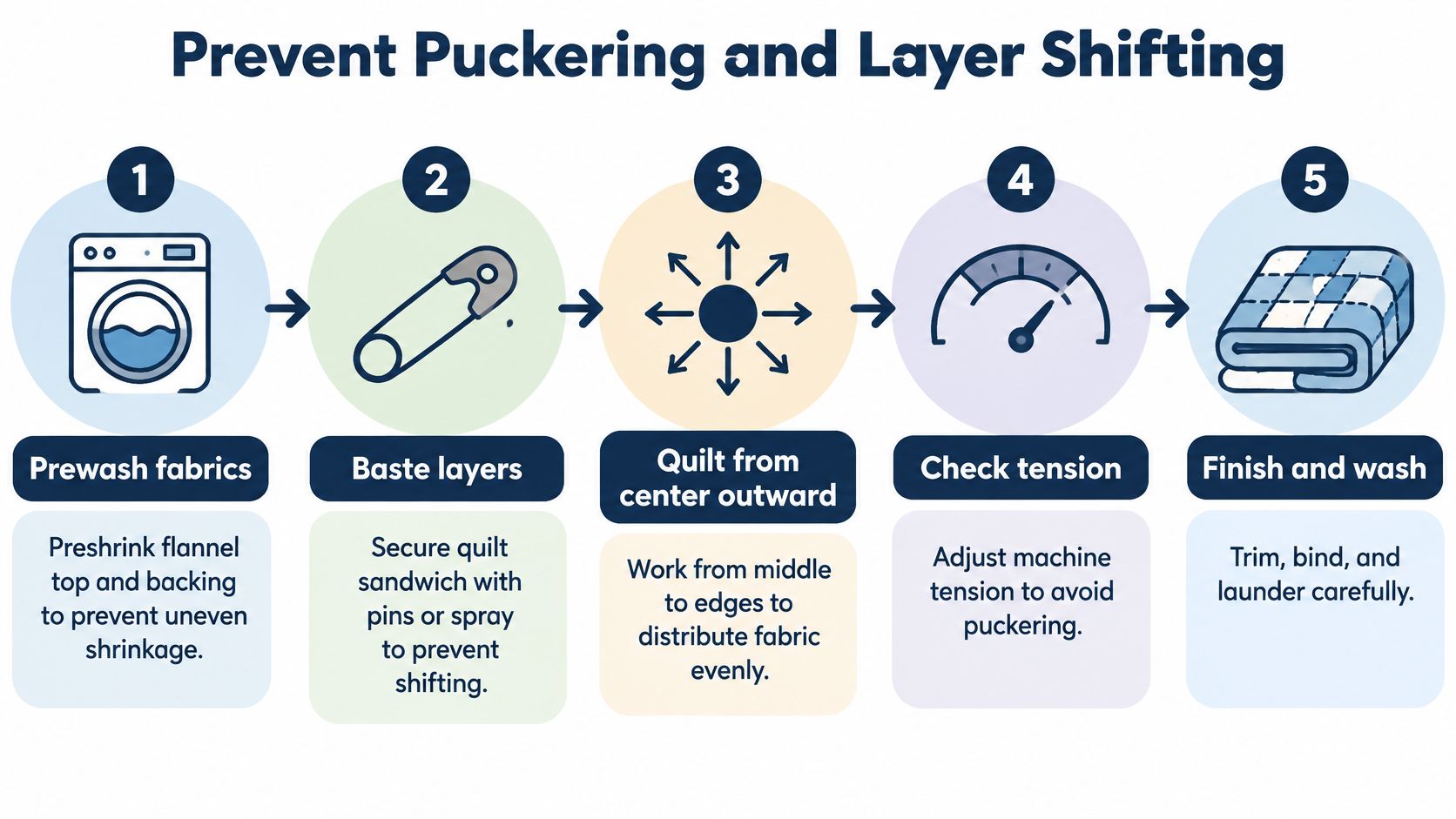
Batting can't prevent a quilt top and backing from contracting differently. Available flannel guidance puts potential flannel shrinkage at approximately 5% to 7%, compared with about 2% to 5% for standard quilting cotton, which makes fabric preparation especially important (quilting with flannel guidance).
That mismatch matters more than whether the batting felt perfectly smooth when you opened it. Prewash and dry the flannel before cutting, and follow the batting manufacturer's preparation instructions rather than putting an unsupported batt through a wash cycle.
Keep the assembly sequence visible while you work.
Test the Actual Materials
Make a small quilt sandwich from the project's flannel, backing, batting, and thread. Mark its dimensions in both directions, quilt it as planned, then launder it using the intended care routine.
Compare the result for drape, surface texture, seam distortion, and puckering. A test sandwich won't guarantee the full quilt's behavior, but it gives you a much better basis for choosing than handling an unwashed batt alone; this comparison of batting fibers and wash behavior supports evaluating the materials together.
- Check the needle: Use the machine and needle manufacturers' recommendations, then test for skipped stitches, snagging, and visible fabric damage.
- Check the spacing: Match the quilting design to the exact batting's maximum permitted distance.
- Check the tension: Inspect both faces before continuing across the quilt.
- Check the feel: Don't approve a sample solely because the stitches look tidy.
Some comparison guidance lists quilting intervals near 8 to 10 inches for low-loft cotton and roughly 2 to 4 inches for high-loft polyester, but these are examples, not universal limits (batting spacing and loft guidance). The product label takes priority.
Secure the Sandwich Without Stretching It
Smooth the backing, position the batting, and add the top without pulling any layer taut. Baste securely using a method compatible with your materials, then work outward from the center while checking the backing regularly.
Plan the assembly with this quilt sandwich preparation guide before starting. Avoid concentrating dense quilting in one area while leaving neighboring areas largely untouched unless the tested design behaves as intended.
If layers shift, reassess the basting and handling. If puckers appear before washing, check tension and fabric feeding; if distortion appears afterward, revisit the sample's shrinkage behavior.
For drying, follow the most restrictive care instructions among the layers. If air drying is appropriate, support the wet quilt rather than letting its weight pull from a narrow hanging point.
Choose Batting by Project Goal
A quilt that stays on a bed has different demands from one that travels between the sofa, car, and washing machine. Choose the compromise you can live with, not the fiber with the most appealing description.
Baby and Lap Quilts
For a baby quilt, I'd choose low-loft cotton or a washable cotton-polyester blend. Keep the finished piece light, pliable, and straightforward to care for rather than adding puff for appearance alone.
This is a recommendation for the quilt's construction, not infant sleep guidance. Give the recipient clear care instructions and avoid choosing a filling that requires maintenance they won't realistically follow.
For a lap quilt, decide whether the user likes a flatter blanket or a gently padded one. I'd favor a blend for an often-washed everyday throw, while reserving a loftier option for someone who specifically wants that fuller feel.
- Main compromise: A flatter filling gives less raised quilting texture.
- Reason to change: The recipient values visible puff more than a compact, easily folded quilt.
- Useful test: Fold the finished sample and judge whether it feels comfortable rather than merely impressive.
Bed, Display, and Longarm Projects
A flannel bed quilt needs attention to total bulk across its full coverage. My preference is a low-profile filling, with the decision between cotton and a blend guided by whether the owner wants traditional texture or more predictable washing behavior.
Before ordering, check the batting size planning guide against your actual top and your quilter's requirements. Don't buy from the bed-size name alone.
For a display quilt, I'd consider polyester when the quilting design is meant to be prominent. The compromise is a fuller finish that may be less suited to relaxed daily use.
For longarm work, ask the quilter about the batting before purchasing it. A familiar, stable product may be more useful than a specialty filling that complicates an otherwise straightforward job.
For guild projects: Standardize the batting and care expectations when consistent results matter. Don't substitute leftover batts simply because they fit.
Charity and higher-volume projects also deserve a practical budget check. Buy for repeatable handling, suitable washing, and useful coverage, then consider whether packages or batting rolls fit the actual workload.
Buy and Care for Your Batting
The fiber name is only the start of the purchase. Buy the specification that fits your quilt, including width, construction, loft, quilting distance, and care requirements.
What You'll Need
- Prepared fabric: Your flannel top and backing, with remnants saved for testing.
- Suitable batting: A package or roll that matches your project and meets your quilting requirements.
- Assembly tools: Basting supplies, a suitable needle, thread, and measuring tools.
- Finishing materials: Binding fabric and the notions needed to complete the quilt.
- A care record: The batting label and written instructions for the finished project.
If you're still preparing the fabric, use this fabric preshrinking guide before cutting. Preparation belongs before final measurements, not after you discover the backing no longer fits.
Read Past the Front Label
Compare the package dimensions with the actual quilt and the handling allowance your quilting method requires. For longarm work, confirm that allowance with the person doing the quilting rather than guessing.
Then check the details that are easy to miss:
- Width and format: Decide whether a package or batting roll produces useful coverage for your projects.
- Loft or weight labeling: Compare like with like instead of assuming a heavier package means a better batt.
- Construction: Note scrim, needle punching, and any stated directional guidance.
- Stitchability: Confirm the permitted quilting distance.
- Care: Make sure every layer can follow the same realistic routine.
A package is often the sensible choice for an occasional baby or lap quilt. Batting rolls deserve a closer look for bed quilts, guild work, and a busy longarm studio, but only if you'll use the material and can store it properly.
Plan the backing at the same time. Include 108-inch backings in your shopping comparison, checking their fiber, width, and preparation needs rather than treating width as proof of compatibility.
If you're building the top from Fat Quarters, Jelly Rolls, Charm Packs, or Layer Cakes, keep the pattern requirements beside the batting measurements. A precut label describes the starting fabric format, not the finished quilt dimensions.
Brand names help identify a product, but they don't replace its specifications. Compare the actual Hobbs, Pellon, or Choice Fabrics batting under consideration rather than transferring assumptions from another product in the range.
Store What You'll Actually Use
Keep batting dry, clean, and protected from snagging. Store packages flat where practical, and keep rolls supported without crushing or contaminating the exposed material.
Save a labeled remnant with the project notes. It gives you a reference if you later need to investigate care problems or match the batting for another quilt.
Make the Final Batting Decision
My recommendation is simple: choose the batting that delivers the intended quilt after washing, not the one that feels most luxurious before sewing. A beautiful flannel quilt should suit its owner's habits as well as the maker's preferred finish.
Use These Decision Rules
- Traditional bed quilt: Choose low- or mid-loft cotton when breathable drape and controlled crinkle are the priorities.
- Frequently washed quilt: Favor cotton-polyester when stability and manageable bulk matter most.
- Dimensional showcase quilt: Choose polyester when pronounced loft and visible quilting are deliberate goals.
- Lightweight winter quilt: Consider wool when its warmth and breathability justify more careful laundering.
- Unfamiliar specialty blend: Buy only after checking the label and approving a test sandwich.
For charity quilts and longarm projects, I'd lean toward a familiar cotton-polyester product with clearly stated construction and care directions. For a quilt intended to feel softly traditional, I wouldn't abandon cotton just to avoid every trace of post-wash texture.
The final checks belong to the specific product: needle guidance, quilting distance, preparation, and care. If its instructions don't suit the planned quilt, change the batting rather than trying to work around the label.
Bring the actual flannel and backing into the decision, even if that means delaying the purchase until your wash test is finished. That small trial is a more useful investment than buying an expensive filling and hoping the layers cooperate.
Keep the label with your project notes, record what you liked about the sample, and choose confidently. The right batting doesn't need to win every comparison; it needs to do the job you're making this quilt to do.
For batting packages, batting rolls, flannel, precuts, and 108-inch backings, visit The Fabric Company to plan your quilt's layers together. Shop our latest Batting collection here. Join The Weekly Thread for more tips and 10% off your first order.