

You've finished the quilt top, and the last thing you want is to spend an evening joining narrow fabric lengths before quilting can even begin. 108 inch quilt backing fabric can simplify that final step by covering a large quilt with one continuous piece, but the right amount depends on your finished measurements, quilting method, and required overhang.
This guide walks through the practical math, fabric choices, thread count, shrinkage, and loading details that help you order with confidence. You'll also see why a wide back isn't automatically enough for every king-size quilt.
Why Quilters Reach for Wide Backing
A king-size sampler can take weeks or months to piece. Once the final border is attached, the top may be beautifully square, but the backing decision can bring the momentum to a halt. Standard quilting cotton is commonly sold around 45 inches wide, so a large quilt may need several lengths joined with long seams.
Every seam adds another place where fabric can shift, wrinkle, or create extra bulk beneath the quilting needle. With 108 inch quilt backing fabric, many large quilts can use one broad piece instead. That means less cutting, less pressing, and fewer alignment decisions before basting.
The practical difference during quilting
A single-piece backing gives the quilter a calmer surface to work with. Longarm quilting especially benefits from fewer seams because the backing can load more evenly onto the frame. Fewer seam lines also reduce alignment risk and help the backing remain more stable as the quilt moves through the quilting process, as explained by Moda's guide to going extra-wide with quilt backings.
The savings aren't only about fabric. A queen-size quilt can use about 3.25 yards of 108-inch backing instead of roughly 8.25 yards of 44-inch fabric, while a king can use about 3.25 yards instead of about 9.75 yards, depending on the dimensions and loading allowance. This can reduce total yardage by about 30% to 40%, although the price per yard and the exact cut still need checking in advance.
Practical rule: Wide backing saves the most work when your priority is a smooth quilting plane, fast preparation, and a clean reverse side.
Wide backs also suit quilts where the back should stay visually quiet. A low-contrast print or solid lets the quilting texture show without a seam interrupting the design. On a busy utility quilt, a lively print can make the reverse side feel intentional while disguising minor stitch variations.
The idea isn't entirely modern. Quilt backs were often plain white cotton until about 1970, but printed and decorative backs had already appeared in documented quilts by the late nineteenth and early twentieth centuries. Barbara Brackman's history of extra-wide printed backing shows that today's wide back is an industrial version of an older quilting choice, using one broad cloth rather than multiple narrow widths.
What 108 Inch Quilt Backing Fabric Actually Is
108 inch quilt backing fabric is woven to a full width of 108 inches across the bolt. That's roughly 2.74 meters, and it's about 2.5 times wider than standard 42-inch quilting cotton, according to Quilt Keeper Studio's backing calculator.
The important point is that this isn't a wider cut from an ordinary quilting bolt. Mills produce wide goods on larger looms, often for bedding, sheets, and drapery markets. That manufacturing scale is much smaller than the scale used for standard 45-inch quilting cotton, which helps explain why wide backing collections usually offer fewer prints.
Why usable width matters
A bolt may be labeled 108 inches, but selvages and edge irregularities can reduce the practical area available for your quilt. Measure the actual usable width after removing stiff or damaged selvage edges, particularly when your top is close to the limit.
Standard quilting cotton is often sold at 42 to 45 inches, yet the usable width after selvage removal is commonly only 40 to 42 inches, as noted in this quilt backing yardage guide. Wide backing gives you a much larger working area, but it still needs enough room for the finished top and the overhang your quilter requires.
Wide does not mean identical
Wide backs can differ in weave, hand, print scale, and fiber content. Cotton is the most familiar choice, but flannel and plush polyester options are also available in wide formats. Some reproduction prints are made in multiple colorways at 108 inches wide, showing how established the format has become for both practical and historically inspired projects.
Before ordering, read the product description carefully. Check the finished width, fiber content, direction of the print, and whether the fabric is sold by the yard or in a premeasured cut. If you're comparing formulas, The Fabric Company's quilt backing yardage chart can help you organize the measurements before you place an order.
Wide Back Versus Pieced Backing
A pieced backing and a wide backing can both produce a strong, useful quilt. The better choice depends on whether you value creative use of scraps, lower upfront cost, fewer seams, or a smooth uninterrupted surface.
A traditional pieced back can turn leftover yardage into a secondary design. You might add a strip of blocks, use orphaned units, or combine remnants from the quilt top. That approach gives the back personality and can make a scrappy quilt feel complete on both sides.
The trade-off is labor. A large backing made from 44-inch fabric may require around 8 to 9 yards for a king-size project, plus seam work, pressing, and careful handling. A single wide cut may cover a comparable king-size top with roughly 3 to 4 yards, but only when the finished dimensions and overhang fit within the usable width.
A side-by-side decision
| Factor | 108 Inch Wide Back | Pieced 44 Inch |
|---|---|---|
| Seams | Often none for large quilts that fit the usable width | Usually several long seams |
| Preparation | Cut, press, and load | Measure, cut, sew, press, and square |
| Design | One continuous print or solid | Opportunity for blocks, strips, and scraps |
| Fabric selection | Fewer wide-back designs | Broadest selection of quilting cotton |
| Quilting surface | Smooth and uninterrupted | Seams can add bulk or shift points |
| Yardage example | Roughly 3 to 4 yards for some king quilts | Roughly 8 to 9 yards for some king quilts |
Seams aren't automatically a flaw. A well-pressed backing seam can quilt beautifully, especially when it's placed with the quilting design in mind. The concern is that each seam adds another construction step and another place where tension can behave differently.
For a detailed construction approach, this guide to piecing quilt backing is useful when your quilt exceeds the available width or you want a designed back.
Price per yard also deserves attention. Wide backing may cost more per yard, but you may need far fewer yards overall. Compare the total amount required, not just the sticker price of one yard.
How to Measure and Order the Right Yardage
Start with the finished quilt top, not the pattern's suggested size. Measure across the center and from top to bottom, because borders can stretch or pull slightly at the edges. Write down both dimensions before you look at fabric.
Next, add the overhang your quilting setup requires. A common longarm allowance is about 4 inches per side, while other guidance recommends 6 to 8 inches total or even 12 inches added to both dimensions for a generous loading margin. These differences are large enough to change your order, so ask the person quilting your project before cutting fabric.
The basic calculation
Use this sequence:
- Measure the finished top. Record width and length separately.
- Add the required overhang to every side. A 4-inch allowance per side adds 8 inches to each finished dimension.
- Compare the adjusted width with the usable backing width.
- Convert the required length from inches to yards. Divide by 36, then round up to the retailer's cut increment.
- Check the bolt length and print direction. A very large quilt may need piecing even when its width appears to fit.
For a 100 by 100 inch top, adding 4 inches per side creates a backing requirement of 108 by 108 inches. A 108-inch bolt is right at the stated width before selvage trimming, so this example needs careful checking and may not be safe for every longarm setup. A 110 by 110 inch top exceeds the width immediately and needs a wider option, a different orientation, or piecing.
Yardage by quilt size and backing width
The chart below is a planning guide, not a substitute for measuring your own top. It uses common finished dimensions and assumes the required overhang fits within the stated width.
| Quilt Size | Top Dimensions | 108" Backing Needed | 120" Backing Needed |
|---|---|---|---|
| Baby | Measure your finished top | Length required after overhang | Length required after overhang |
| Throw | Measure your finished top | Length required after overhang | Length required after overhang |
| Queen | Measure your finished top | Often a single cut, if width permits | Often a single cut, if width permits |
| King | Measure your finished top | Verify usable width and overhang carefully | More room for large adjusted dimensions |
A king quilt measuring 108 by 108 inches illustrates the problem. Some calculators show about 3.25 yards of 108-inch backing for a king, while other guidance notes that a king backing may need 116 by 116 inches, which is wider than a standard 108-inch bolt. This backing calculator makes the edge case clear: the quilt's finished size and the loading margin matter more than the label on the bolt.
Before ordering, check for selvage damage, confirm the dye lot if you're buying multiple cuts, and round up rather than down. This fabric yardage calculation guide can help you record the math in a repeatable way.
Fabric Types, Weights, and Thread Count
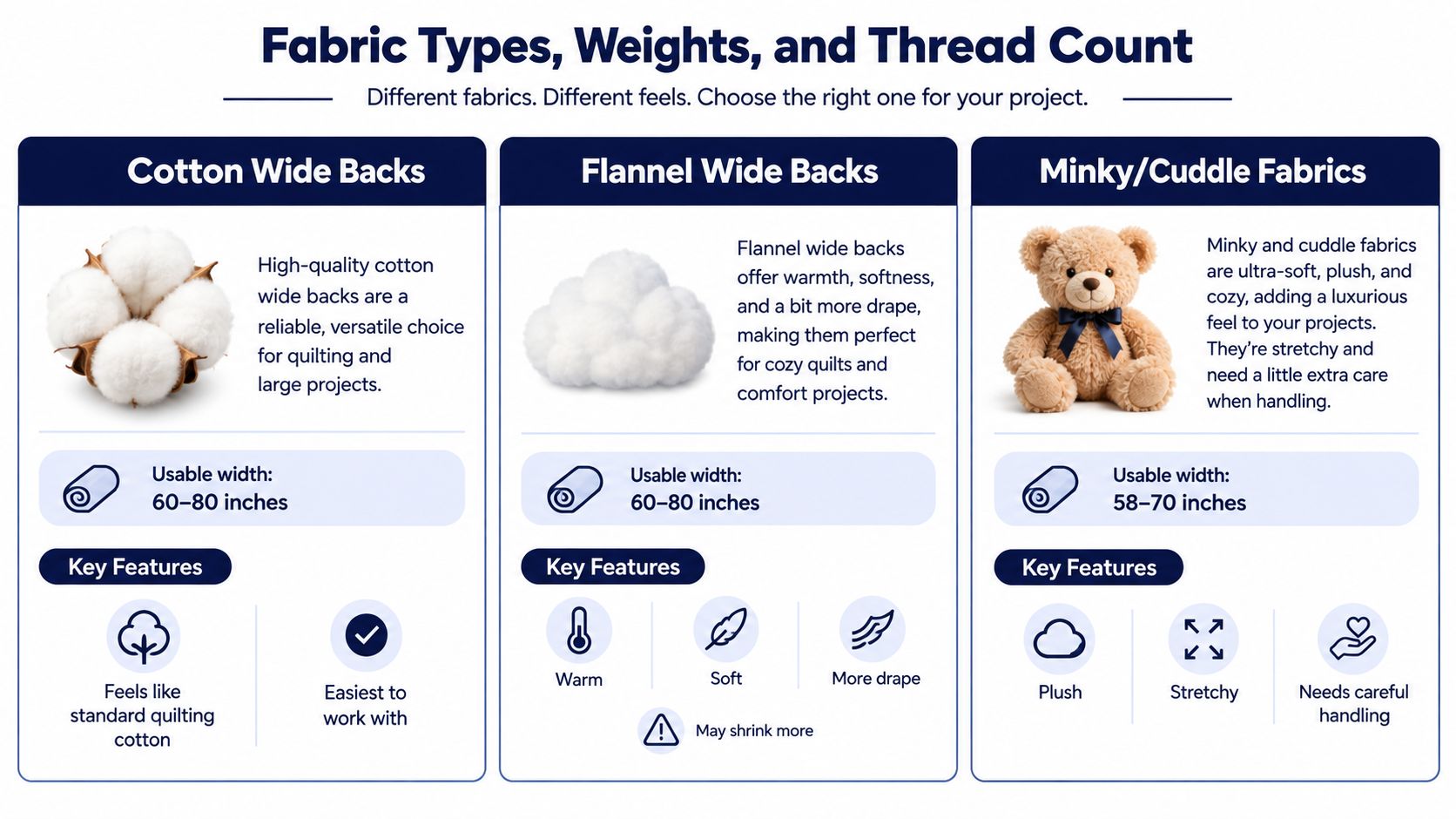
The backing changes how a quilt feels as much as how it looks. Cotton gives the most familiar quilting experience, flannel adds warmth and softness, and plush polyester fabrics create a different kind of comfort with more stretch and handling needs.
Cotton wide backs
Cotton wide backs are usually the easiest match for a pieced cotton top. They breathe, press predictably, and work well with common batting choices, including needle-punched cotton and blends. Premium wide backs can have a much tighter weave than ordinary quilt-shop cotton. Moda describes typical quilt-shop-quality cotton as about 60 x 60 threads per inch, while premium wide backings can reach 200 thread count, creating a smoother hand and stronger backing plane. See Moda's technical discussion of wide backing fabric for that comparison.
A denser weave can improve print clarity and stability, but it doesn't remove the need to plan for shrinkage. Cotton quilting fabrics commonly shrink about 2% to 5% on the first wash, according to the same Moda reference.
Flannel and plush options
Flannel or brushed cotton adds warmth and a soft surface. It can pair well with a winter quilt or a project intended for close cuddling, but the added loft changes how the needle passes through the quilt sandwich. Make sure the batting and quilting density suit the thicker combination.
Minky and Cuddle fabrics are plush polyester choices. They're soft and forgiving to touch, but they can stretch while you baste or quilt. A walking foot, longer stitch length, and slower machine speed can help on a domestic machine. For a broader explanation of how fabric texture affects handling and drape, The Sofa Cover Crafter's fabric guide offers helpful background.
Fabric match: Pair a dense cotton backing with a cotton top for predictable quilting. Choose flannel or plush backing when warmth and softness matter more than a familiar cotton hand.
This short video can also help you think through fabric behavior before cutting.
For flannel-specific considerations, this guide to 108-inch flannel quilt backing is a useful reference.
Care, Prewashing, and Finishing the Back
Prewashing is a choice, but it should be an informed one. If you're concerned about color transfer, test a small piece first, especially when the backing contains deep red, navy, or purple. If the backing is unwashed cotton, allow for natural-fiber shrinkage before final measurements.
Cotton quilting fabrics commonly shrink about 2% to 5% on the first wash. That range comes from the earlier Moda guidance, and it's why an exact-fit backing can become too small after laundering. Prewashing both the top and backing can help them respond more similarly, but you'll still want to measure again after drying.
Pressing a wide cut
A narrow ironing board makes a very wide piece awkward. Use a large, clean, flat surface and press in sections, keeping the grain aligned rather than dragging the fabric sideways.
Inspect the selvages while you press. If an edge feels stiff, puckered, or distorted, trim it away before measuring usable width. A small amount of preparation can prevent an edge wrinkle from traveling into the quilting area.
Loading without surprises
For domestic machine quilting, spread the backing flat, smooth the batting over it, and check for wrinkles before basting. If you use tape or temporary adhesive, keep the fabric square as you work outward from the center.
Longarm loading calls for careful alignment on the leaders. Square the backing before attaching it, keep the grain straight, and confirm that the overhang is sufficient for the frame and quilting design. Pantograph work benefits from a backing that rolls evenly without a bulky seam interrupting the path.
This guide to preshrinking fabric gives a useful process for deciding whether washing belongs in your preparation routine.
After quilting, fold the backing along the lengthwise grain where possible. A careful fold reduces sharp creases that may show through the quilt top during storage.
A Simple Buying Checklist for Your Next Quilt
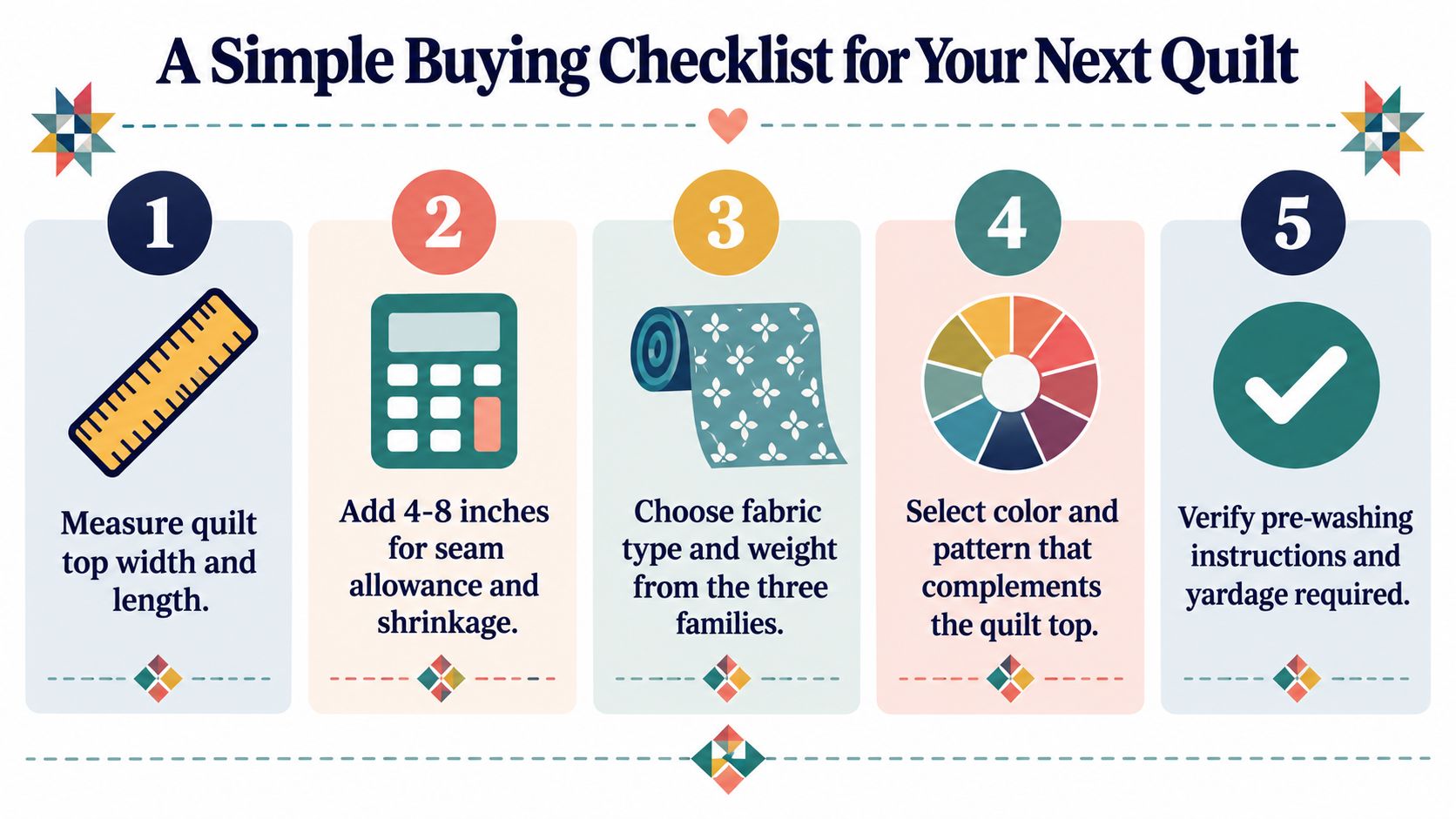
Save this checklist with your project notes. It turns a wide-back purchase into a short measurement exercise instead of a guess.
Before you choose the print
- Measure the finished top. Record the width and length through the middle, including borders.
- Add your working margin. Add about 4 to 8 inches per side when your quilter or loading method calls for it. Longarm requirements may be more generous.
- Confirm the usable width. Don't assume the full 108 inches remains after selvage removal or edge trimming.
- Choose the fabric family. Cotton suits most quilts, flannel adds warmth, and minky or Cuddle creates a plush polyester finish.
- Review the weave and hand. A higher thread count may feel smoother and more stable, while a looser weave may soften more quickly.
- Plan for washing. Decide whether to prewash, then allow for the 2% to 5% cotton shrinkage range when dimensions must remain precise.
- Inspect the listing. Look for fiber content, finished width, directional print information, and cut increments.
- Check the bolt condition. Ask about selvage flaws, printing issues, and dye-lot consistency when ordering multiple cuts.
- Keep the rest of the sandwich in mind. Match the backing to the quilt top, batting loft, scrim, and quilting density.
- Record the final order. Write the adjusted backing dimensions on your project sheet before you cut.
A useful habit: Screenshot the checklist, then add your own quilter's preferred overhang beside the measurement line.
The Fabric Company's online quilting selection includes quilt backings, 108-inch backings, batting packages and rolls, precuts such as Jelly Rolls, Layer Cakes, Charm Packs, and Fat Quarters, plus supplies from brands including Robert Kaufman, Cloud9, Riley Blake Designs, and Hobbs. Makers can also visit Our Springfield, Tennessee showroom to compare color and hand in person.
Quick Answers to Common Backing Questions
Is one yard of 108-inch backing enough for a baby quilt?
It may be, but only after you measure the finished top and add the required overhang. One yard equals 36 inches of length, so the quilt's adjusted length must fit within that amount.
What if my top measures exactly 104 inches wide?
Check the actual usable width and your quilter's overhang rule. A 108-inch bolt may leave too little room after selvage removal or loading allowances.
What if the only available color clashes with my quilt top?
Choose a low-contrast print, a tone-on-tone, or a neutral that supports the quilting thread. A busy print can soften the visual effect of minor stitch variations.
Should I choose flannel or minky?
Choose flannel for breathable warmth and a brushed cotton feel. Choose minky or Cuddle when plush softness matters and you're prepared to control stretch during basting and quilting.
Can every king quilt use one 108-inch piece?
No. Some king calculations work in about 3.25 yards, but a king backing requirement of 116 by 116 inches exceeds a standard 108-inch width. Measure first, then confirm the loading requirements.
Shop The Fabric Company for 108-inch quilt backing fabric, batting rolls, flannel, minky, and project-ready quilting supplies, or visit Our Springfield, Tennessee showroom for help choosing a backing by hand. Join The Weekly Thread for more tips and 10% off your first order.